
BRUSSELS (AP) — As sympathy for immigrants erodes around the world, European nations agreed Wednesday to consider changes that rights advocates say would weaken migrant protections that have underpinned European law since World War II.
The consensus coalesced as mainstream political parties across Europe have adopted tougher migration policies as a way to blunt the momentum of far-right politicians exploiting discontent over immigration, even though illegal border crossings are actually falling.
Members of the 46 countries that make up the Council of Europe acknowledged “challenges” posed by migration while reaffirming their respect for the European Convention on Human Rights and the European Court of Human Rights, the council’s secretary general, Alain Berset, told journalists after discussions in Strasbourg, France.
Berset described the 75-year-old convention as a “living instrument.” While nations reaffirmed their commitment to the rights and freedoms of the convention, they also recognized countries’ responsibility to “safeguard national vital interests such as security.”
The convention and the court, which handles complaints against the council, have been increasingly criticized by some member states, including Italy, Denmark and the United Kingdom. They argue that they are too limited in how far they can go to tackle illegal migration and deport migrants who commit crimes.
Ministers of the 46 countries will now begin debating a political declaration on migration to be adopted in May and a new recommendation to deter human smuggling, Berset added.
The council, which is not an European Union institution, was set up in the wake of World War II to promote peace and democracy.
Growing consensus for a new interpretation
Discussions over the need to reform or reinterpret the convention as it relates to migrants began last year after nine nations signed a letter attempting to curtail the power of the court, the council’s independent legal arm.
The group of nations argued that the court’s interpretation of rights and obligations prevented them from expelling migrants who commit crimes and keeping their countries safe. Berset defended the court’s independence at the time, but support for a tougher stance has only grown.
While Berset sought to downplay the division, 27 nations signed a separate statement Wednesday calling for a less restrictive interpretation of the law, echoing the arguments made last year.
“A right balance has to be found between the migrants’ individual rights and interests and the weighty public interests of defending freedom and security in our societies,” it read.
Andrew Forde, co-founder of the AGORA group of academics, researchers and lawyers, said Wednesday’s conclusions and the statement signed by two-thirds of the members showed clearly that the majority of governments supported a more conservative understanding of the convention based on political interest.
“For the first time in the history of the Council of Europe, member states have pinpointed a specific group of people that they want to afford fewer rights protection to,” said Forde who previously worked for the council.
Meanwhile, the prime ministers of Denmark and the U.K. published an op-ed Tuesday in the Guardian newspaper calling for tighter migration controls to deny entry to those seeking better economic opportunities as opposed to fleeing conflict.
“The best way of fighting against the forces of hate and division is to show that mainstream, progressive politics can fix this problem,” wrote Mette Frederiksen and Keir Starmer.
The EU vows to crack down on smugglers
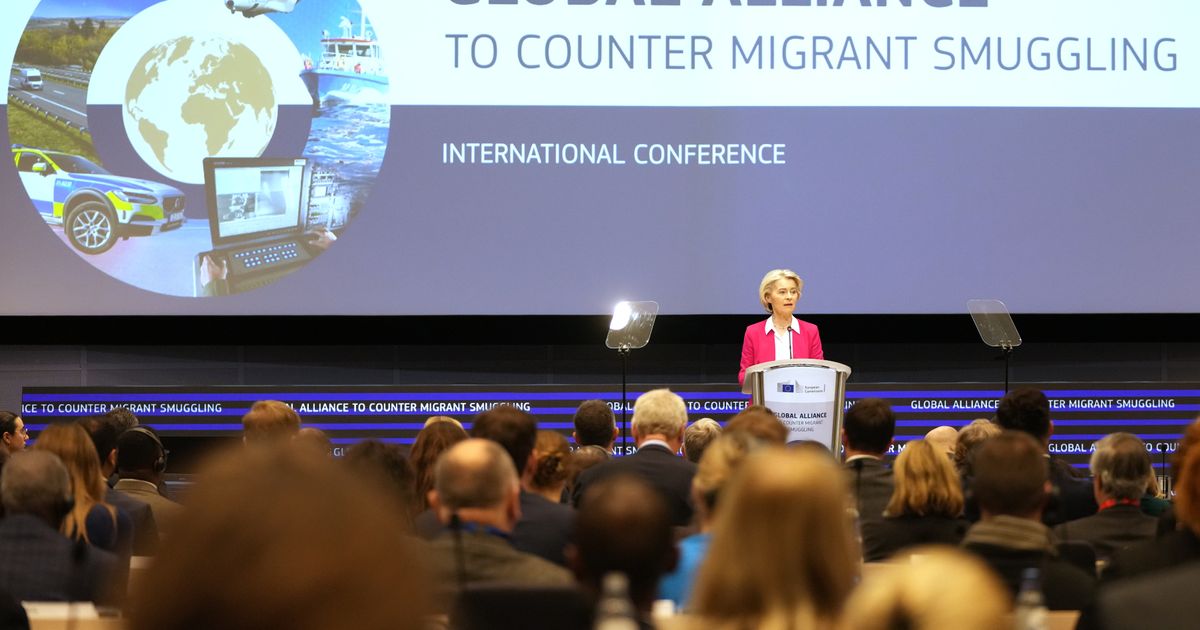
Separately, in Brussels, European Commission President Ursula von der Leyen spoke to ministers from the 27 nations of the EU and pledged to dismantle smuggling networks that bring people into the bloc illegally.
“Our goal is simple. We want to bankrupt their businesses through all means available,” von der Leyen said at an event marking the second anniversary of the EU-led Global Alliance to Counter Migrant Smuggling.
While migration is high on the political agenda, irregular border crossings into the EU were down 22% from January to October this year compared with the same period last year, according to Frontex, the EU’s border and coast guard agency. The agency recorded 152,000 unauthorized border crossings in the first 10 months of the year.
Most migration to Europe is legal, with many migrants entering on visas that they then overstay.
The EU has spent billions of euros (dollars) to deter illegal migration, paying countries in Africa and the Middle East to intercept migrants trying to cross the Mediterranean and the Atlantic.
At the same time, European nations facing aging populations and labor shortages have been investing in programs to attract and train foreign workers.
___
Brito reported from Barcelona.