
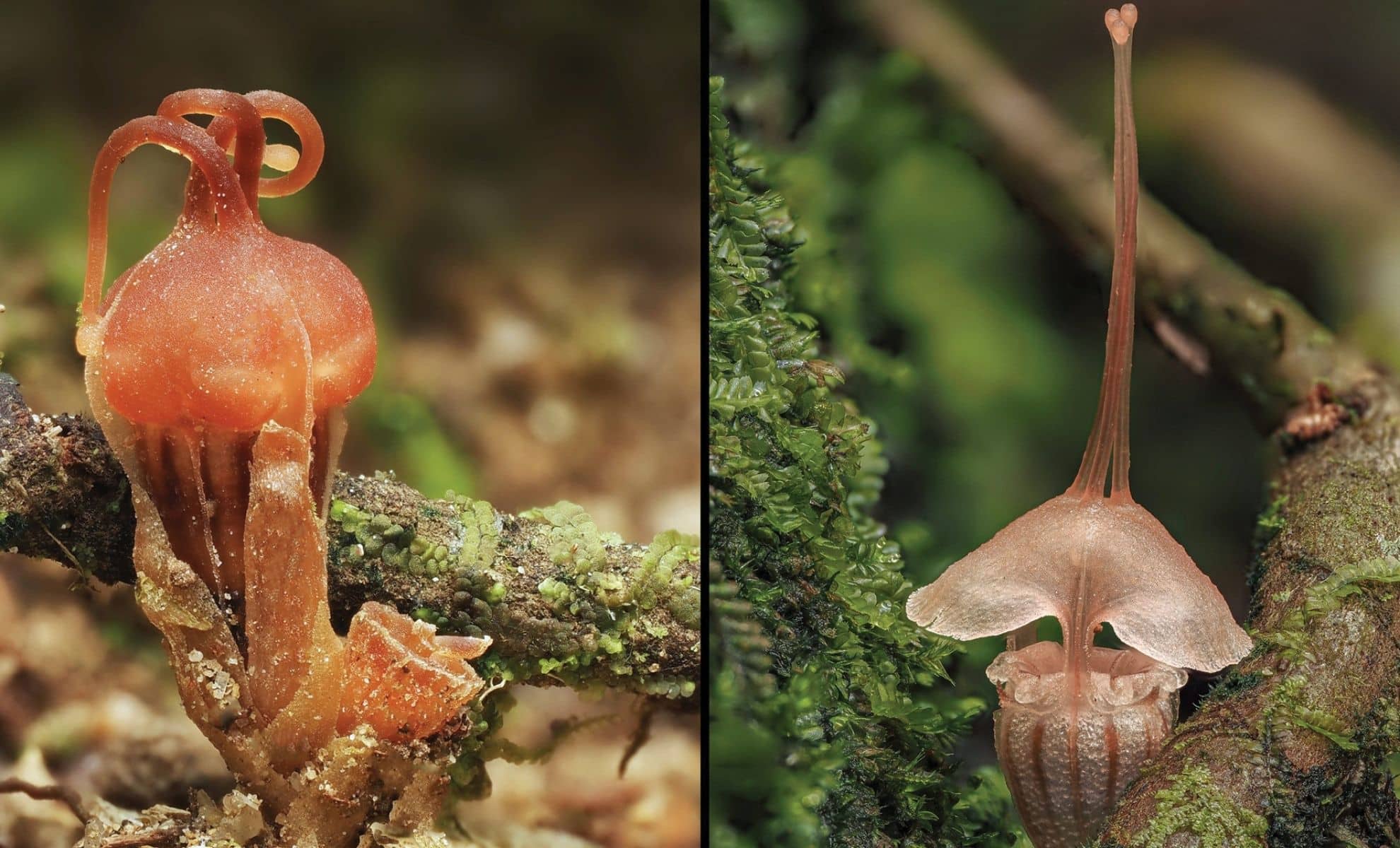
Found in Malaysia’s Selangor region, this tiny plant stands just 4 inches tall and is uniquely mycoheterotrophic, meaning it survives by parasitizing underground fungi instead of relying on sunlight. Despite its fascinating biology, conservationists warn that the species’ survival is threatened by its tiny, localized population and the proximity of human activity in the area.
The discovery of Thismia selangorensis was made in November 2023 by naturalist Tan Gim Siew during an outing in Taman Eko Rimba Sungai Chongkak, a forest just outside Kuala Lumpur. The plant’s peach-pink flower, which rises from damp leaf litter near tree roots, adds to the mystique of this rare species. However, its fragile existence is further complicated by the fact that it grows in a highly accessible area often frequented by local families.
A Rare and Unusual Species
Thismia selangorensis is a member of a little-known group of plants that do not produce their own food via photosynthesis. Instead, it relies on underground fungi to obtain the nutrients necessary for survival. This unique strategy classifies it as a mycoheterotroph, which means it acts as a parasite on the fungi, obtaining carbon that the fungi have secured from surrounding trees and shrubs. Unlike most plants, Thismia selangorensis has no chlorophyll, which explains why it cannot photosynthesize, reports Earth.com.

The plant is also distinguished by its striking flower. The flower of Thismia selangorensis has a tubular structure with a broad, umbrella-like cap known as a “mitre.” The cap, which starts out convex, flattens and splits into irregular lobes as it matures. The pale peach tissue inside the flower features fine, translucent ridges, a characteristic known as reticulation, unique to this species.
The plant blooms only between October and February, and each flower lasts just a few days. Given this short window, careful surveys are necessary to detect the plant, as it can remain invisible underground for much of the year.
Vulnerable Habitat
Thismia selangorensis is found in a specific and limited patch of lowland forest along a river valley. This area is roughly 3.9 square kilometers in size and is located near recreational sites, including picnic tables and footpaths.
The plant grows close to the buttress roots of trees, in moist leaf litter—an ideal habitat that provides the necessary conditions for its survival. However, the presence of local families using the nearby footpaths poses a significant risk to the plant’s survival.

According to Siti-Munirah Mat Yunoh, a botanist at the Forest Research Institute Malaysia (FRIM) and leader of the research team, the plant’s small size makes it especially vulnerable. A single boot could easily crush it, and local floods or even a decision to develop the area could erase the entire species.
In fact, the entire population of Thismia selangorensis exists within this small, confined area, making it particularly susceptible to extinction. The plant’s dependence on a delicate underground network of fungi further complicates its conservation. If the local soil conditions are disturbed or the fungi are harmed, the plant’s entire life cycle could collapse. As a mycoheterotroph, Thismia selangorensis is highly sensitive to changes in its environment, and the integrity of its habitat is essential for its survival.
Conservation Challenges
The research team, which included experts from FRIM, has classified Thismia selangorensis as critically endangered. This designation reflects the plant’s high risk of extinction, based on its tiny recorded range and the significant threats it faces from habitat decline and human activities.
The plant’s location near heavily used recreational areas raises additional concerns, as studies on similar species have shown that human interference, such as trampling and off-trail walking, can have a devastating impact on plant populations.
In light of these risks, conservationists are calling for immediate action. According to Mat Yunoh, “Understanding its presence is the first step toward ensuring that this extraordinary plant is not lost.” The research team has urged local authorities to implement protective measures around the known sites and to carefully monitor the population as part of ongoing surveys.