
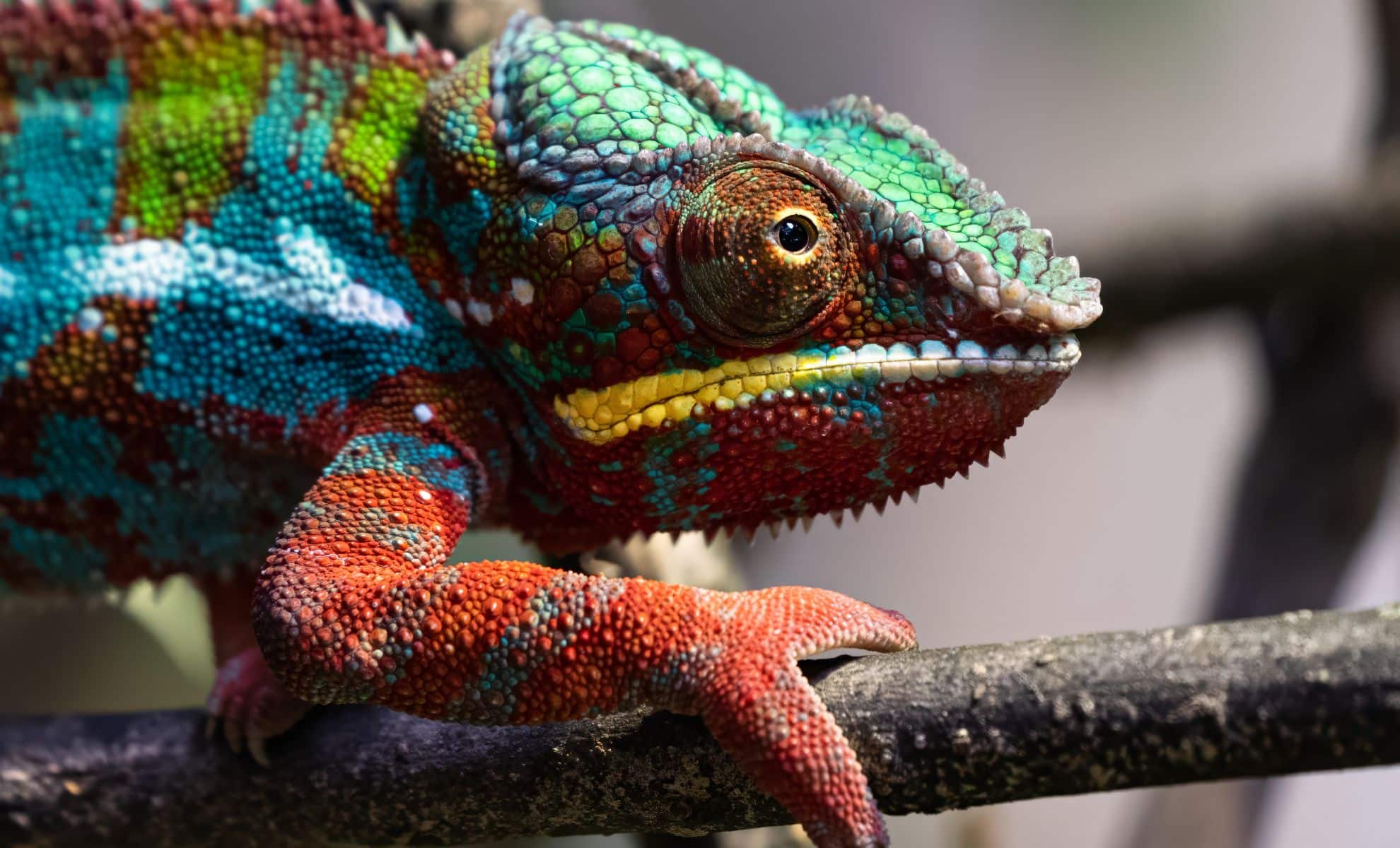
The ability of chameleons to swivel their eyes in multiple directions has fascinated biologists for centuries. Ancient thinkers, including Aristotle and Newton, speculated on how these lizards managed their independent eye movements, often coming up with conflicting theories. With the help of cutting-edge imaging technology, scientists have now uncovered the true mechanism: long, tightly coiled optic nerves that provide extra slack for the eyes to rotate without putting strain on the nerve itself.
The Secret Behind Chameleons’ Wandering Eyes
Chameleons’ ability to independently move their eyes, scanning for prey and predators at the same time, has long been a subject of curiosity. However, the internal structure enabling this ability was not fully understood until recently. According to a study led by Juan Daza at Sam Houston State University, chameleons possess coiled optic nerves that allow their eyes to move freely in nearly all directions. This coiled design provides the necessary flexibility for their eyes to swivel without causing strain on the optic nerves.
CT scans revealed that the optic nerves in chameleons are significantly longer and coiled in a way that other reptiles do not have. This adaptation provides the slack needed to rotate their eyes over a large range without pulling on the nerves. Unlike owls, which rely on head rotation to see around them, chameleons use their independently mobile eyes to scan their surroundings, one eye might focus on a potential meal while the other keeps watch for predators.
Chameleons’ Evolution in the Trees
Chameleons are arboreal creatures, spending most of their lives in trees. The unique structure of their eyes is an evolutionary response to the challenges of life in the treetops. To survive in this dynamic environment, chameleons needed to adapt to a visual system that could give them a wide field of vision without requiring them to move their heads, as many other animals do. According to Daza, their stiff necks and bodies were not suited for swift movements, so they evolved the ability to rotate their eyes independently instead.
Their eyes, which can move in almost any direction, give chameleons a distinct advantage when hunting or avoiding danger in the trees. The coiled optic nerves allow them to maintain stability while moving through their habitats, providing flexibility for extensive eye rotation without putting undue stress on their nervous system.
The Role of CT Scans in Revealing New Biological Secrets
The discovery of coiled optic nerves in chameleons was made possible by the use of modern CT scanning techniques. These non-invasive methods enabled scientists to study the anatomy of the chameleon’s brain and optic nerves without damaging the delicate structures, a significant improvement over traditional dissection methods. Daza’s team was able to scan entire specimens and create 3D models, revealing the previously unseen coiled structure of the optic nerves.
This advancement in imaging technology is transforming the study of animal biology. CT scans allow scientists to explore the internal anatomy of animals in incredible detail, uncovering features that were previously overlooked. In the case of the chameleon, these digital tools provided the clarity needed to explain how their eyes can move independently, solving a mystery that had remained unsolved for centuries.