
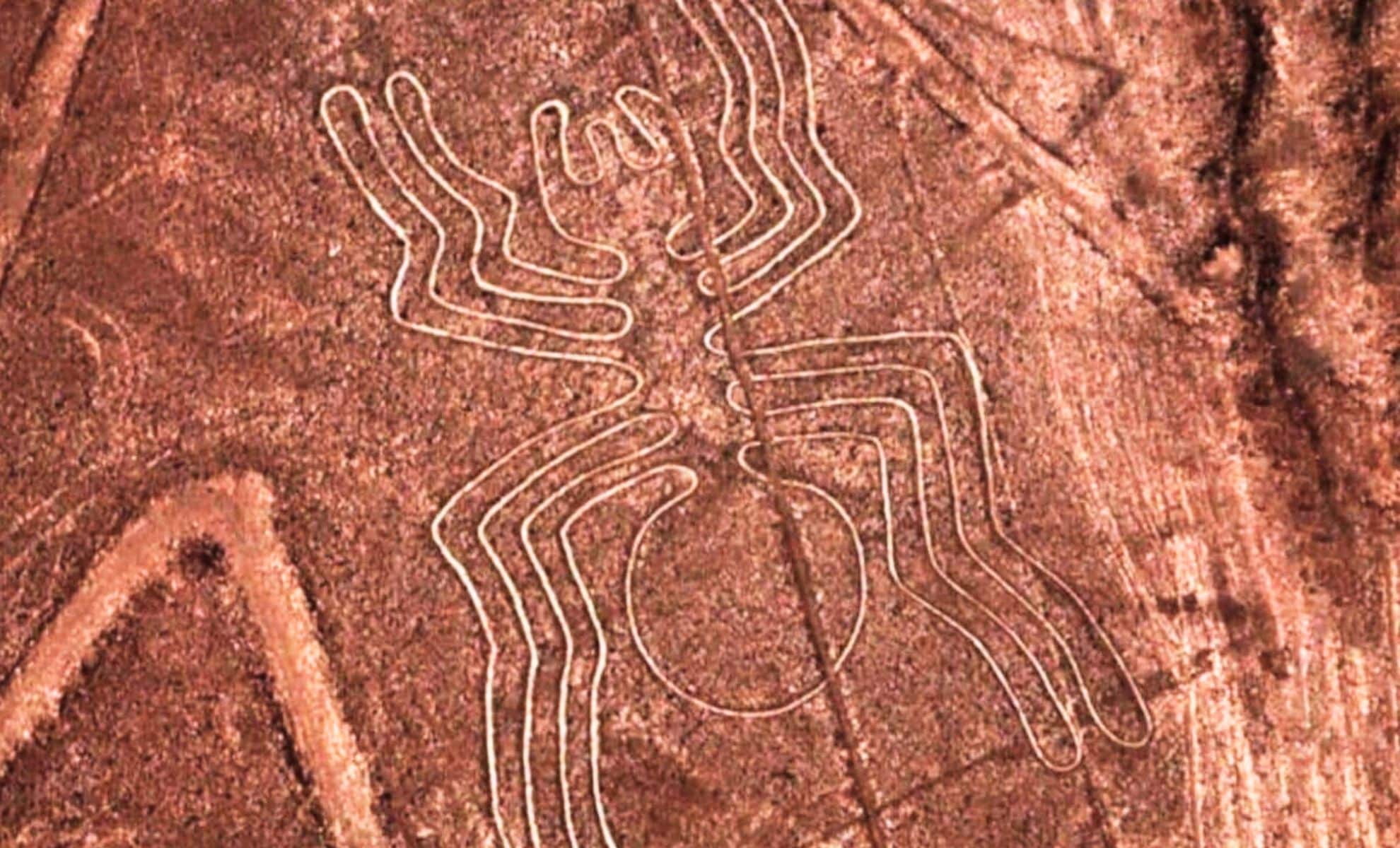
A team of researchers has used artificial intelligence to identify 303 previously undocumented Nazca geoglyphs in southern Peru, almost doubling the number of known figures in the region. The discovery offers new insight into the spatial organization, symbolism, and purpose of the Nazca Lines, a UNESCO World Heritage Site and one of the most studied archaeological landscapes in the world.
The findings result from a collaboration between Yamagata University and IBM Research, combining high-resolution aerial and drone imagery with deep learning algorithms. The research, published in PNAS, represents one of the most significant accelerations in archaeological documentation in recent decades, identifying in six months what previously took nearly a century of manual surveying.
Evidence for a Dual-Use Ritual Landscape
Among the 303 newly discovered geoglyphs, 81.6% depict human-related subjects—primarily humanoid figures, decapitated heads, and domesticated camelids. These differ significantly in style, size, and content from the previously known line-type geoglyphs, which often portray large stylized animals and geometric shapes stretching up to 90 meters in length.
The newly documented figures are classified as relief-type geoglyphs, constructed by removing dark surface stones to expose lighter ground beneath. They average approximately 9 meters in size and are often located within 43 meters of ancient walking trails.

This proximity supports the hypothesis that relief-type geoglyphs were intended for individual or small-group viewing during pedestrian travel, rather than for large-scale ceremonial use or aerial observation. By contrast, line-type geoglyphs are typically positioned near linear and trapezoidal formations associated with broader ceremonial routes and pilgrimage networks across the Nazca Pampa.
According to the study, the spatial and thematic differences between the two types suggest distinct purposes. Relief geoglyphs may have served to communicate localized cultural narratives or ritual functions, while line-type figures likely operated within a broader community-based ceremonial framework.
Deep Learning Model Enabled Scalable Archaeological Detection
The AI system developed for the project was designed to detect subtle ground disturbances across a 629 km² region. Using a model pre-trained on conventional photographic data, researchers fine-tuned it using aerial imagery of 406 known relief-type geoglyphs. The algorithm generated a geoglyph probability map by scanning the desert in overlapping 11×11-meter image tiles at a resolution of 5 meters.
From this, the system flagged 47,410 high-likelihood locations, which were manually reviewed. Field teams conducted ground-truthing between September 2022 and February 2023, confirming the existence of 303 new figurative geoglyphs and 42 additional geometric designs. The entire validation effort required 2,640 labor hours.

The model was particularly effective in detecting clustered geoglyphs, revealing narrative groupings that include symbolic depictions of human-animal interactions and decapitation scenes. These findings expand previous understandings of how iconography and spatial orientation functioned in Nazca visual culture.
The project demonstrates a scalable method for archaeological detection, particularly in environments where conventional surveys are limited by terrain, visibility, or preservation conditions. The team projects that at least 248 additional geoglyphs flagged by the AI remain unverified, and further discoveries are likely.
Implications for Cultural Interpretation and Preservation
The contrast in motif distribution is among the most significant outcomes of the study. Wild animals dominate line-type geoglyphs (64%), while relief-type figures show a complete absence of such motifs. Instead, relief designs frequently include human forms and decapitated heads, which researchers interpret as connected to ritual activity, sacrifice, or symbolic representation of power and status.
The difference in average placement distances—43 meters for relief-type geoglyphs from foot trails, and 34 meters for line-type figures from ceremonial geoglyph networks—further strengthens the argument for a dual-purpose ritual landscape.

Mapping these differences is now also a conservation priority. The Nazca Lines, though located in one of the driest deserts on Earth, face increasing risk from climate-related flash flooding, illegal vehicle incursions, and erosion. AI-assisted detection methods allow researchers to identify, document, and potentially protect fragile sites before they are lost.
Preservation also depends on the speed of documentation. As noted in the Yamagata University project overview, prior surveys identified approximately 430 figurative geoglyphs over the course of nearly 100 years. By contrast, the AI model helped discover 303 in less than half a year.
A Test Case for Digital Archaeology
This study provides a reference model for how AI and remote sensing can accelerate archaeological discovery in high-volume, low-contrast environments. It also raises the possibility of similar applications in other regions where ancient features may be obscured by vegetation, erosion, or scale.
The researchers emphasize that machine learning did not replace traditional methods, but rather enhanced fieldwork precision and reduced the time and resources needed for wide-area coverage.
The Nazca geoglyphs, dating back to at least the 1st century BCE, remain a key subject in the study of early Andean cultures. With over 1,000 candidate sites still awaiting verification and hundreds of partially mapped trails, this AI-enhanced survey represents only the initial phase of what could become the most comprehensive mapping of a ritual landscape in pre-Columbian South America.
For now, the integration of machine learning, archaeology, and field validation is redefining what is possible in the search for meaning beneath the surface—literally and methodologically.