
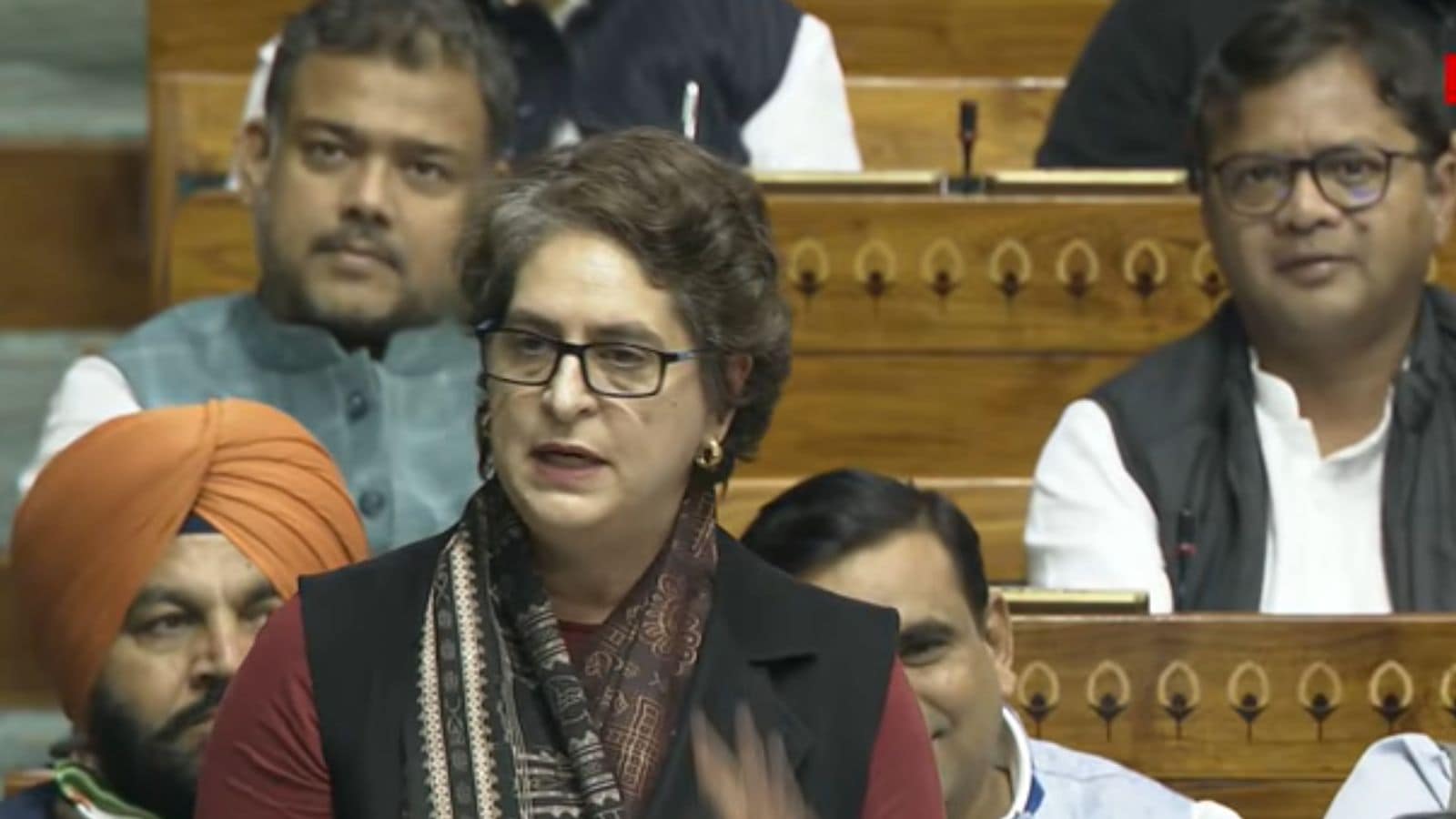
Questioning the objective behind the discussion on Vande Mataram, senior Congress leader Priyanka Gandhi Vadra said it was an attempt by the Narendra Modi government to frame its agenda ahead of the Assembly elections in West Bengal, and yet another bid to keep people mired in the past and distract them from the government’s failures, present-day problems and future challenges.
Speaking in Lok Sabha hours after Modi launched a blistering attack on the Congress on Monday, Vadra dipped into the past to counter his charges point by point, and posited it with present-day politics.
Saying that Vande Mataram is part of the country’s “soul” and remains etched in the hearts of all Indians, she said: “It is our national song..What debate can there be on it?” She said the PM had committed a “sin” by bringing the national song into controversy.
The government’s main objective behind such a debate is the upcoming Bengal elections, as the “Prime Minister wants to play his role in that,” she said. The second objective, she said, is that “those who led the freedom struggle, those who made sacrifices… the government wants an opportunity to level allegations against them”.
And the third objective is to distract people from important issues like unemployment and price rise, she said. “You want us to keep delving into the past because this government does not want to look at the present and the future. They are no more capable of doing that. Prime Minister Modi is not the PM he used to be; the truth is that it shows that his self-confidence is on the wane and his policies are weakening the country. My friends in the government are silent because they, too, know this deep inside,” Vadra said.
By raising questions on the “form” of the national song which was accepted by the Constituent Assembly and endorsed by icons including Mahatma Gandhi, Netaji Subhash Chandra Bose, Jawaharlal Nehru, Rajendra Prasad, Acharya Narendra Dev, Sardar Vallabhbhai Patel, Rabindranath Tagore and B R Ambedkar, the PM has “insulted those great men… denigrated the tall leaders who were members of the Constituent Assembly… (and reflected) his anti-Constitution mindset,” she said.
Hitting back at Modi for his repeated attacks on Nehru, she said the government should bring out a list of allegations against him, and Parliament should debate this and close the chapter once and for all. “I have a small piece of advice… Our Prime Minister had some months ago. during elections, brought out a list of insults that the Opposition and its leaders had hurled at him. It had some 90-99 instances. My advice to him is that bring out a list of all your complaints about Nehru, the mistakes that he has committed according to you, the abuses that you want to give… the insults that you want to heap… Come out with a list…990 insults, 9,999 insults… and then let’s fix a time. Like we are discussing Vande Mataram for 10 hours, let’s fix a time… 10 hours, 20 hours, 40 hours… jitne ghanton main aapki yeh shikayat poori ho jaye (in as many hours as it takes to resolve your complaints)… let’s discuss. But the precious time of this House… the people have sent us to discuss their problems and resolve them… the time should be used for that. So once and for all, let’s close the chapter. The country will listen. What are the complaints… who did what… What did Indira do, what did Rajiv do… what is dynasty… What all mistakes did Nehru commit… suna lijye phir khatam (tell us, and then end it),” she said. “After that, let us discuss unemployment, price rise, issues faced by women,” she said.
“You keep talking about the past… you are doing this to distract the attention of the people, to hide the reality of the present… the issues faced by the youth, women… issues like price rise, unemployment, paper leak, pollution. You don’t want us to discuss the present and the future… the reality is that your government is a government of oppression, your politics is just pretence, you are doing the politics of event management, your politics is from election to election..your politics is politics of distraction … Vande Mataram is desh ki uni ummedon ki guhaar hain jine aapka shahsan har roz tukra raha hai (Vande Mataram is the cry of hope that your government is rejecting everyday),” she said.
Vadra peppered her speech with references to the Bengal elections. When some ruling members tried to interrupt her while she was quoting a letter from Bose, she said: “You don’t want to hear what Netaji said… Bengal elections are coming.” And when the disruptions continued, she said: “You are for elections and we are for the country. No matter how many elections we lose, we will sit here and continue to fight you and your ideology… you cannot stop us.”
Countering Modi, who said the Congress and Nehru had “divided” the Vande Mataram under pressure from the Muslim League, she gave a “chronology” of the song and its history. She said the first two stanzas of the present-day national song was written by Bankim Chandra Chattopadhyay in 1875. He added four more stanzas in 1882 in his book Anandmath.
“In the 1930s, when communal politics was on the rise, this song became controversial. While the PM quoted a few lines from a letter Nehru had written to Bose in 1937… I want to place the full facts. The letter (of Nehru) Modiji read out in the House was of October 20, 1937. And he said that Nehruji wrote to Bose and said that there should be a discussion on the song. Before that, three days ago, Bose had written to Nehru. This was not mentioned by the PM,” she said.
Vadra said Bose had written to Nehru to discuss the issue in the Congress Working Committee and with Tagore. “On October 20, Nehruji replied to this. One line of the reply was read out by the PM. Why didn’t he read the rest? Because what is Nehruji saying… ‘There is no doubt that the present outcry against Vande Mataram is to a large extent a manufactured one by the communalists. Whatever we do, we cannot pander to communalists’ feelings. But to meet real grievances where they exist. I have decided now to reach Calcutta on the morning of the 25th. This will give time to see Dr Tagore and others’,” she said, quoting from the letter.
Vadra also read out a letter from Tagore to Nehru, in which he had written that the two stanzas that have always been sung had deep importance, and the stanzas that were added later could be interpreted in a communal manner. She said the two stanzas which form the national song now were accepted by all the great men of the freedom movement. “After Independence, in 1950, when Dr Rajendra Prasad declared in the Constituent Assembly that the two stanzas of song would be the national song…those same great men were present. Also present were B R Ambedkar and Jan Sangh leader Shyama Prasad Mukherjee, and no one objected,” she said.