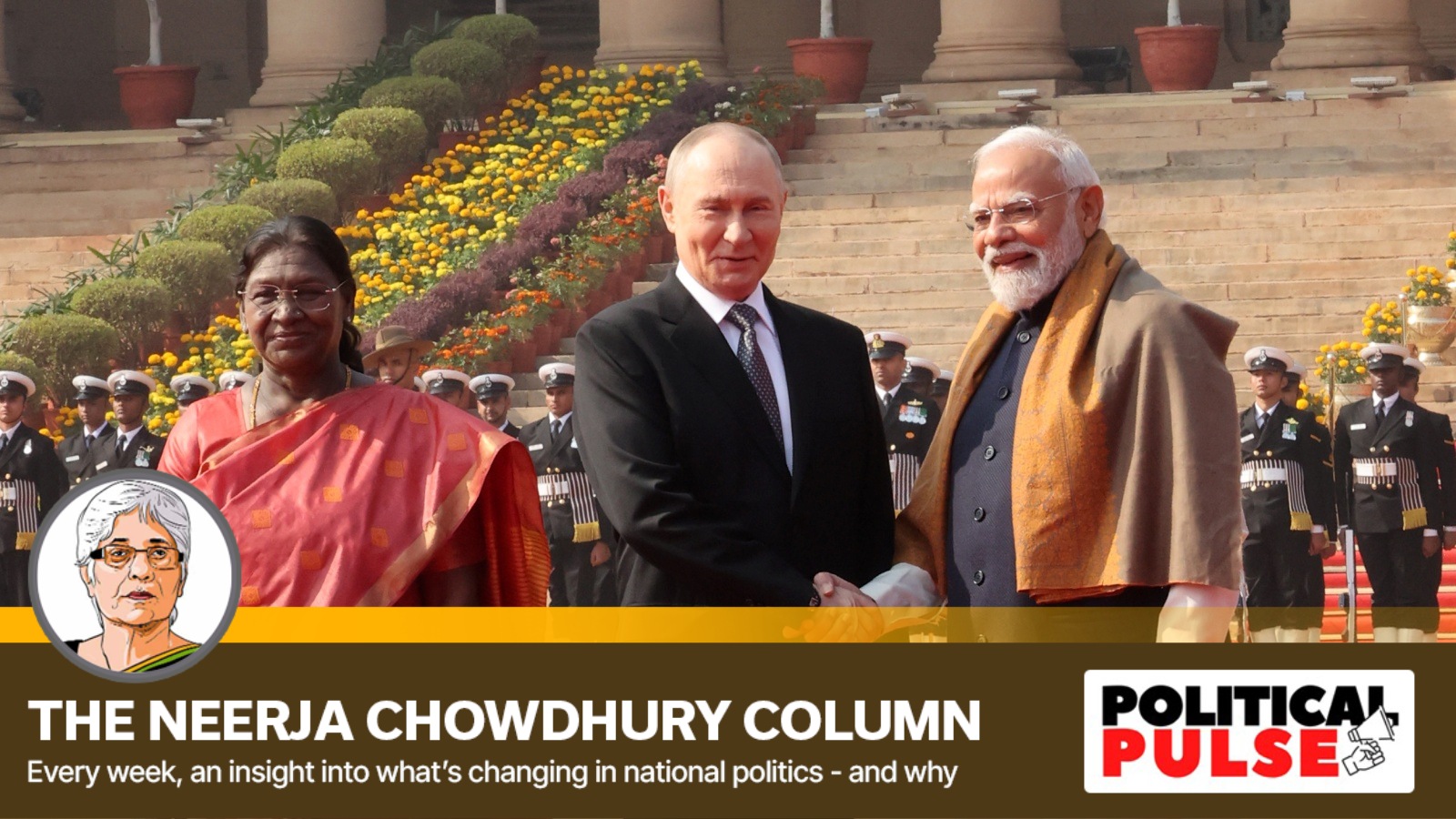
It was surprising that the Leaders of the Opposition (LoPs) in both Houses of Parliament, Rahul Gandhi and Mallikarjun Kharge, were not invited to a dinner hosted by President Droupadi Murmu at Rashtrapati Bhavan for the visiting Russian President Vladimir Putin last week. This appeared to be a discordant note struck during the well-crafted visit.
Time will tell how strong the sustained partnership between New Delhi and Moscow will remain on key bilateral issues including trade, energy, defence, nuclear power and labour mobility.
We will know soon enough the impact it would have on US President Donald Trump, with an American team here to resume talks with their Indian counterpart on their proposed bilateral trade agreement.
This was Putin’s first visit to India since the start of the Ukraine war in February 2022, which showed that the Russian President was not isolated and that Prime Minister Narendra Modi has options other than just the US, with which India has enjoyed a strategic relationship for a quarter of a century. But then foreign policy is nothing but a convergence of interests.
The “tarmac moment” — Modi was there when Putin alighted from the aircraft and they embraced warmly — their smiling picture inside the vehicle in which they rode together, Putin’s praise for India’s rise, his interview by two women TV anchors from India Today, all these contributed to the optics for the high-profile visit. Some questions were then raised.
Rahul Gandhi criticised the government that he was not allowed to meet Putin, adding that it was a deviation from conventions in the past. A meeting with the LoP, Rahul argued, would enable the visiting dignitaries to hear a different viewpoint—and should happen routinely in a democratic set-up. He attributed this “lapse” to a sense of “insecurity” in the government.
It had earlier been a common practice for the Opposition figures to be invited to banquets held for visiting foreign leaders. On its part, the government has held that it is for the visiting dignitaries to decide who they want to meet. The government could, however, always nudge them to meet certain people outside their official engagements.
It is not as if the heads of government have not met Rahul Gandhi. Several foreign leaders have met him during their visits over the last year, including Bangladesh PM Shaikh Hasina in June 2024, Malaysia PM Anwar Ibrahim and Vietnamese PM Pham Minh Chinh in August 2024, New Zealand PM Christopher Luxon in March 2025, and Mauritius PM N Ramgoolam in September 2025.
Govt position
The government may have a point that this decision ultimately rests with the foreign dignitaries as to how they want to plan their visit. The curious aspect of the story, however, was not the one-on-one meeting Rahul did not have with Putin. It was rather about the Lok Sabha LoP not being invited to the Rashtrapati Bhavan’s banquet, which was an official affair held for someone as significant as the head of the Russian Federation, whose visit to India was being tracked closely by the world capitals. It was held at a time when India is navigating a tricky terrain following Trump’s trade blitz. And the guest list was no small one. It involved over 150 invitees. Nor was this about Rahul Gandhi, the individual, given that the LoP is a statutory position.
What is more, and this would have strengthened the government’s position, is the point that the Congress party has had a long-standing relationship with Russia as well as its erstwhile avatar, the USSR. It was Indira Gandhi who had signed the strategic Indo-Soviet Treaty of Peace, Friendship and Cooperation in August 1971 in view of the growing nexus between Pakistan, China and the US ahead of the creation of Bangladesh. She had swung into action the moment the then US Secretary of State Henry Kissinger went on a secret visit to China from Pakistan, within a couple of days of visiting India.
The Congress PMs who followed her consolidated the country’s relationship with Russia. PV Narasimha Rao, during whose term the USSR disintegrated in 1991, focused on Russia and the Central Asian Republics, which had just become independent. Manmohan Singh deepened the strategic ties with Russia and pushed for several critical defence deals, including the production of the BrahMos.
The Congress is miffed about the invite sent to Shashi Tharoor instead of Rahul for the Rashtrapati Bhavan banquet. But Tharoor is not the issue here. Admittedly, he enjoys a rapport with the PM. But Tharoor’s profile is more than that of a Congress MP. Apart from being a popular author, he was also the Under Secretary-General at the United Nations before he joined politics.
It goes without saying that the presence of the LoPs — and other leaders from different parties — at an official banquet for a head of state only goes to project a united face of India, regardless of the political differences on the domestic front.
Bipartisan spirit of old
There have been many instances in the past of the government and the Opposition working together to reinforce India’s position on the global stage on various issues.
Indira Gandhi had sought Vajpayee’s help to send out a signal that the entire country stood behind her in the creation of Bangladesh.
In 1994, Narasimha Rao appointed the then LoP Vajpayee as the head of an official delegation to the UN, with MoS Salman Khurshid under him, to counter the Pakistan offensive about India’s record on human rights in Jammu and Kashmir.
PM Vajpayee had “encouraged” Left leaders to hold an agitation to demand that India should not sign the CTBT (Comprehensive Test Ban Treaty) in a bid to ward off pressure from Western nations.
And Modi sent several multi-party delegations to many countries across the world earlier this year to explain India’s stand on Operation Sindoor.
On November 26, at an event in the Central Hall of the Old Parliament building to mark the Constitution Day, the two LoPs were on the dais along with the President, Vice-President, Prime Minister, and Lok Sabha Speaker. This bipartisan spirit was missing from the Rashtrapati Bhavan’s guest list.
Neerja Chowdhury, Contributing Editor, The Indian Express, has covered the last 11 Lok Sabha elections. She is the author of How Prime Ministers Decide.