
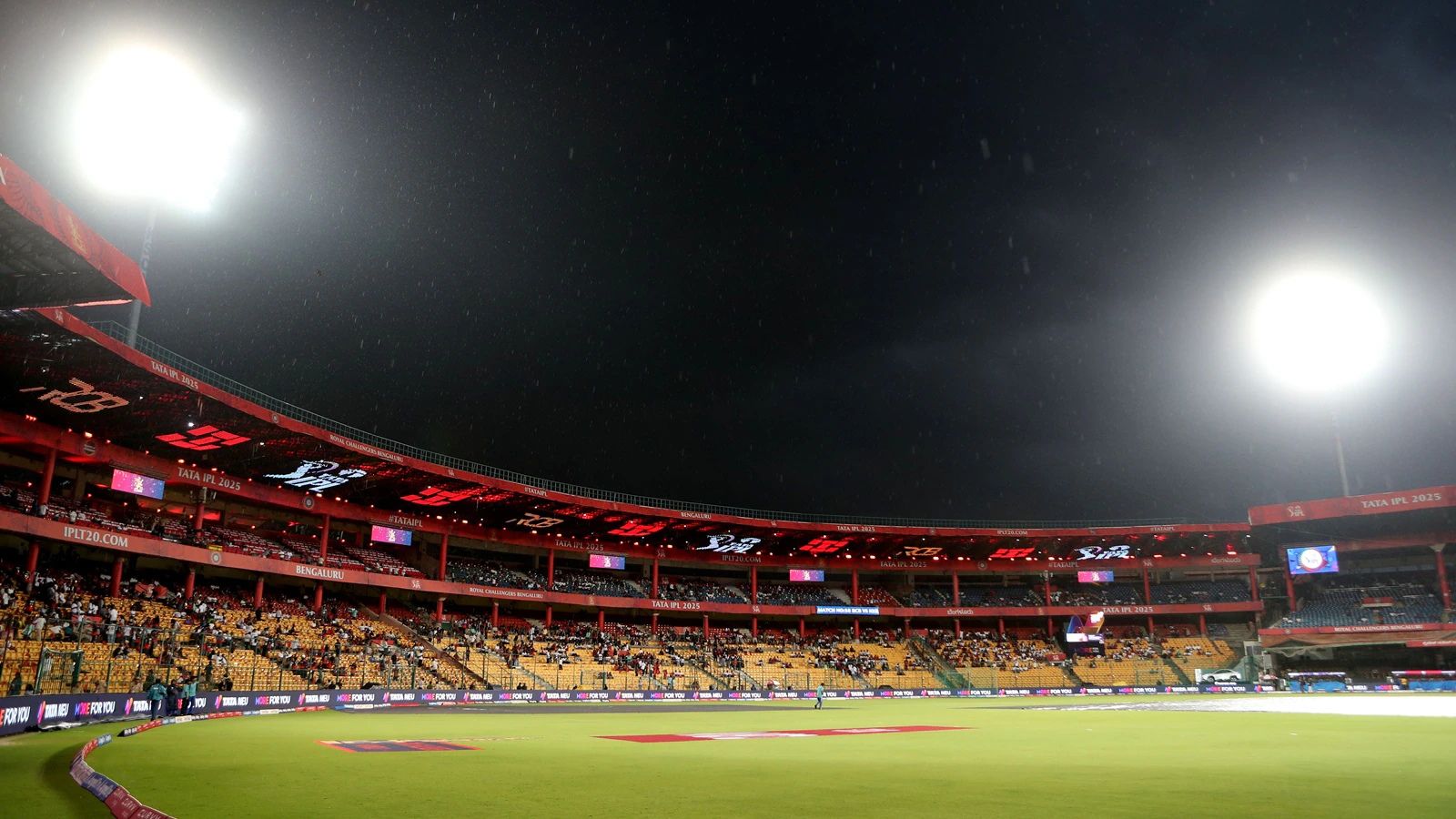
Despite a recommendation by a judicial commission not to hold large public gatherings at M Chinnaswamy Stadium in Bengaluru until crowd control measures are put in place, Karnataka Deputy Chief Minister D K Shivakumar said Sunday that Indian Premier League (IPL) 2026 matches will be held at the venue.
Following the June 4 stampede outside the Chinnaswamy Stadium during the IPL 2025 victory celebration by Royal Challengers Bengaluru, which resulted in 11 deaths, a judicial commission recommended the implementation of crowd control measures at the stadium. As a result, hosting major cricket matches at the stadium has been suspended.

Despite the cloud hanging over the hosting of IPL 2026 matches in Bengaluru in the aftermath of the July stampede deaths, Shivakumar, also a member of the Karnataka State Cricket Association (KSCA), said that he “would not allow IPL matches to be shifted out of the Chinnaswamy stadium”.
Story continues below this ad
On Sunday, Shivakumar cast his vote in the KSCA elections, won by former India player Venkatesh Prasad, and said the hosting of the IPL games at Chinnaswamy Stadium, RCB’s home venue, is a matter of pride.
“This is a question of Bengaluru and Karnataka’s pride. We will ensure the IPL matches are held here,” he said. “We will allow all the matches which are going to take place here.”
Story continues below this ad
“I am a cricket fan. We will ensure that such incidents don’t recur and uphold the stadium’s reputation. We will also build a new stadium as an alternative,” he added.
“I am a member of KSCA. Nagaraj (former KSCA official), whose son was my classmate, had given me a membership when I was very young. I know a lot of cricketers, including (Erapalli) Prasanna and Anil Kumble, through Brijesh Patel. I have cast my vote for the ones I support,” Shivakumar said.
RCB, KSCA and organisers booked
After the stampede outside the stadium, which occurred as crowds rushed to enter without proper crowd control, the Bengaluru police filed multiple cases against RCB, KSCA, and the event organisers, DNA Entertainment Network.
Story continues below this ad
Chargesheets have yet to be filed in the stampede cases taken up by the police, following a July 8 directive of the Karnataka High Court that chargesheet not be filed without its clearance.
The Karnataka Criminal Investigation Department (CID) is conducting a probe into the criminality involved in the stadium stampede case, in which the culpable homicide section has been invoked in the FIR.
Judicial commission recommendations
A judicial commission headed by retired Karnataka HC judge Justice John Michael D’Cunha was set up by the Karnataka government to probe the stampede. The panel recommended legal action against multiple officials of RCB, DNA Networks, KSCA and the Bengaluru police.
Story continues below this ad
The commission also recommended that no major public events should be held at the stadium till safety measures are installed. It also recommended the introduction of several measures at the stadium, including adequate entry and exit gates, integration with public transport facilities, and infrastructure for emergency responses before conducting any future public event.
“Until such infrastructural changes are made, continuing to host high attendance events at the current location poses unacceptable risks to public safety, urban mobility and emergency preparedness,” the judicial commission said in a recommendation made in a report submitted to Chief Minister Siddaramaiah.
The commission stated in its report that, without addressing “systemic limitations” at the stadium, located in the heart of the city on MG Road, it would not be appropriate to hold large public events there.
Story continues below this ad
Given the systematic limitations, “the commission strongly recommends that stadium authorities consider relocating events that are expected to attract large crowds to venues that are better suited for such large gatherings,” the report stated.
“Any future venue should adhere to international standards, including: Purpose built queuing and circulation zones separated from public roads. Adequate entry / exit gates for mass entry and exit (ingress and egress) Integrated public transport access points and tourist hubs. Emergency evacuation plans compliant with international safety norms. Sufficient parking and drop off infrastructure to handle attendee volumes,” the commission said.
“The design and structure of the stadium was unsuitable and unsafe for mass gathering. All the entry and exit gates were directly opening into the public footpath. Spacious and organised holding area for crowd were not provided at the entry, as a result, the audience were forced to queue up on the footpath or the road abstracting and endangering the pedestrians and vehicular movements as well as giving scope for the miscreants to join the crowd aggravating the risk especially in the absence of proper security management,” the report stated.
Story continues below this ad
New stadium proposed
The Karnataka government has meanwhile accorded in-principle approval to facilitate the construction of a mega cricket stadium for 80,000 spectators at Rs 2,350 crore in Anekal on the southern outskirts of Bengaluru.
The new cricket stadium has been projected as being necessary for the city of Bengaluru on account of the Chinnaswamy Stadium operated by the KSCA having a capacity of only 38,000 spectators.
“The Chinnaswamy Stadium in Bengaluru is old and has a capacity of only 38,000. Many cities, both big and small, have stadiums that are bigger than Bengaluru. A Bengaluru Stadium, which meets the needs of the city with all the modern facilities, is a must for the city,” a Cabinet note for the in-principle approval stated.
Story continues below this ad
Earlier this year, Advocate General informed the Karnataka High Court that the cause of the stampede on July 4 was nearly 2,50,000 fans attempting to enter the stadium, which has a capacity of 33,000.
Senior state officials, including police officers, have said that the long-term solution to prevent incidents like stampedes is to relocate the cricket stadium to a higher-capacity facility on the outskirts of the city.