Actors act — that’s their job after all, right? Sometimes, though, they need to dig deeper into their characters than just memorizing their lines and understanding the context of the scenes. Now, not everyone needs to summon the spirit of Cthulhu, make a blood pact with a demon, or become a method actor who takes things too far, but a performer may choose to transform their voice to add another layer to their performance. This plays a major part in bringing each character to life and convincing the audience to come along on the journey.
It could be an accent change, pitch shift, or even an entire overhaul of how they speak — from cadence to tics. For viewers, it’s often mind-blowing to compare how an actor speaks normally to the voice they use in character. Look at someone like Melissa Rauch, and the radical voice change she underwent to play Bernadette Rostenkowski-Wolowitz in “The Big Bang Theory,” as a classic example; it’s almost like hearing two different people. What kind of sorcery is this?!
Let’s take a look back at the times in which actors went to greater lengths than usual to transform their voices for the benefit of the audience. For the purpose of this piece, we’ll be focusing on live-action performances only, but a special shoutout to all the voice actors who metamorph each and every day.
Austin Butler (Elvis Presley)
To say that Austin Butler disappears into the role of the King in 2022’s “Elvis” is the understatement of the century. It’s a shake, rattle, and roll of cinematic performances, as Butler becomes Elvis Presley in the biopic, even speaking in the same Southern drawl as the legendary musician. The actor worked with a dialect coach to perfect this instantly recognizable voice, as he understood just how iconic Elvis was — and how iconic he remains to this day. Also, he likely knew the King’s fanbase would never let him live it down if his performance ventured into the parody domain.
Butler paid special attention to the tiniest details of Elvis’ voice. “I’d hear him say a certain word and I would clip just that bit out so I knew how he said that word,” he told Entertainment Weekly. “I created my own archive of how he said every word and every diphthong, and the way that he used musicality in his voice.”
For his efforts in “Elvis,” Butler received critical and fan acclaim, and his performance later secured him an Oscar nomination. On top of that, Elvis’ ex-wife, Priscilla Presley, lavished praise on him too. Ironically, Austin Butler’s Elvis accent created a problem for “Masters of the Air,” as the actor couldn’t help but fall in love with everything about the King — meaning he continued to speak like him during filming on the Apple TV+ series. Essentially, he had to learn how to rid himself of all his Elvis-ness, because he had spent such a long time becoming him.
Idris Elba (Nelson Mandela)
Delivering one of Idris Elba’s best on-screen performances, the actor plays South African liberation icon and former president Nelson Mandela in 2013’s “Mandela: Long Walk to Freedom.” Being a biographical motion picture about an important and beloved world figure, this was a project that had a lot of eyes on it from the get-go. But the movie was scrutinized even further when Mandela’s death was actually announced during the London premiere. Fortunately, Elba didn’t let anyone down, as he captured the essence of the great man — especially in his interpretation of Mandela’s voice.
In a conversation with NPR, Elba expressed that it was vital to find the right voice for Mandela. The actor explained that, while his parents were from West Africa, their accents were different from the South African kind; however, there are certainly similarities in the rhythm of speaking. He also revealed that his father sounded a little like Mandela, which helped him find the appropriate voice, too.
“I had a foundation to understand where to start from,” Elba said. “But then here’s a quality in [Mandela’s] voice that, you know, I had to pay attention to. I have a deep voice but my voice is quite light, actually, I speak in a higher register. And believe it or not, when Mandela was younger he spoke in quite a higher register up here. And he spoke really quickly. His inflections are so odd that he could make anything sound noble.”
Colin Farrell (The Penguin)
When you talk about jaw-dropping examples of outstanding onscreen metamorphoses, you have to mention how Colin Farrell transformed himself into Oz Cobb – first in 2022’s “The Batman,” and then in HBO’s 2024 series “The Penguin.” If someone didn’t tell you it was Farrell under all the layers of prosthetics and makeup, it would be impossible to guess it’s him. It also helps that the character’s voice sounds nothing like the Irish actor. Instead, the Penguin huffs and puffs with a thick New York accent.
Speaking to Fandango, Farrell explained that he found the character’s voice by collaborating with his dialect coach, Jessica Drake, with whom he has worked on a number of past projects. “She and I sat in a room and listened to audio,” he said. “Listened to tapes. Thought about characters and films we’ve seen that might have not just a dialect quality but an energetic quality. A tonality that we thought Oz might have. It was fun. It’s a journey of exploration.”
According to Farrell, they came across the voice of an elderly man who used to be a caretaker of a New York building in the ’80s. In particular, they loved how he pronounced the words “gefilte fish.” That turned out to be the jumping-on point for the creation of Oz’s voice, and they ran — or waddled — with it all the way to Gotham City.
Tom Hardy (Bane)
It might be controversial to say, but “The Dark Knight Rises” might be the best movie in Christopher Nolan’s “Dark Knight” trilogy. One of the major reasons why people think this is Tom Hardy’s performance as Bane. Not only does Hardy look the part as the hulking cerebral villain, but he also crafted an idiosyncratic voice for him. Seriously, who doesn’t love to imitate those raspy pipes, declaring, “Oh, you think darkness is your ally,” whenever someone turns off the lights in a room?
As a matter of fact, Hardy’s Bane voice has been used as the influence for the character several times since then, including Doug Benson’s portrayal in 2017’s “The LEGO Batman Movie” and James Adomian’s riff on the Santa Prisca bruiser in the “Harley Quinn” animated series. While these are great imitations and tributes, Hardy still remains the O.G. in this regard.
Appearing on a WIRED segment, Hardy credited Nolan for letting him explore Bane’s voice, as well as the character’s Latinx origins. “So, I looked at the concept of Latin and found a man called Bartley Gorman, who’s a Romani gypsy,” Hardy said. “The King of Gypsies. A bareknuckle fighter. And a boxer.” The actor discovered a clip of Gorman’s voice and presented it to Nolan. As Hardy explained, he told Nolan that they could go play it safe with a “Darth Vader” approach — or take a risk with a Gorman-like voice. Ultimately, Nolan decided to back Hardy’s gamble.
Melissa Rauch (Bernadette Rostenkowski-Wolowitz)
Even though Melissa Rauch only joined “The Big Bang Theory” in the third season, Bernadette Rostenkowski-Wolowitz went on to become synonymous with the popular sitcom, establishing herself as a beloved character who brings even more laughs to the show’s madcap antics. Viewers loved Bernadette’s feisty personality, as well as her distinctive squeaky voice. Here’s the capper, though: Rauch sounds absolutely nothing like her character does in real life. So, where did Bernadette’s voice come from? As it turns out, there’s some familial history here.
Appearing on her “Big Bang Theory” co-star Mayim Bialik’s podcast “Mayim Bialik’s Breakdown,” Rauch explained how nerves played a role in her decision to come up with the voice. “It was just for a guest star initially, and I was just very nervous in the waiting room,” she said. “And there [were] so many people there, and I just wanted to try something different. I [had] just been on the phone with my mother whose register is very close to Bernadette’s.”
Rauch pointed out that, while her mother and Bernadette aren’t really similar, she decided to use a variation of her mother’s voice in the audition. “So I sorta did a little bit of an imitation of my mom without the Jersey accent,” she said. Funnily enough, Rauch said that her normal speaking voice tends to “fry out” on occasion, which actually helped her to hit Bernadette’s higher register.
Heath Ledger (Joker)
The late Heath Ledger’s eerie yet enthralling portrayal of the Joker in 2008’s “The Dark Knight” remains one of the best interpretations of the character — and of any supervillain, really. From that unsettling lip-smacking tic to the way he adapted his voice, Ledger delivered an all-time great performance that rightfully earned him a posthumous Oscar in 2009.
While Ledger never got to enjoy the effusive praise for his performance — or discuss his process for getting into the character in-depth — others who worked with him have opened up about how he became the Joker. In Joseph McCabe’s “100 Things Batman Fans Should Know & Do Before They Die” (via The Hollywood Reporter), director Christopher Nolan discussed how Ledger pulled from the punk rock world for his character’s influences, while also drawing inspiration from Malcolm McDowell’s villainous Alex DeLarge, of “A Clockwork Orange” fame.
Ledger also reportedly spoke to Nolan about the movement and voice of ventriloquist dummies — something which baffled the filmmaker at first. As Nolan explained, Ledger was able “to show how the character moved and how the character gestured and how the character spoke, with this extraordinarily unpredictable voice. The range of the voice, from its highest pitch to its lowest pitch, is very extreme, and where it shifts is unpredictable and sudden.”
Lupita Nyong’o (Red)
In 2019’s “Us,” Lupita Nyong’o pulls a double shift playing two characters: Adelaide Wilson and her doppelganger, Red. Nyong’o utilized a different voice for Red while making the film — one that’s raspier and far more unnerving to listen to. According to The New York Times, writer-director Jordan Peele intentionally kept the details about Red vague in the script; the strongest description he gave about her voice was that it was “scratchy.” This enabled Nyong’o to shape the character in the way she saw fit, and she later explained how inspiration came to her in the most unexpected place — when she heard the voice of Robert F. Kennedy Jr. at an event. Kennedy has spasmodic dysphonia, which the Cleveland Clinic describes as “a rare speech disorder that can make it hard to use your voice.”
“It’s not really understood why it happens, or how it happens,” Nyong’o said. “It could be a trauma in your life — someone dying, or a physical assault. It varies. For me, it felt very organic as an inspiration for Red, who’s had this kind of strangled past.” On this basis, Nyong’o worked with her dialect coach, Beth McGuire, to adapt and find the right voice for Red. When Nyong’o eventually demonstrated the voice to Peele, the filmmaker was left impressed; he later described it as “so creepy” and fitting for the character.
Bill Skarsgård (Pennywise)
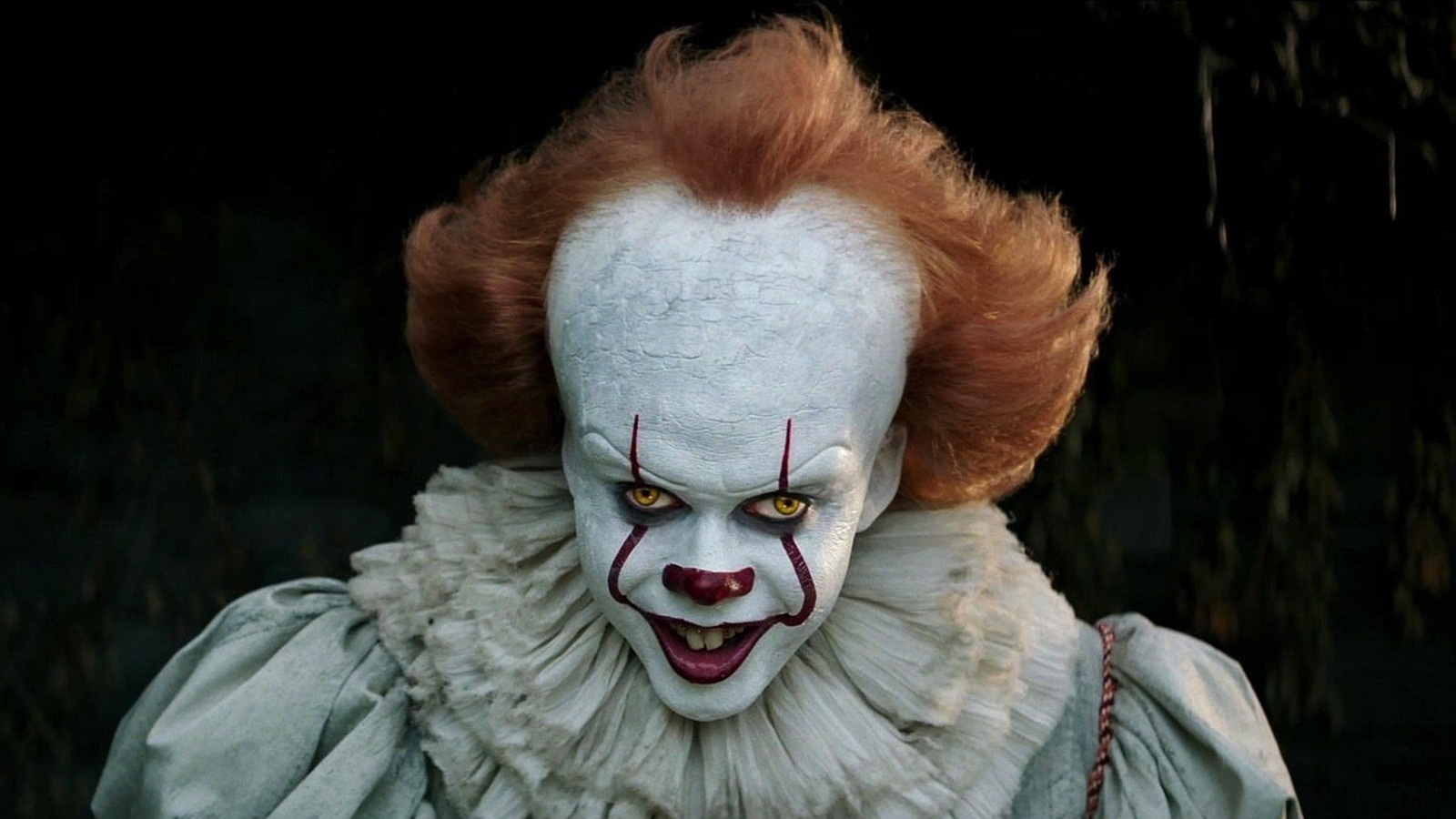
You wouldn’t have wanted to be in Bill Skarsgård’s shoes heading into 2017’s “It.” Playing the creature It — who most frequently takes the form of Pennywise the Dancing Clown — Skarsgård had the shadow of the indomitable Tim Curry looming over him. Curry had brought a trick-or-treat menace to the malevolent entity in the 1990 TV adaptation of Stephen King’s legendary horror novel, leading a whole generation of viewers to find their fear of clowns. It’s a tough act to follow, but, against all odds, Skarsgård’s Pennywise proves to be equally as terrifying — if not more so. Not only did the Swedish actor capture the physical performance required for the character, but he also found a unique and frightening voice for him.
Speaking to Variety’s “Playback” podcast, Skarsgård described how he developed his approach for Pennywise. “The voice for me sort of started out with a laugh,” he said. “I was playing around with a laugh, but on the verge of a panic attack and crying at the same time. When I started doing it just by myself, I started to creep myself out.”
Yet Pennywise wasn’t the last time that Skarsgård would demonstrate his stellar voice acting abilities and out-of-the-box thinking when it comes to characterization. The original plan for 2024’s “Nosferatu” was for the actor’s voice to be digitally altered for his role as Count Orlok, but Skarsgård opposed this decision, instead choosing to bring out his character’s ominous tones from within.
Robert De Niro (Max Cady)
Robert De Niro knows a thing or two about playing villains. Even so, the role of Max Cady from 1991’s “Cape Fear” may have been one of the most challenging of his career. Cady is a heinous psychopath who commits all kinds of despicable crimes, and De Niro fully committed himself to the role. Allegedly, Robert De Niro went so far to get into character for “Cape Fear” that he had dental work done to grind down his teeth, which he then had reversed after production ended.
A less costly — and less painful — decision was the voice he employed for Max. Everyone knows De Niro’s natural and unmistakable New York drawl, but he switched it up for “Cape Fear.” Dialect coach Sam Chwat worked with De Niro in preparation for the movie; in 1994, Chwat spoke to NPR about how they approached Max’s voice. “[T]he way we identified this accent,” he said, “was we sat down and analyzed the videotapes of Southern prisoners, people who were put in Appalachian prisons for extremely violent crimes, men of about his age, white men of about his age, and we listened to them until he said, ‘That’s the guy I want to sound like, that one right there.'” He added that they compared their chosen accent to De Niro’s, then “worked on sound replacements” to find Max’s voice.
Jaleel White (Steve Urkel)
In the late ’80s and ’90s, it was almost impossible to miss Jaleel White’s Steve Urkel on “Family Matters.” While the character was only meant to show up once on the sitcom, Urkel’s geeky appearance, chaotic energy, and nasally voice endeared him to the viewers. Not only did he return to the series on a full-time basis, but he also ended up becoming the star of the whole show.
On occasion, audiences heard White’s real voice on “Family Matters,” as he also starred as Urkel’s suave alter ego, Stefan Urquelle. Most people couldn’t believe this was the same person, a fact that only demonstrated White’s talent when it came to disappearing into his character. Speaking at 90s Con 2024 (via People), White revealed that he hadn’t worked with a dialect coach for his role. As impressive as it is that he did it all on his own, his performance did end up damaging his voice. “I spoke to a doctor, and what happened is during puberty I spoke at the same pitch for extended periods of time,” White said. “If the pitch had been going all over the place I wouldn’t have damaged it quite as much.” Fortunately, this didn’t result in permanent damage to White’s voice in the long term, and he now works with a vocal coach for his roles.