
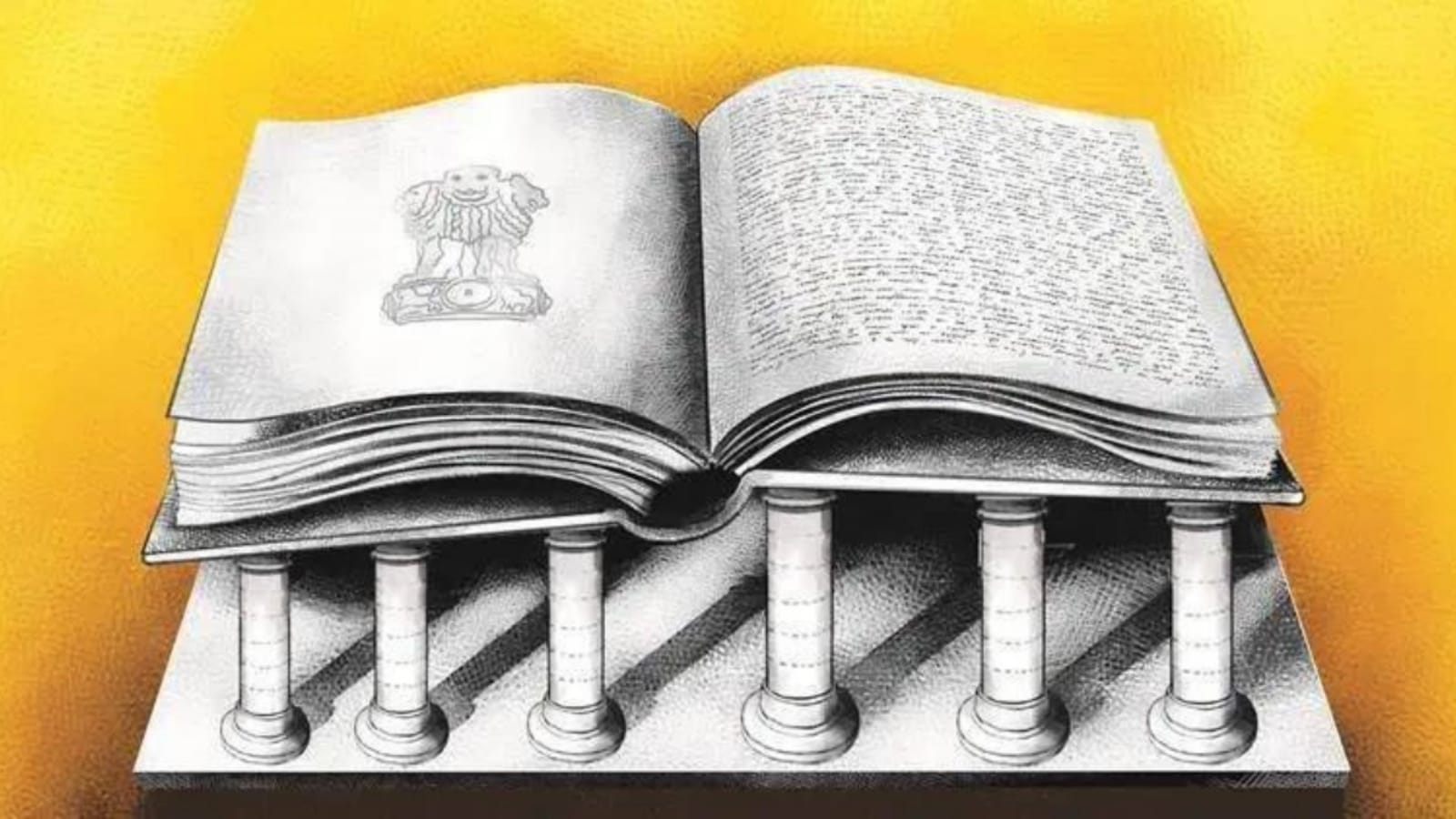
While there has been some debate in recent times about whether “socialist’ and “secular” should be removed from the Preamble to the Constitution, the Constituent Assembly itself saw a brief discussion on an amendment moved by K T Shah to add the two words to Article 1. The chairman of the Drafting Committee of the Constitution, Dr B R Ambedkar, who passed away on December 6 exactly 69 years ago, found the amendment “superfluous” and opposed it. The amendment was ultimately rejected.
Shah, a socialist and a trained economist, moved the amendment to Article 1 on November 15, 1948, suggesting that it read, “India shall be a Secular, Federal, Socialist Union of States.” He wanted the words “secular”, “federal”, and “socialist” added to Article 1, “owing to the arrangements by which the Preamble is not considered at this moment”.
Shah offered his rationale for the move. “As regards the Secular character of the State, we have been told time and again from every platform that ours is a secular State. If that is true, if that holds good, I do not see why the term could not be added or inserted in the constitution itself, once again, to guard against any possibility of misunderstanding or misapprehension.”
He added, “The secularity of the state must be stressed in view … of the unhappy experiences we had last year and in the years before and the excesses to which, in the name of religion, communalism or sectarianism can go.”
Shah then came to the word socialist, asserting, “By the term `socialist’ I may assure my friends here that what is implied or conveyed by this amendment is a state in which equal justice and equal opportunity for everybody is assured, in which everyone is expected to contribute by his labour, by his intelligence, and by his work all that he can to the maximum capacity, and every one would be assured of getting all that he needs and all that he wants for maintaining a decent civilised standard of existence.”
He added that “it would not be quite a correct description of the state today in India to call it a Socialist Union”, emphasising “it is anything but Socialist so far”.
Ambedkar’s response
Dr Ambedkar opposed the amendment, directing Shah’s critique to the proposed inclusion of “socialist”, while not referring to the word secular at all.
“The Constitution … is merely a mechanism for the purpose of regulating the work of the various organs of the State. It is not a mechanism whereby particular members or particular parties are installed in office. What should be the policy of the State, how the Society should be organised in its social and economic side are matters which must be decided by the people themselves according to time and circumstances,” he said.
“It cannot be laid down in the Constitution itself, because that is destroying democracy altogether. If you state in the Constitution that the social organisation of the State shall take a particular form, you are, in my judgment, taking away the liberty of the people to decide what should be the social organisation in which they wish to live,” he said.
Ambedkar said while it was possible that “the majority of the people” considered “the socialist organisation of society … better than the capitalist organisation of society” at that time, “it would be perfectly possible for thinking people to devise some other form of social organisation which might be better than the socialist organisation of today or of tomorrow”.
He said the amendment was “purely superfluous”.
“Prof. Shah… does not seem to have taken into account the fact that apart from the Fundamental Rights, which we have embodied in the Constitution, we have also introduced other sections which deal with directive principles of state policy,” Ambedkar said, reading out some of the Directive Principles that were socialist in orientation.
“If these directive principles to which I have drawn attention are not socialistic in their direction and in their content, I fail to understand what more socialism can be?” Ambedkar added.
Socialist H V Kamath also agreed with Ambedkar. “As regards the words ‘secular and socialist’ suggested by him, I personally think that they should find a place, if at all, only in the Preamble. If you refer to the title of this Part, it says, ‘Union and its Territory and jurisdiction’. Therefore, this Part deals with Territory and the jurisdiction of the Union and not with what is going to be the character of the future Constitutional structure,” he said.
Kamath said as the Constitution specifically provided for division of legislative subjects into lists — he meant Union, state and concurrent lists — the word “federal” wasn’t needed.
Soon after Ambedkar and Kamath spoke, Shah’s amendment was put to a vote before the Assembly, which rejected it. Throughout the short debate, the word “secular” was not mentioned even once, though reasons for opposing the inclusion of “socialist” and “federal” were given.
While it isn’t clear why Ambedkar did not refer to “secular” — neither did Kamath or anyone else — writer Anand Teltumbde offers a possible reason why. “He avoided saying anything about secularism, because he could not have said what he said for socialism. Perhaps he knew that secularism cannot be equal to providing stray freedoms in respect of religions,” he writes in Iconoclast, his biography of Ambedkar.
After 50 years of the Emergency, when secular and socialist were added to the Preamble, RSS general secretary Dattatreya Hosabale, this June, called for a debate on whether the two words should be removed from the Preamble, with Union ministers Shivraj Singh Chouhan and Jitendra Singh agreeing with him.