
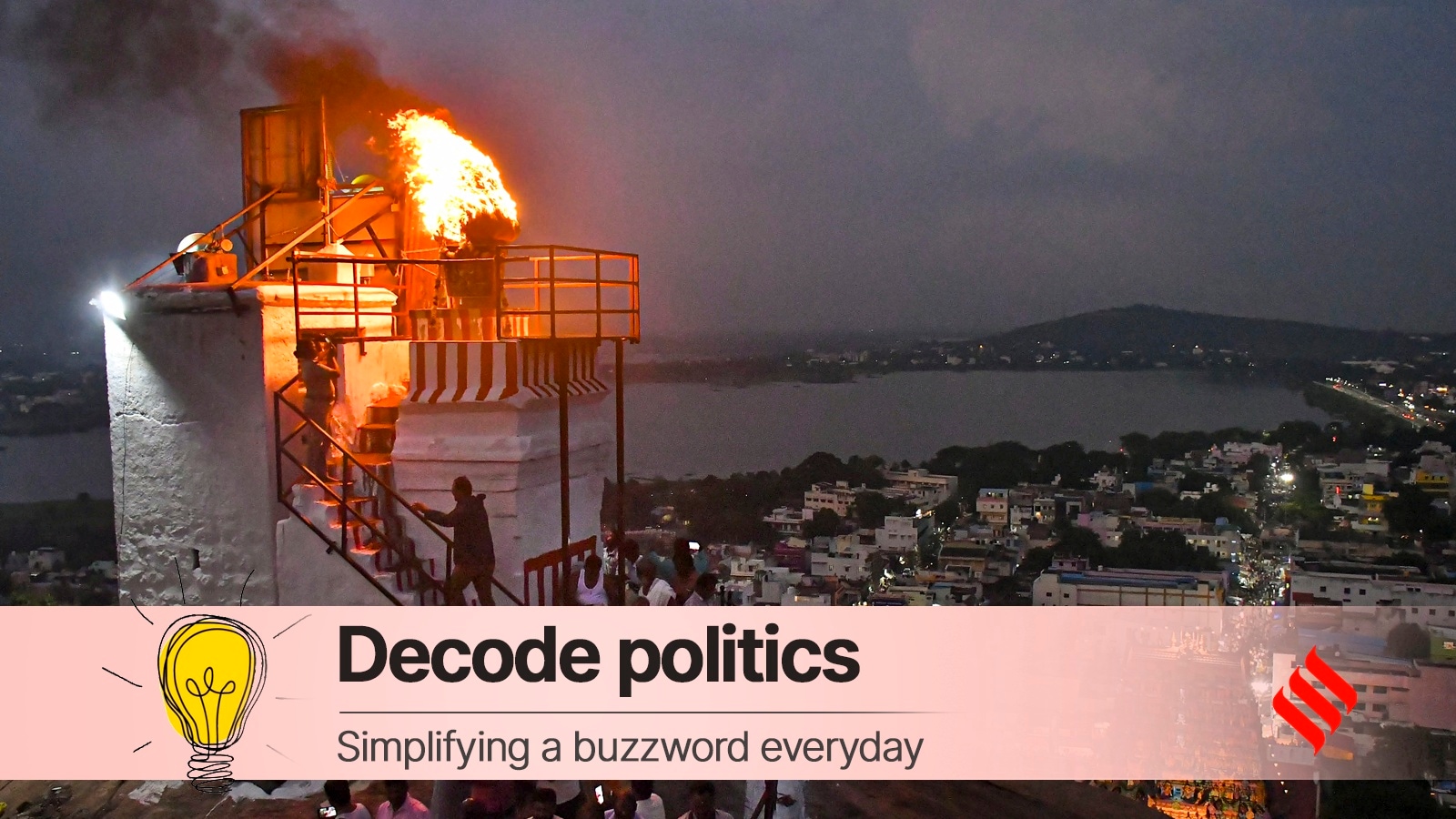
Following a Madras High Court order on December 1, a century-old property disagreement between a Hindu temple and an adjoining dargah in Tamil Nadu’s Madurai has returned, deepening contemporary political fault lines.
Over the past two years, petitions, counter-petitions, police prohibitions, demonstrations, and judicial directives have sought to define, and sometimes resurrect, rituals, processions, rights, and territorial claims tied to the disputed Deepathoon site at Thirupparankundram Hill that houses the Subramanya Swamy Temple, which, according to believers, is one of the six abodes of Lord Muruga, and the Sulthan Sikkandar Avulia Dargah that is located just metres away.

On Wednesday, the Madurai Bench’s contempt order, triggered after state officials failed to carry out the court’s December 1 directive to light the “Karthigai Deepam” lamp at the pillar known as the Deepathoon, led to Central Industrial Security Force (CISF) escorting the petitioner and supporters up the hill to complete the ritual. The judge called the act “symbolic but necessary,” writing that failure to enforce the order would “sound the death knell of democracy”.
As news spread, supporters of an outfit called Hindu Munnani gathered near the temple complex and pelted stones, injuring at least six officers, the police said. Hours later, the Madurai District Magistrate imposed prohibitory orders under Section 163 of the Bharatiya Nagarik Suraksha Sanhita (equivalent to Section 144 of the CrPC), citing an “emergent law and order situation.”
The court on Thursday dismissed the Tamil Nadu government’s appeal challenging a contempt order, leaving the original directive intact. Late on Thursday night, BJP state president Nainar Nagendran and senior party leader H Raja were detained when they attempted to enter the disputed site.
What is the history of the dispute?
Story continues below this ad
While the present mobilisation centres on the lamp-lighting ritual, the underlying question — who controls which part of the hill — predates Independence.
Court records and administrative correspondence show that between 1915 and 1916, a dispute erupted when the hukdars (caretakers) of the dargah attempted to build a mandapam at the nearby Nellitope area using quarried stones from the hill. The temple authorities, then administered through the Madurai Meenakshi Devasthanam, objected, citing documents, including a 1837 one, which claimed the entire rock and its surrounding hamlets belonged to them.
The British-era Madurai Collector, G F Paddison, attempted mediation, even proposing a shared rest house for both communities. While the hukdars agreed, the temple refused, asking that the matter be resolved in court.

After a series of proceedings, first before a subordinate judge in Madurai in 1923, then before the Madras High Court in 1926, the case reached the Judicial Committee of the Privy Council in London. In 1931, the Privy Council upheld the subordinate judge’s finding: the hill belonged to the temple, except for the Nellitope area and the physical site of the mosque, its flagstaff, and steps. The ruling emphasised the hill’s religious antiquity, referring to it as Swamimalai or God’s Hill, and cited decades of records showing the temple exercising “acts of ownership”. The dispute was then handled largely between clergy and administrators without political mobilisation or outsider involvement.
Why is the dispute simmering again?
The dispute, which was dormant for decades, revived in recent years amid petitions challenging or reviving ritual practices on the hill, including processions and the location of ceremonial fire-lighting during festivals.
This February, during another hearing over proposed religious processions, Justice N Ilanthiraiyan questioned whether an alternative route could help avoid conflict. However, both sides rejected compromise. Senior Public Prosecutor Hasan Mohammed Jinnah argued that allowing a new route or ritual would “ignite communal passions”, especially given that past demonstrations had resulted in criminal cases for provocative speeches.
The court said two FIRs were registered after participants at Hindu Munnani-organised demonstrations were accused of promoting enmity and provoking riots. In his order, the judge directed the authorities to prevent “any form of protest that disrupts public peace and harmony” and urged the state to restore “the previously prevailing order”.
Against that backdrop, last week’s petition, filed by individuals with established links to Hindu Munnani and associated groups, rather than local residents, marked a strategic shift: litigation focusing on specific rituals, framed as reclaimed tradition.
Wednesday’s contempt ruling leaned heavily on archival litigation, including the Privy Council findings, to argue that lighting the lamp at the Deepathoon revived a historical practice connected to temple-owned land.
What is the DMK government’s position?
The DMK government has repeatedly accused the BJP and Sangh-aligned organisations of attempting to manufacture a communal flashpoint in Tamil Nadu.
In a statement, Hindu Religious and Charitable Endowments Minister P K Sekarbabu said earlier this year, “The BJP aims to create law-and-order problems and bring down the DMK government by dividing people based on caste, religion and language.” He said the mosque had stood atop the hill for nearly 600 years, the temple for centuries longer, and that people of Thirupparankundram had lived “in total harmony”.
He referred to ongoing and historic litigation, including a 1920 Madurai court ruling and the 1931 Privy Council verdict, stressing that the state would “follow the rule of law and implement court orders in letter and spirit”, while ensuring long-standing rituals continued without disruption.
What comes next?
With the state government’s appeal against the contempt order now dismissed, the legal position remains unchanged: the December 1 order requiring the temple administration to light the Karthigai Deepam at Deepathoon stands, as does the contempt order permitting the petitioner to light the lamp under CISF protection if the authorities fail to comply.
In its ruling, the Division Bench of Justices G Jayachandran and K K Ramakrishnan said the government’s appeal was both procedurally and substantively untenable. The judges described the appeal as “a pre-emptive step” to avoid contempt rather than contesting the underlying factual or legal issues. The Bench also noted that the government had not complied with the December 3 contempt order even after it was issued, and instead invoked prohibitory measures that the court said appeared to have been passed either beforehand or “manipulated after this Court called for the original file”.
The Bench said lighting the lamp at Deepathoon was now a judicially settled right, linked to Articles 25 and 26 of the Constitution. The order reiterates that the state machinery carries a constitutional obligation to implement court rulings and cannot rely on executive prohibitory orders to override them.
Politically, the BJP will look to make gains months before the state Assembly elections by mobilising over the dispute. The detention of Nagendran and Raja marked the party’s first direct political intervention in the issue. BJP ally AIADMK condemned the detention, with party chief Edappadi K Palaniswami asking in a statement, “Does the government consider itself to be above the judgments of the court?”
What began over who may light a flame, and where, has now evolved into a test case balancing religious identity, legal precedent, state authority, and judicial assertiveness. On a hill where two places of worship have coexisted for centuries, the dispute once resolved through administrative diplomacy and litigation is now unfolding under a new grammar of politics shaped not by local worshippers, but by petitions, speeches, and organised mobilisation.