
Rotund, ground-dwelling and unafraid of humans to its own peril, the famed dodo bird became an icon of extinction when it disappeared from the island of Mauritius, and from Earth, in the 17th century, soon after Dutch settlers first encountered the bird.
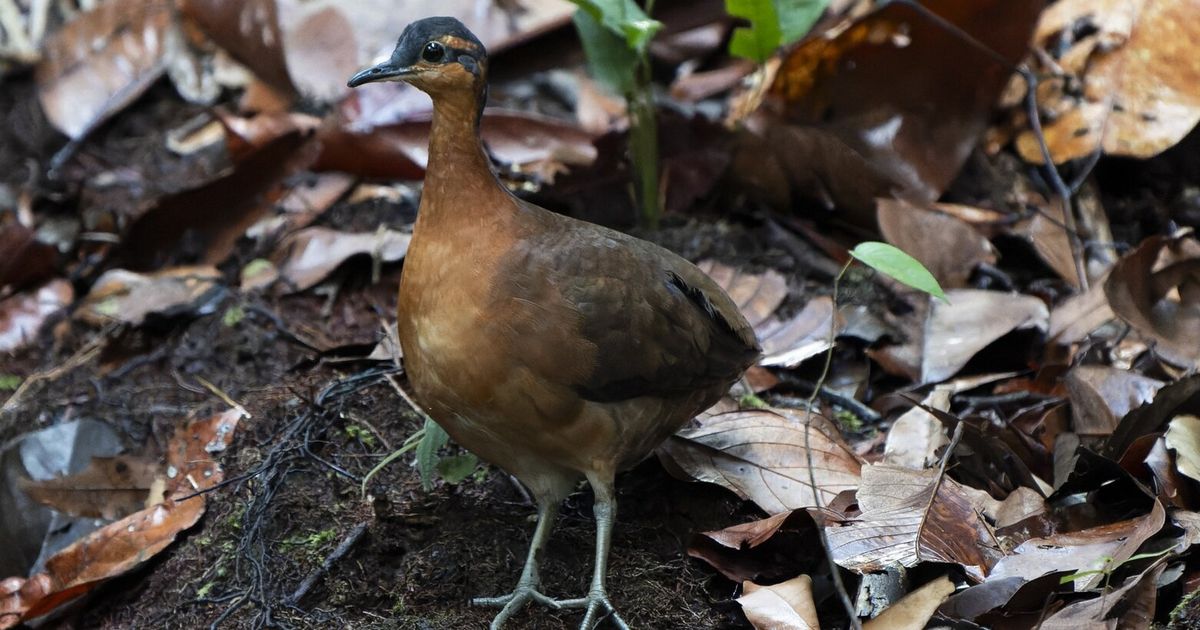
Now Brazilian ornithologists say that they have discovered an analog of the dodo in the remote Amazon: the slaty-masked tinamou, a chickenlike bird that exhibits a total lack of fear toward people. The researchers are looking to the dodo’s demise to prevent the tinamou from suffering a similar fate.
The comparison to the dodo was “scientifically accurate,” said Luis Morais, a doctoral candidate in zoology at the Museu Nacional of Rio de Janeiro and the lead author on the paper announcing the finding, which was published Tuesday in the journal Zootaxa. “The bird’s behavior mirrors historical accounts of the extinct dodo, and its extinction risk is equally real.”
Discovered in the remote Serra do Divisor mountains of western Brazil, the slaty-masked tinamou appears, sings and behaves in a manner strikingly different from any known relative. Most tinamous are shy, cryptic birds with coloring that allows them to blend into their surroundings. The slaty-masked tinamou, in contrast, is adorned in vivid cinnamon-rufous plumage with a dark stripe across its eyes, hence the “masked” in its name.
Most unusual is its oblivious demeanor. Morais’ team spent three years trying to lay eyes on the bird, after detecting it by ear for the first time in October 2021 in Acre, Brazil. But once it revealed itself, it appeared remarkably tame, wandering calmly through the forest understory and showing no aversion to human presence. The researchers were stunned when individual birds walked right up to them on several occasions.
Its vocalizations are similarly bizarre: long, haunting calls that diffuse through the forest so thoroughly that they confuse a listener’s sense of both distance and direction. Tinamous tend to employ simple, repetitive, sometimes mournful whistles, hoots and trills. But the slaty-masked tinamou’s complex voice rises in frequency, building like a pianist working up a scale, one careful step at a time.
“This bird is totally crazy-looking, and it is an opera singer,” said Diego Calderón-Franco, a biologist from Colombia and an expert on Neotropical birds, adding a colorful adjective for emphasis. Calderón-Franco was not involved in the research but did review its findings, including the audio recordings, before publication. “It has a voice like no other, a voice that gains energy as it sings and bounces all over the walls of the valleys where it lives.”
Its scientific name, Tinamus resonans, refers to the striking echo and disorienting acoustics of its song. The bird is believed to be the first new small forest tinamou species discovered in 75 years.
“Someone finding a brand-new tinamou in the field is simply absurdly bananas,” Calderón-Franco said. “The fact that this bird has been hiding in a little remote corner of Brazil forever is mind-blowing.”
Like the dodo, the slaty-masked tinamou lives on an island of sorts: Its entire known range is limited to a narrow elevation band in the Serra do Divisor, an isolated mountain range on the border between Brazil and Peru. This remote and poorly known region, the easternmost extension of the Andes, acts as an ecological “sky island” surrounded by the Amazon lowlands, with half-mile-high peaks and distinctive plants and animals occupying narrow niches and microhabitats.
Five other small forest tinamous are present in the Serra do Divisor, but none live at the higher elevations. The slaty-masked tinamou was detected exclusively above 1,000 feet. The tight elevation range places the bird on an ecological knife’s edge, acutely vulnerable to mounting outside pressures, Morais said.
Analogy aside, the slaty-masked tinamou is evolutionarily unrelated to the dodo in any significant way. (The dodo was most closely related to pigeons and doves.) But the similarities — ground-dwelling, naive to humans as potential predators — are striking and concerning, Morais said. Its total population is estimated at 2,000.
“The area is nearly uninhabited and largely intact, but the species’ long-term survival is far from secure,” Morais said. “Species restricted to tight elevation ranges are highly sensitive to climate change.”
Montane forests are like apartment buildings, with different animals inhabiting different floors, and species often climb to higher altitudes as temperatures warm. Species that reach the very top have nowhere higher to go — a phenomenon that scientists call the “escalator to extinction.”
The slaty-masked tinamou resides on what is effectively the top floor of the Serra do Divisor. As such, land-use changes and human activities pose a big risk, Morais said. Fire is a particular danger. The Serra do Divisor forests sit on ancient sandstone soils, where a single burn could erase thousands of years of habitat growth — and the tinamou’s entire population.
Other potential human threats include construction of a proposed highway between Brazil and Peru as well as a transcontinental railway project that environmentalists say would accelerate the destruction of the Amazon. Currently, the area encompasses Brazil’s fourth-largest national park, but the Brazilian government has considered weakening its protection status to allow for greater economic exploitation of the region, and legislation could open the Sierra do Divisor to mining.
“All of this makes me think the species will not have an easy future,” Morais said. “We are working hard to ensure it is recognized before these policies advance any further.”
Diego Mendes, an environmental analyst at the Chico Mendes Institute for Conservation and Biodiversity, or ICMBio, the government body responsible for species conservation in Brazil, said that the agency carried out continuous monitoring and enforcement actions in the area. The agency’s efforts to control illegal activities helped reduce deforestation in the region by more than 11% in 2025, he said.
In December, Morais’ team will meet with ICMBio to determine the slaty-masked tinamou’s official status and discuss its conservation.
“Mitigation actions will be defined based on scientific evidence obtained in ongoing studies and the extinction risk assessment,” Mendes said in an email. “The species requires further studies on its distribution and ecology, which will serve as a basis for defining mitigation and conservation actions.”
Morais’ team identified the new species through field surveys and by examining three specimens. Their study lacked genetic analysis, which will be essential to providing better understanding of the bird’s evolutionary history and proper taxonomic placement, said Jessie Williamson, a zoologist at the University of Wyoming who specializes in mountain birds but who was not involved in the finding. Tinamous are among the least-studied Neotropical bird families; few studies have addressed their taxonomy in this region.
“This exciting finding highlights the importance of Serra do Divisor as one of the most biologically diverse spots on the planet,” Williamson said. “It will be fascinating to see how genetically distinct T. resonans is from other tinamou species.”
Having evolved without natural predators, the dodo was helpless when Dutch sailors first arrived on Mauritius in 1598. Sixty-four years later it was gone, a victim of overharvesting, deforestation and predation from invasive species. Of the 30 or so bird species native to Mauritius, 40% are now extinct. Island birds have accounted for 90% of known bird extinctions since 1600, according to BirdLife International, a conservation organization.
While the slaty-masked tinamou’s situation is different, the threats it faces are entirely human-driven and therefore not all that dissimilar. Scientists estimate as much as 20% of the Amazon rainforest has been destroyed or degraded, putting more than 2,000 animal species at risk of extinction. Human activity is scarce in the bird’s restricted range, but in nearby areas tinamous are commonly hunted for food by local people.
The slaty-masked tinamou is one of several species endemic to the region that researchers fear are too rare and specialized to withstand external pressures should the area be disturbed.
“Detailed studies on this bird’s natural history and ecology are urgently needed,” Morais said. “Understanding its environmental requirements, population dynamics and sensitivity to habitat changes will be essential for guiding conservation strategies and ensuring the species’ long-term persistence.”