
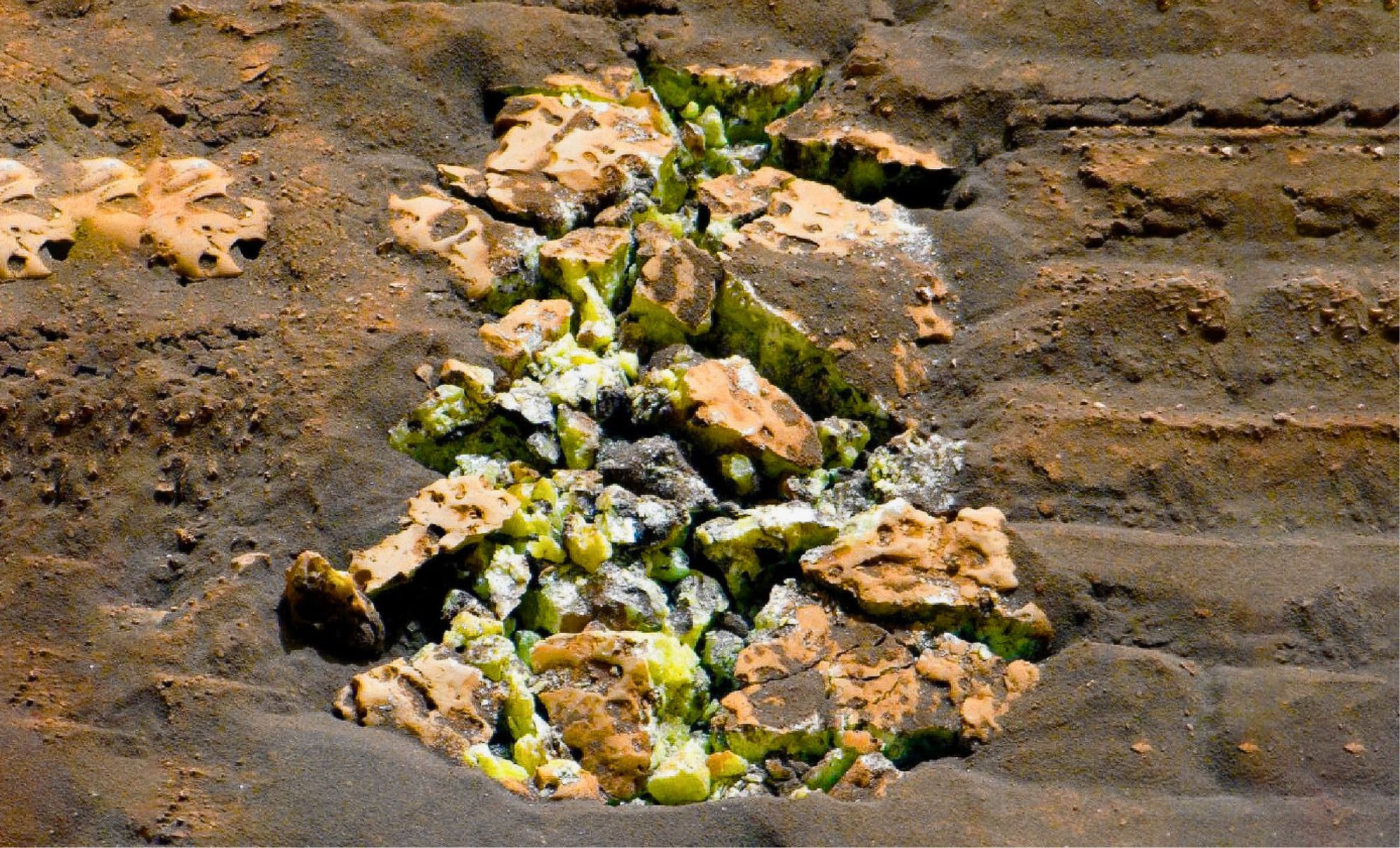
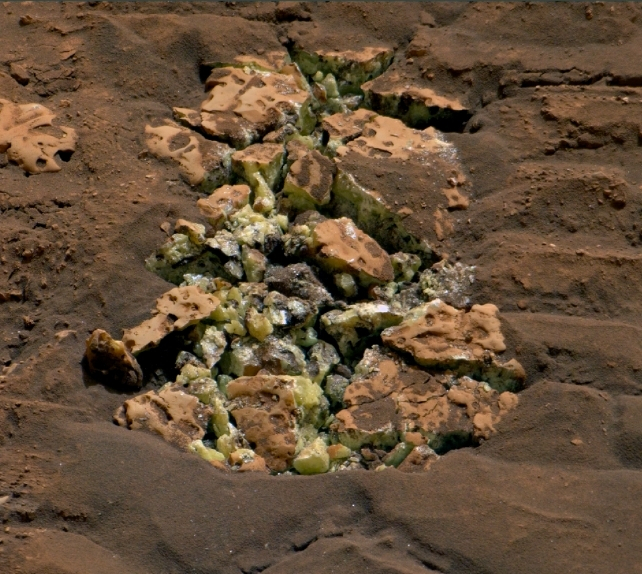
On May 30, 2024, during a routine traverse across the rugged surface of Mars, NASA’s Curiosity rover rolled over a brittle rock in Gediz Vallis Channel, cracking it open and revealing something no previous mission had detected: crystals of elemental sulfur.
The vivid yellow substance sparked immediate attention from the science team. While sulfur compounds are not new to Mars, sulfur in its elemental form—S₈—is unprecedented. This wasn’t just a novel find. The discovery occurred in a geologic zone where such a compound simply wasn’t expected.
NASA scientists were quick to point out that pure sulfur only forms under highly specific conditions—typically linked to volcanic or hydrothermal processes, which had not previously been associated with this region of Mars. That makes this find both geochemically unusual and potentially significant in the ongoing search for evidence of past habitability.
“Finding a field of stones made of pure sulfur is like finding an oasis in the desert,” said Ashwin Vasavada, Curiosity’s project scientist at NASA’s Jet Propulsion Laboratory, in NASA’s official statement.
A Yellow Crystal, a Deeper Mystery
Sulfur plays a vital role in sustaining life on Earth. Many microbial species use sulfur compounds as energy sources, especially in oxygen-poor environments such as deep-sea hydrothermal vents. That context matters on Mars, where scientists have spent decades chasing geologic signals that might once have supported life.
Elemental sulfur, in particular, forms only under narrow geochemical conditions, often involving volcanism, groundwater reactions, or low-oxygen environments. Yet no such processes had been documented in Gediz Vallis—until now.
The landscape where Curiosity made the find is known for its complexity. The Gediz Vallis Channel features layers of material shaped by catastrophic floods, landslides, and erosion. Researchers believe that water and debris flows once carved the channel, which winds down the slopes of Mount Sharp, the 5-kilometer-high mountain the rover has been climbing since 2014.
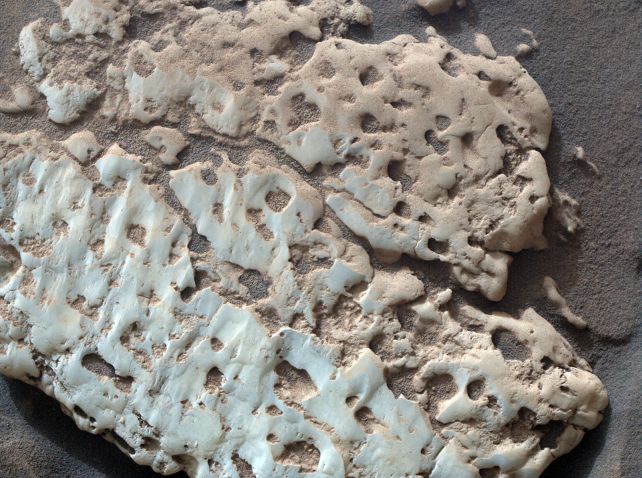
According to NASA’s detailed science update, the region’s mix of rounded river rocks and angular avalanche debris shows how violently it was reshaped over time. Nearby rocks show faint white halos—marks typically caused by long-gone groundwater interactions—suggesting sulfur may have precipitated out of chemically altered fluids. That interpretation aligns with a growing body of evidence that Mars once had a complex hydrosphere and volatile geochemical cycles.
Accidental Science, Major Implications
The sulfur crystals were discovered entirely by chance. Curiosity crushed the rock unintentionally, breaking it open while navigating the rugged terrain. Just days later, mission scientists noticed similar rocks scattered nearby, all bearing the same yellow hue. Because the original sulfur rocks were too soft for drilling, the team turned to a sturdier candidate: a rock called “Mammoth Lakes”, located in the same channel.
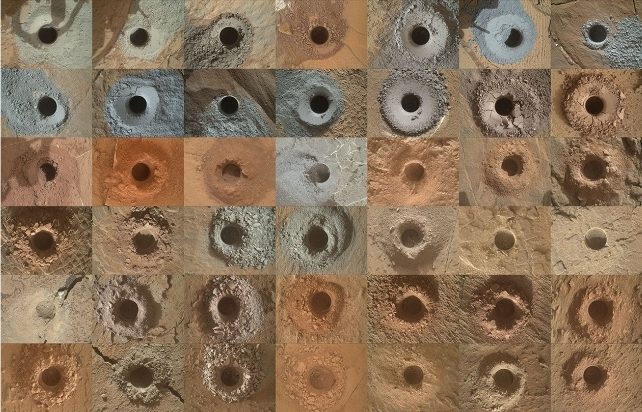
On June 18, 2024, the rover successfully drilled its 41st sample site, collecting powdered rock for internal analysis using its SAM (Sample Analysis at Mars) and ChemCam instruments. That sample is now under close review to determine whether other compounds—like phosphorus, carbon, or nitrates—coexist with the sulfur, helping researchers reconstruct how the yellow crystals formed.
The implications of this find extend beyond geology. In an Earth.com analysis, researchers emphasized the astrobiological potential of sulfur. On Earth, sulfur-driven metabolisms help support microbial life in isolated, extreme environments. While this find doesn’t indicate biology, it does suggest Mars once had chemically rich zones that may have supported energy gradients needed for microbial activity.
Sulfur, Geochemistry, and the Life Equation
In planetary science, sulfur is a powerful clue. On Earth, sulfur exists in multiple oxidation states and cycles between atmosphere, hydrosphere, and biosphere. The pure sulfur found on Mars hints at dynamic redox chemistry, which may have played out billions of years ago.
The finding also adds context to long-term data collected by Curiosity, which has been studying sulfate-bearing minerals since it arrived at this region in late 2023. Until this discovery, Mars’ sulfur inventory was understood mostly in the form of sulfates, salts formed by the evaporation of ancient water bodies. The addition of elemental sulfur, as described in ScienceAlert’s coverage, opens the door to new interpretations of how volatile chemistry shaped the planet’s surface.
The Wikipedia entry on sulfur confirms that elemental sulfur typically forms in volcanically active zones or through biological activity in reducing environments. Both scenarios are now under consideration for Gediz Vallis—though more data will be needed to narrow the possibilities.