
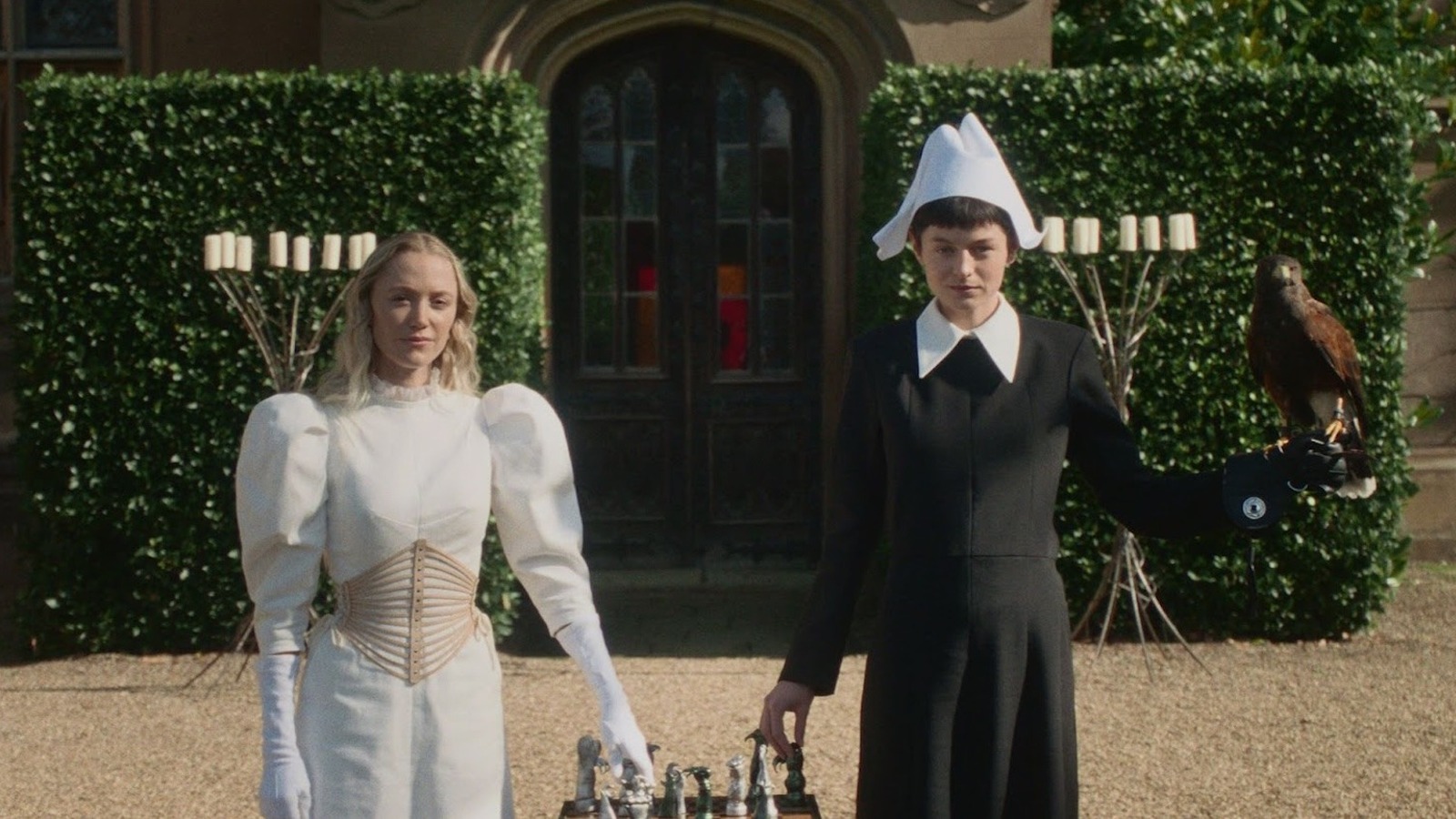
RATING : 5.5 / 10
- Appealing central romance
- Quirky sense of humor
- For a film about storytelling, the actual story is too rushed and basic
“100 Nights of Hero” is a pleasant little nothing of a movie, which is only a big problem in as much as it so clearly wants to be something. If you’re making a film about the power of stories to change the world, you most likely don’t want your own storytelling to be so flimsy. There are pleasures to be had here: Emma Corrin and Maika Monroe are cute together as secret lesbian lovers, Nicholas Galitzine’s himbo goofiness and Felicity Jones’ sardonic narration offer a decent amount of laughs, and the Wes Anderson-lite fantasy aesthetic is appealing throughout. I don’t even object to the film’s big messages being simple and obvious. But did the presentation of these messages have to feel so simple and obvious?
I have not read the graphic novel by Isabel Greenberg that writer-director Julia Jackman based the film on, so I couldn’t tell you how it compares. The film gives the impression of being cut down to the bare bones — of the promised “100 Nights,” it only really shows like 10 of them, and significant plot points, including the film’s big climax, are passed over in lines of exposition. As much as I respect the idea of sticking to 90 minutes in an age where big movies like “Marty Supreme” can exhaust their lengthy runtimes, surely there’s something left on the cutting room floor that would strengthen “Hero,” right? Maybe there is, maybe there isn’t. If the book is as bare-bones in its storytelling as the film, perhaps it works better in a more symbolic medium.
Whatever happened in bringing this story to the big screen, “100 Nights of Hero” starts off enjoyable enough in the moment, but by the time it ends, it’s easy to feel underwhelmed.
A simple story gets stretched out for many nights
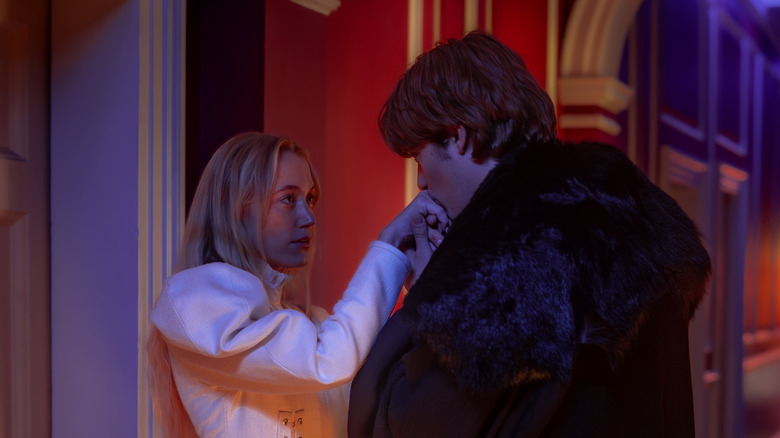
As its title implies, “100 Nights of Hero” draws loose inspiration from “One Thousand and One Nights.” The noblewoman Cherry (Maika Monroe) is caught in a sexless marriage with her husband Jerome (Amir El-Masry), who has decided to test whether she’ll be seduced by her houseguest Manfred (Nicolas Galitzine) while he’s away for the next 100 days. Cherry’s maid and “special friend” Hero (Emma Corrin) protects her from this seduction by telling a story every night.
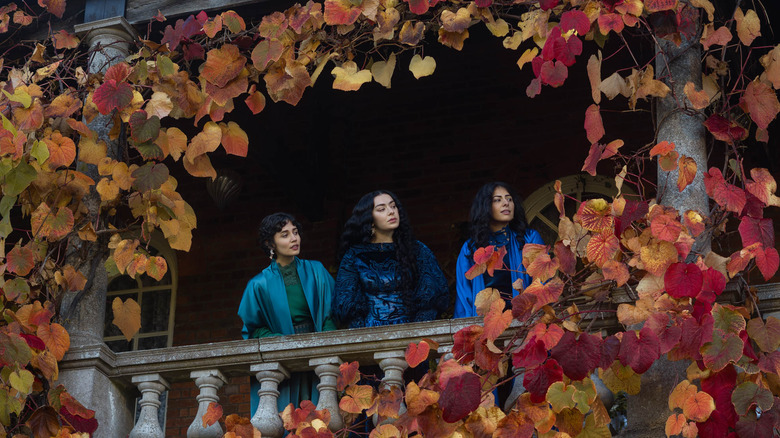
Unlike Scheherazade of “One Thousand and One Nights,” who’d start a new story immediately after ending her last, Hero only tells one story over the course of her 100 nights, about three sisters (Charli XCX, Kerena Jagpal, and Olivia D’Lima) accused of witchcraft for the crime of literacy. It’s here where the movie’s underwhelming flimsiness starts to show: Hero’s story, while interesting, does not feel like the sort of epic it would take 100 nights to tell, and it’s impossible to get that sense when we’re skipping over the vast majority of those nights anyway.
This is the first of at least nine movies starring Charli XCX to hit theaters over the next few years. I missed the premieres of two of Charli’s other films, “Erupcja” and “Sacrifice,” at the 2025 Toronto Film International Film Festival, so this is my first chance to judge whether the “brat” superstar is a talented actress or just a smart Letterboxd user with an incredible agent. My verdict: I still don’t know! Her role in “100 Nights of Hero” is to pose and look pretty in Susie Coulthard’s pretty gowns while Corrin narrates. Corrin has the meatiest dramatic role in the cast, getting across histories of yearning in small glances. Galitzine’s also a standout in a comic relief part — he’s doing basically the same shtick he did in “Bottoms,” but it’s still funny here.
Well-intended messages don’t make a great movie
The world of “100 Nights of Hero” is not our own. The characters live on a planet with three moons, ruled over by a misogynist deity known as Birdman (Richard E. Grant). Yet the fantasy elements don’t mean as much as you might want them to; the only visible difference between the “Birdman” religion and more repressive medieval forms of Christianity is that priests of the former wear beak-like hoods. I’m left unsure how much of the fantasy worldbuilding is just for the sake of cool production design and how much is fear that a more realistic historical drama would be viewed as too confrontational.
At a time when the rights of women and queer people are under such heavy attack around the world, I don’t want to be dismissive of a queer feminist film for being too “basic” when it’s clear even the most basic feminism is still somehow radical in this environment. Yet I also know good intentions alone don’t make a great movie. It’s hard to get into what makes the end of “100 Nights of Hero” so unsatisfying without getting into spoilers, but I believe there could have been a version of this film that makes its basic insights feel like more of a revolution for the characters — and one that actually shows the impacts of these revolutions rather than just telling us what happens off-screen. I’m usually a sucker for these sorts of “power of stories” stories — I was kinder than most critics toward George Miller’s messy but beautiful “Three Thousand Years of Longing” (which we also reviewed), for instance, and was a huge Neil Gaiman fan up until the point we all stopped being Neil Gaiman fans — but for all its positive virtues, “100 Nights of Hero” held little power over my imagination.
“100 Nights of Hero” opens in theaters on December 5.