There’s no question that the adaptation process from page to screen is difficult, and it’s likely very intimidating to take a book series that spans seven novels and thousands of pages and try to trim it down to fit into movies of a somewhat reasonable length. For that reason, when the “Harry Potter” novels came to the big screen, they did change a bunch of stuff … but were all of these changes good and in service of the story?
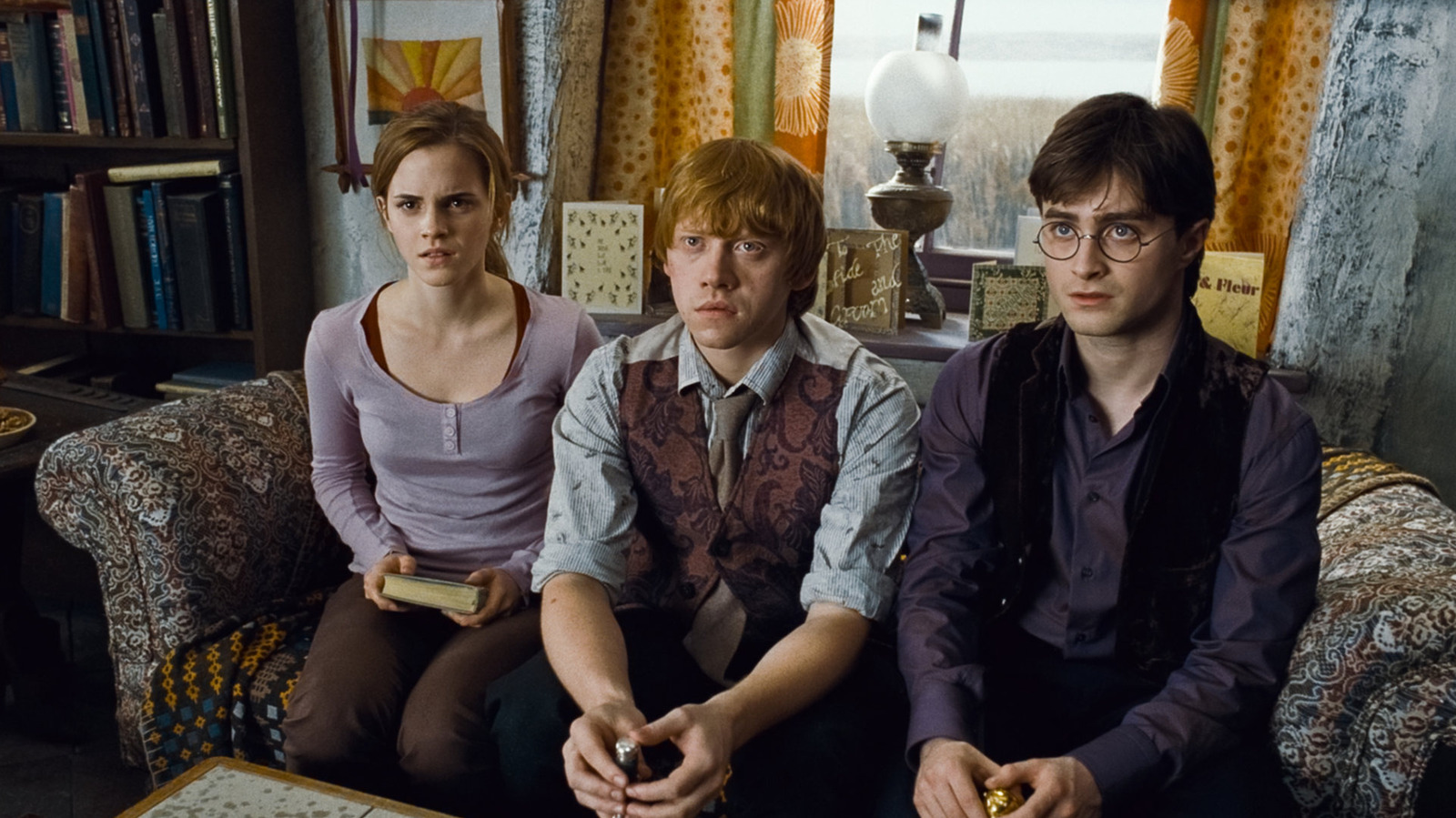
No, honestly; not even a little bit. As a refresher, the “Harry Potter” novels tell the story of the titular boy — played on-screen by Daniel Radcliffe in the role that made him famous — who survives an attack by the Dark Lord Voldemort (played in his human form by Ralph Fiennes) as a baby that kills his parents. Nobody seems to know why Harry lives and takes down Voldemort in the process, but he realizes the extent of his fame in the magical world after he turns 11 and becomes eligible to attend Hogwarts School of Witchcraft and Wizardry. Flanked by his two best friends Ron Weasley (Rupert Grint) and Hermione Granger (Emma Watson), Harry has to fight off Voldemort on a basically annual basis as the wizard keeps trying to come up with more convoluted ways to kill him; under the tutelage of powerful wizard and Hogwarts headmaster Albus Dumbledore (Richard Harris and Michael Gambon in the films), Harry eventually learns a way he can destroy Voldemort once and for all.
So what are the most egregious changes that happened in the adaptation process when it comes to “Harry Potter?” From outright character assassinations to confounding additions to unexplained plotlines, here are 10 absolutely infuriating changes in the “Harry Potter” films.
Ginny’s character is diminished and changed
In the “Harry Potter” books, Ginny Weasley — the only daughter and youngest child of the large, red-headed Weasley family — is a shy and introverted girl with a huge crush on Harry who ends up possessed and nearly killed by Voldemort’s haunted diary in the second installment, “Harry Potter and the Chamber of Secrets.” After this harrowing experience, Ginny grows up quite quickly … and by the fifth and sixth books, subtitled “Order of the Phoenix” and “Half-Blood Prince,” Ginny is a formidable and skilled witch whose spellcasting talents are only matched by her excellent flying on the Gryffindor Quidditch team. It’s no surprise, then, that during “Half-Blood Prince,” Harry develops feelings for Ginny, and their relationship is genuinely one of the better parts of the later novels.
This is not true in the “Harry Potter” movies, where Ginny is played by Bonnie Wright and is … nondescript at best and useless at worst. Somehow devoid of all the spunk and personality she shows off in the books is absolutely gone, and unfortunately for Wright, her chemistry with Daniel Radcliffe is basically non-existent (all of the romantic scenes between them are borderline painful). Add in a bunch of irritating cuts and changes — like someone else suggesting the rebel group name of Dumbledore’s Army in “Order of the Phoenix” instead of Ginny, and the way her first kiss with Harry happens differently between the “Half-Blood Prince” book and film — and you’ve got a much worse character. Seriously, are we supposed to believe that the movie version of Ginny spent her childhood breaking into the family home’s shed, stealing her brothers’ broomsticks, and practicing while they weren’t looking?
Prisoner of Azkaban cut a really major plotline about Jams Potter
The Marauder’s Map is one of Harry’s most valuable magical possessions in the “Harry Potter” books, but he doesn’t get ahold of it until the third book and film, subtitled “Prisoner of Azkaban.” After he’s not allowed to go to Hogsmeade on weekend trips with all his friends (because his awful aunt and uncle didn’t sign the permission slip), Ron’s twin brothers Fred and George Weasley (played by real-life twins James and Oliver Phelps) give Harry a gift: this magical map, which shows the movements of every single person within the boundaries of Hogwarts. This is how Harry gets the map in both the book and the film, so where’s the big change?
The issue with the Marauder’s Map in the “Prisoner of Azkaban” film is that its origin story is never explained on-screen, but we learn it in the book … and it’s vital. Throughout “Prisoner of Azkaban,” Harry is led to believe that escaped convict and murderer Sirius Black (Gary Oldman in the films), who’s recently escaped from the wizard prison Azkaban, is hunting him down. As it turns out, Sirius, Harry’s godfather, isn’t looking for Harry; he’s looking for Peter Pettigrew (Timothy Spall), his Hogwarts friend who betrayed Harry’s parents Lily and James to Voldemort, caused their deaths, and used his powers as an Animagus to turn into a rat and hide in plain sight as Ron’s pet. The point here is, though, that James, Sirius, Peter, and their fourth best friend Remus Lupin, played by David Thewlis as an adult, created the Marauder’s Map, and the movie never bothers to reveal this.
Half-Blood Prince sacrifices Voldemort’s backstory to let everyone do kissing
By the time “Half-Blood Prince” hit theaters in 2009, the “Harry Potter” fanbase was very firmly established, and the millions of fans of the franchise were a massive built-in audience for the movies. That’s why it feels particularly irritating that director David Yates and screenwriter David Kloves cut most of the book’s plot and replaced it with … teenage romance plotlines.
In the book, Harry and Dumbledore start meeting for private “classes” together to learn more about Voldemort’s life and, eventually, his Horcruxes (the magical artifacts containing pieces of his very soul that keep him from being killed outright while they exist). Through these “lessons,” Harry and Dumbledore acquire memories from people who encountered Voldemort as a child, teenager, and beyond; they even go back to a time before his birth and learn about his mother Merope, Muggle father Tom Riddle Sr., and genetic connection to Hogwarts founder Salazar Slytherin. Plus, there’s an important flashback to an adult Voldemort asking Dumbledore for the post of Defense Against the Dark Arts teacher at Hogwarts, which explains why nobody ever held the job for longer than a year; Voldemort put a curse on the position.
All of that — and more! — is omitted from the film version of “Half-Blood Prince” in favor of letting characters like Ron and his annoying first girlfriend Lavender Brown (Jessie Cave) smooch almost non-stop. There’s another infuriating change to “Half-Blood Prince” we’ll discuss in a bit, but this one is really bad, because the Voldemort lore is so important.
The very stupid transformation of Ron Weasley
Ron Weasley might be one of the three main characters of “Harry Potter,” but the movies do him so dirty. Screenwriter Steve Kloves rather infamously and regularly said that Hermione Granger was his favorite character, and unfortunately, any growth Hermione experiences throughout the “Harry Potter” movies is largely at Ron’s expense. A lot of this happens in the third movie, “Prisoner of Azkaban,” perhaps most notably in a moment where Hermione tells Sirius that if he wants to kill Harry, he’ll have to kill all of them. In the books, not only is this Ron’s line, but he drives the point home by standing on a broken leg to deliver it.
This seems like small potatoes in the grand scheme of things, but it’s really not … because it’s just one of the many ways that Ron in the movies is dumber, meaner, and worse than Ron in the books. In a moment in the “Prisoner of Azkaban” book, Ron yells at Potions master Severus Snape (the late, great Alan Rickman on screen) when he makes Hermione cry in class; in the movie, Snape still makes Hermione cry by calling her an “insufferable know-it-all,” and Ron agrees with him. Yes, Ron is funny in the books and is mostly treated like comic relief in the movies, but in the books, he’s also brave, smart, savvy, and good in a crisis. You wouldn’t know it from watching him on-creen, with all due respect to Grint.
Peeves the Poltergeist never terrorizes Hogwarts in the movies
Hogwarts School of Witchcraft and Wizardry is a bizarre and wonderful place. The subjects of all its paintings are conscious beings of some kind, the staircases move at random, and in the books, it plays host to a poltergeist alongside four ghosts who represent each Hogwarts house. Those ghosts — the Bloody Baron, Nearly-Headless Nick, the Gray Lady, and the Fat Friar, who represent Slytherin, Gryffindor, Ravenclaw, and Hufflepuff, respectively — are seen in the films, and Nick and the Gray Lady are portrayed by pretty famous actors (Nick is played by John Cleese, and the Gray Lady by Kelly MacDonald). So what about Peeves the poltergeist?
Though Peeves was originally supposed to appear in at least the first “Harry Potter” movie, “The Sorcerer’s Stone” — and was played by British comedian Rik Mayall — his scenes ended up on the cutting room floor. (Mayall passed away in 2014, but the films had already concluded by then.) While it makes sense to cut Peeves if you must cut a character in adaptation — his storylines don’t usually have that big of an effect on the overall narrative — he’s a really delightful character in the books, and his dynamic with the cantankerous Hogwarts groundskeeper Argus Filch, portrayed by David Bradley in the film franchise, is also a highlight. Again, while it makes sense to cut Peeves if it’s absolutely necessary, it’s still disappointing that he didn’t even play a small role in the movies.
The way Voldemort dies in Deathly Hallows — Part 2 is absurd
In the “Harry Potter” books and movies, we learn that throughout his life, Voldemort created a whopping seven Horcruxes, which, again, each prevent him from being killed. The specifics here are very upsetting — each one of these Horcruxes was created through the act of murder — but the gist is that, in order to actually kill the Dark Lord, Harry, Ron, and Hermione must hunt down and destroy each Horcrux. Because these magical artifacts can only be truly destroyed by rare items like basilisk fangs — essentially, items that render an object beyond repair — or the Sword of Gryffindor, which happens to be imbued with basilisk venom, this is very difficult.
Finally, though, Harry destroys all of Voldemort’s Horcruxes with Ron and Hermione’s help, including one residing within Harry’s very own soul — which he destroys by offering himself as a willing sacrifice to Voldemort and briefly dying before returning to life — and it’s time for him to take Voldemort down. In the book, the fact that all of his Horcruxes have fallen means that Voldemort, like his enemies, is a mere mortal, and when Harry uses a Disarming Charm to reverse Voldemort’s Killing Curse back onto the Dark Lord, he falls as anyone else would. “Tom Riddle hit the floor with a mundane finality, his body feeble and shrunken, the white hands empty, the snakelike face vacant and unknowing,” the book reads.
In the movie, though, Voldemort doesn’t die in any way a mortal man ever has. Instead, he explodes into evil confetti. This is all very cinematic, but it goes directly against the whole point of his uneventful death in the book: he’s just mortal and fallible now, not some mythical creature.
Harry’s disposal of the Elder Wand is missing something crucial
In the book version of the final “Harry Potter” installment, “Harry Potter and the Deathly Hallows” — which was ultimately split into two films released in 2010 and 2011 — we’re formally introduced to the Elder Wand, one of three Deathly Hallows of lore (with the other two being the Resurrection Stone and the Cloak of Invisibility). Even though the Deathly Hallows are sort of a crackpot conspiracy theory even by magical standards, Harry happens to own a truly impenetrable Cloak of Invisibility, and before long, he, Ron, and Hermione learn that not only is the Elder Wand very real, but it belonged, for years, to Albus Dumbledore.
The path of the Elder Wand in “Deathly Hallows” is pretty convoluted, but the point is this: Voldemort steals it from Dumbledore’s tomb and realizes it’s not working as effectively as it should for him because he’s wrong about its true master. In the book, Harry outlines it for Voldemort and traces it back to the moment that Draco Malfoy (Tom Felton in the films) Disarmed Dumbledore, making him the true master of the Elder Wand. In turn, Harry Disarmed Malfoy, transferring the ownership of the wand to him.
Despite being the true master of the wizarding world’s most powerful wand, Harry, in the book, uses it to repair his own broken wand and buries it with Dumbledore. In the movie, he … breaks it and tosses it away. Not only is this an insane move, but what about his broken wand?! This change makes no sense at all, and it actually stops Harry from reuniting with his beloved wand that chose him years prior.
Why would you burn down the Burrow?
Introduced in both versions of “Chamber of Secrets,” the Burrow is the cozy, ramshackle home of the decidedly not wealthy Weasley family, and whenever Harry spends time there, it’s clear that he feels comfortable, loved, and at home (in stark contrasts to his stressful and cruel time spent with his Muggle relatives, the Dursleys). It’s probably for this reason, then, that “Half-Blood Prince” director David Yates and Steve Kloves decide to take yet another thing away from Harry when they burn down the Burrow in the film version of this story, but narratively, this is an infuriating change that makes no sense.
Not only does the Burrow remain intact in the books, but in the very next installment, the wedding of eldest son Bill Weasley (Domhnall Gleeson) and Harry’s former Triwizard competitor Fleur Delacour (Clémence Poésy) takes place at the family home, at which point it’s rebuilt as if nothing happened at all. So why add this? “Half-Blood Prince” is the least action-packed “Harry Potter” book because of the way it provides Voldemort’s backstory, and apparently, Yates and Kloves thought the film needed a big action setpiece. It didn’t.
Neville Longbottom loses his full, devastating backstory
There are a lot of sad backstories and tragic details in the “Harry Potter” universe, but few are quite as gutting as Neville Longbottom’s. Played in the movies by Matthew Lewis, this quiet, accident-prone boy is sort of a punchline in both the early “Harry Potter” books and movies; even though he later reveals himself to be a seriously skilled wizard, Neville’s anxiety and stage fright often get in his own way, leading to various magical mishaps. What we learn about Neville in the book version of “Order of the Phoenix,” though, is heart-breaking, and explains why he’s often so worried and nervous (in a way).
When Ron’s dad is attacked by Voldemort’s snake, he ends up in St. Mungo’s Hospital for Magical Maladies and Injuries … and while there, Harry, Ron, Ginny, and Hermione run into Neville visiting his parents alongside his grandmother Augusta Longbottom (who raised him for most of his life). Frank and Alice Longbottom, Neville’s parents, were part of the resistance group known as the Order of the Phoenix alongside Harry’s parents Lily and James, but when Frank and Alice were captured by Voldemort’s Death Eaters, those Death Eaters, including Bellatrix Lestrange (played by Helena Bonham Carter in the films), tortured the couple so badly that they became permanently mentally incapacitated. Not only that, but Neville, born mid-summer to parents who defied Voldemort thrice, could have become the Boy Who Lived instead of Harry if Voldemort hadn’t “chosen” Harry to mark as his equal. Neville’s backstory is heartbreaking, truly dark, and nowhere to be found in the Harry Potter movies.
The Barty Crouch issue in Goblet of Fire is truncated to the point of nonsense
In the fourth “Harry Potter” book and movie, “Goblet of Fire,” the person who orchestrated Harry’s participation in the dangerous, deadly Triwizard Tournament turns out to be not Voldemort himself but one of his most dedicated acolytes, Bartemius Crouch Jr. (played by David Tennant). After kidnapping former Auror and Hogwarts’ new Defense Against the Dark professor Mad-Eye Moody (Brendan Gleeson), Crouch Jr. impersonates the one-eyed wizard throughout Harry’s fourth year at school, only to reveal himself as the mastermind behind the plan at the end of the story.
Barty Crouch Jr. is in the movie, yes, but the reason behind his appearance — faking his own death to escape from Azkaban after his mother died of grief, his involvement with Voldemort, and his home imprisonment at the hands of his powerful Ministry official father Bartemius Crouch Sr. (Roger Lloyd Pack) — is omitted almost entirely, abbreviating his entire story to the point of nonsense. In the book, the younger Crouch man kills his own father in service of Voldemort and ensures that Harry “win” the Tournament so he can be taken, via a secret Portkey, directly to Voldemort; again, this is how it happens in the movie too, but the “why” gets seriously lost because of how much of this character’s story is cut out. The sad, harrowing story of the entire Crouch family is a highlight of the “Goblet of Fire” book, and it’s a total shame that it didn’t make it onto the big screen.