
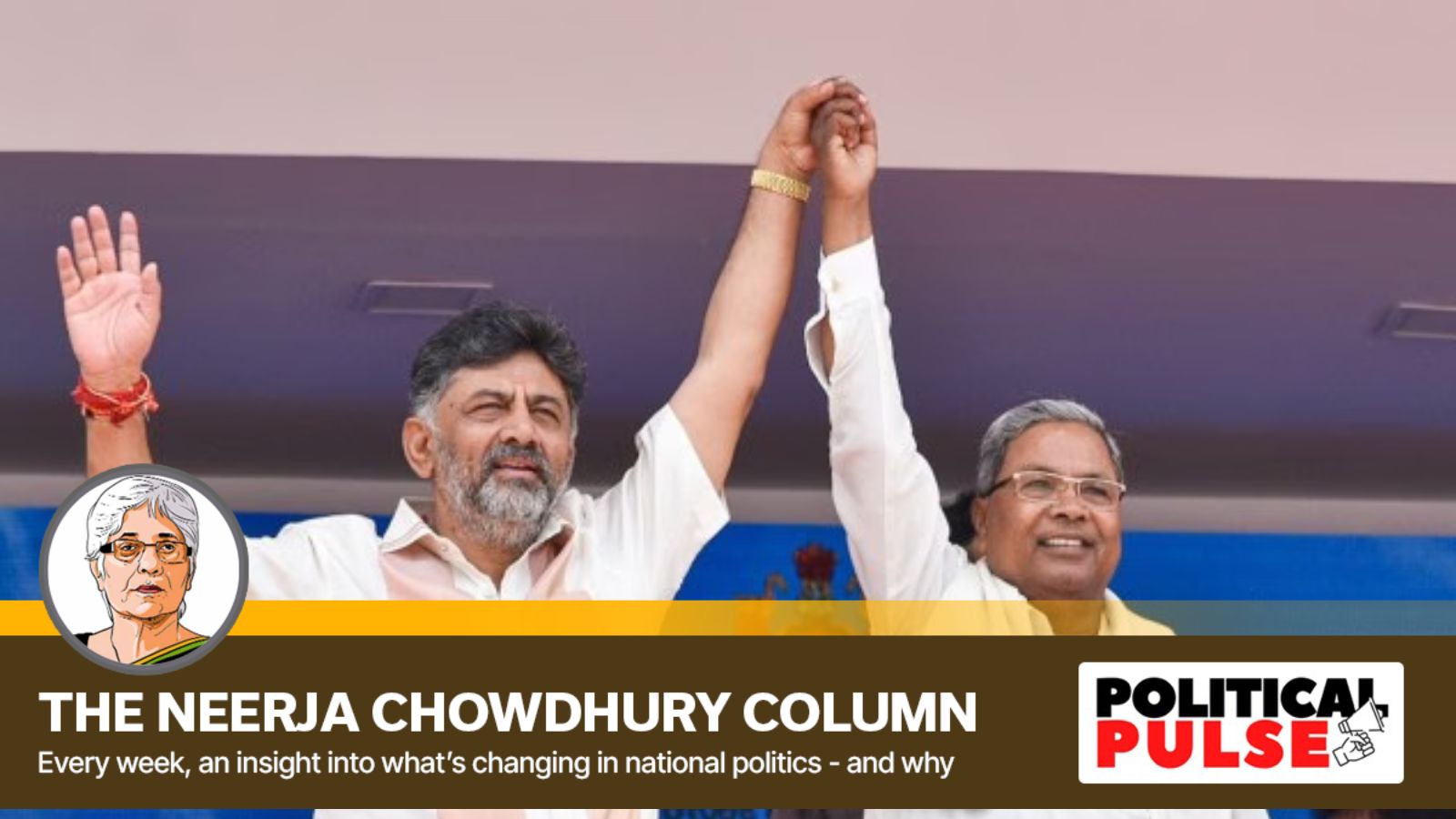
One of the tantalising questions thrown up by the recent Karnataka potboiler is why Deputy Chief Minister D K Shivakumar chose to up the ante to replace CM Siddharamaiah at this particular juncture.
DKS, as Shivakumar is popularly referred to, is too much of an organisation man not to know that Siddharamaiah has the support of a majority of MLAs and that unless the high command rooted for him, Siddaramaiah would manage to get the better of him, which he seems to have done in the first round.
The developments in Karnataka have to be seen in the context of Prime Minister Narendra Modi’s recent statement that the Congress would split soon. While the states going to the polls in 2026 are important for the BJP, there is no other state as important for the party as Karnataka, which holds the key to its plans for the South. The BJP, along with ally Janata Dal (Secular), is confident of winning the next electoral bout in Karnataka and the PM is learnt to stay in close touch with JD(S) patriarch and former PM H D Deve Gowda.
Realising that the 2028 round may be difficult, it was possibly a “now or never” moment for DKS to mount pressure on the high command to keep its “word” on a power-sharing pact allegedly struck when the party came to power in the state in 2023. The Deputy CM is believed to have the support of 56 of the 135 Congress MLAs, but if the high command gives its nod, most will fall in line. Few would want to bring on an election. DKS would also know that while he can bring down the Congress government, to try and form a government with the BJP’s help, and be at its mercy, would be risky.
Having helped the party with funds over the years, not just in Karnataka but also in other states, Shivakumar may think he can encash the leverage he has enjoyed with the high command. He chose to strike when the party leadership was at its most vulnerable: soon after Bihar exploded in its face, deepening the demoralisation in the rank and file and raising questions about Rahul Gandhi’s leadership.
Siddaramaiah’s strength
Shivakumar has to contend with Gandhi, the Leader of Opposition and most powerful member of the high command, who has been batting for Siddharamaiah. Gandhi’s “backward” class politics built around a caste census is in sync with what Siddharamaiah stands for. Seen as a mass leader with a clean reputation — though this has been dented this term with charges made against his wife and a lacklustre record of governance — the CM’s credentials are of an OBC (a Kuruba) who represents the AHINDA coalition of OBCs, Dalits, and minorities that has stood the Congress in good stead over the decades. The AHINDA group is not a monolith at present and is riddled with divisions.
So, when Congress general secretary (organisation) K C Venugopal, seen as Gandhi’s eyes and ears, urged the two sparring leaders to meet, Siddharamaiah promptly invited Shivakumar to breakfast at his home instead of going to Shivakumar’s home for lunch, which might have been seen as a sign of weakness. The one-hour “peace breakfast” at the CM’s official residence, “Cauvery”, has led to a reprieve for both the CM and the beleaguered high command.
Story continues below this ad
For the moment, no change of guard is taking place in Bengaluru, as both Siddaramaiah and Shivakumar have vowed to do the high command’s bidding. It remains to be seen whether the CM will make way for his junior colleague after January 7, when he becomes the longest-serving CM, overtaking Devraj Urs — this is cited as one of his dreams — or he stays on till March, when presenting the Budget as a Finance Minister will present him with the chance to shore up his popularity. Siddaramaiah may also look to buy more time to “implement” policies based on the Caste Census, a dream project of Gandhi. Or Siddaramaiah may even look to push things back till 2028, when the next elections are due.
This is precisely what happened in Rajasthan, where Ashok Gehlot repelled Sachin Pilot’s efforts to take over as CM halfway through the term. Siddaramaiah, at least for now, is not making Gehlot’s mistake of getting on the wrong side of the Gandhis. The CM knows it won’t be easy for the high command to remove the party’s only OBC CM unless it is of his own volition.
Karnataka is symptomatic of what ails the Congress today. There is a weakening of the high command, given the party’s inability to win elections. It is unable to ensure its writ runs. It could not do so in either Rajasthan or Chhattisgarh (where a rotational arrangement was promised to T S Singh Deo when Bhupesh Baghel took over in 2018). But the consequences of the open war are there for all to see: in both states, the party sits in the Opposition today.
Karnataka is also a reminder that the two-and-a-half-year rotational formula of chief ministership is a non-starter. It has only served to intensify factionalism in the Congress, a way to wriggle out of an uncomfortable situation that leaves behind an avoidable trail. In contemporary times, rotational CM-ship worked only once: when PDP’s Mufti Mohammed Sayeed made way for the Congress’s Ghulam Nabi Azad as CM of Jammu and Kashmir in 2005, halfway into his term.
Story continues below this ad
In Karnataka, the Congress did not need an open fight between its top two leaders in full public gaze, which is the surest way of creating uncertainty about the government’s future. Karnataka is the country’s knowledge capital, an IT hub, home to multinational corporations and startups, where people aspiring to create a modern, forward-looking state live. And for the Congress, it is a bulwark against the BJP’s entry in the South, which, if it happens, will give the ruling party the foundation to extend its dominance to the entire country.
(Neerja Chowdhury, Contributing Editor, The Indian Express, has covered the last 11 Lok Sabha elections. She is the author of How Prime Ministers Decide.)