
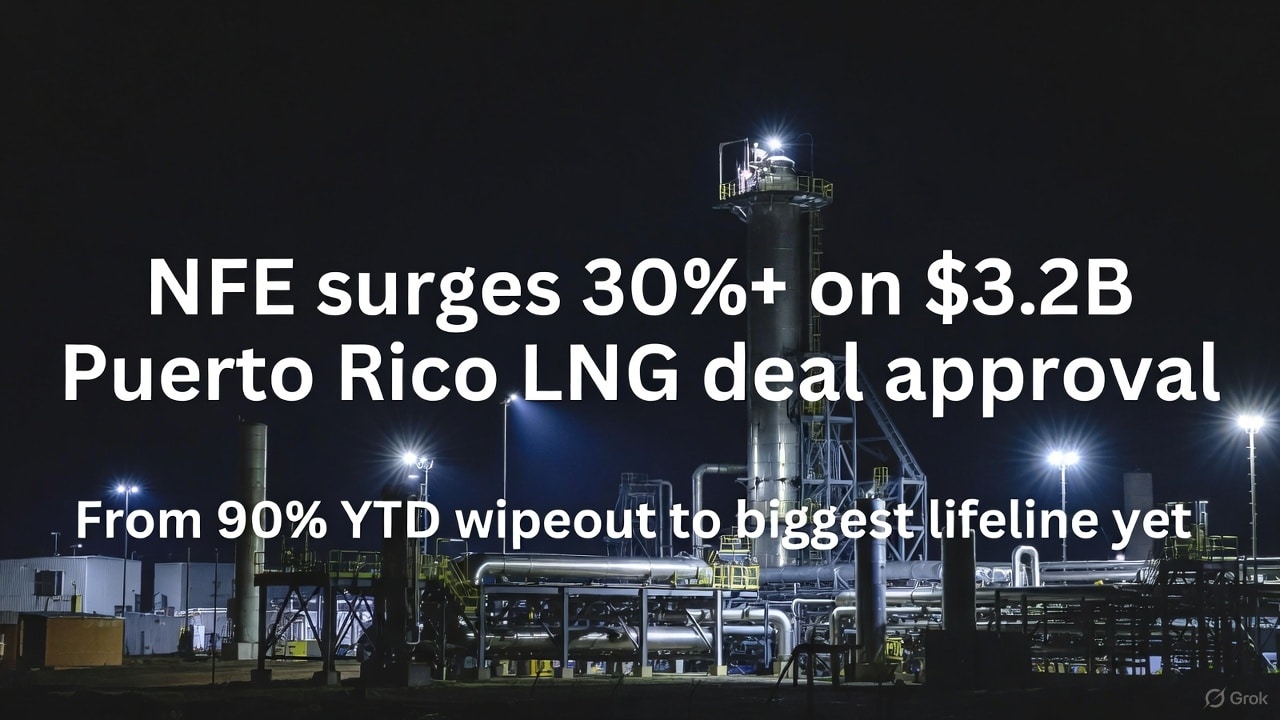
New Fortress Energy Inc. (NASDAQ: NFE), a pioneer in integrated gas-to-power infrastructure, has endured a brutal year. Shares have plummeted over 90% year-to-date, closing at $1.22 on November 30 amid a cascade of impairments, asset sales, and covenant waivers that underscored the company’s precarious financial position. Yet, on December 1, 2025, the stock surged more than 25% in early trading (reaching highs around $1.62) following conditional approval from Puerto Rico’s Financial Oversight and Management Board (FOMB) for a revised $3.2 billion, seven-year LNG supply agreement. This scaled-back deal, contingent on securing a backup supplier and enhancing port access, represents a pivotal de-risking event in a market where NFE has long been a high-stakes bet on rapid LNG deployment.
While the Puerto Rico approval has ignited short-term optimism—evidenced by volume exceeding 25 million shares and a short float of 36.84%—it serves primarily as a catalyst underscoring a deeper, underappreciated fundamental shift. This article advances a forward-looking investment thesis: New Fortress Energy’s aggressive debt restructuring, combined with its modular Fast LNG technology, will enable it to capture disproportionate market share in the emerging markets’ LNG-to-power segment by 2028, driving a multi-fold valuation re-rating as global LNG demand accelerates 1.5% annually through 2030. This thesis, grounded in NFE’s unique operational agility rather than broad energy tailwinds, posits a path to normalized multiples akin to peers like Cheniere Energy, potentially valuing the company at $2-3 billion in enterprise value on a distressed basis (current EV ~$9.25 billion per recent metrics, but with significant deleveraging potential). We explore this through qualitative precedents, quantitative benchmarks, and a rigorous risk assessment, drawing on industry data and historical analogues.
The Core Thesis: Modular Innovation as the Turnaround Engine
New Fortress Energy’s resurgence hinges on its proprietary Fast LNG platform—a floating, modular liquefaction system that compresses project timelines from years to months, bypassing the multi-billion-dollar sunk costs of traditional terminals. This technological edge, often overshadowed by NFE’s debt woes, positions the company to outpace competitors in high-growth, underserved markets like the Caribbean, Latin America, and Southeast Asia, where power grids crave quick, reliable LNG conversions. As global LNG export capacity surges by over 300 billion cubic meters per year (bcm/yr) from 2025-2030—led by U.S. and Qatari expansions—the IEA forecasts a net supply increase of 250 bcm/yr, easing prices and spurring demand growth to 380 bcm by decade’s end. NFE’s model thrives here: It not only supplies LNG but integrates it into turnkey power plants, creating sticky, long-term revenue streams.
The Puerto Rico deal exemplifies this without dominating the narrative. By mandating a third-party backup and open port access, it mitigates past monopoly critiques while validating NFE’s infrastructure playbook—deploying floating storage regasification units (FSRUs) to deliver 1.5-2.0 million tonnes per annum (mtpa) of LNG for baseload power. This approval extends NFE’s runway to December 15 for noteholder forbearance, aligning with recent credit amendments that suspend debt covenants through Q4 2025. Critically, it underscores the thesis by providing $450-500 million in annual EBITDA visibility starting 2026, funding further Fast LNG rollouts. Unlike generic LNG exporters, NFE’s vertical integration—controlling terminals, ships, and power assets—yields higher margins (projected 40-50% on power contracts) in regions where grid reliability commands premiums.
Historical Analogues: Lessons from LNG’s Turnaround Playbook
To validate the thesis, consider precedents where distressed LNG firms leveraged restructuring and contract wins for explosive growth. Cheniere Energy (NYSE: LNG), NFE’s closest peer, emerged from Chapter 11 in 2009 with $3.5 billion in restructured debt and no operating assets. By 2016, long-term contracts for its Corpus Christi Phase 1 (2.2 mtpa) catalyzed a 600% stock surge, with EBITDA climbing from negative to $4.5 billion as U.S. LNG exports boomed 10x. Cheniere’s EV/EBITDA multiple expanded from 8x to 12x, reflecting de-risked cash flows— a trajectory NFE could emulate if Puerto Rico and pending Brazil/Mexico deals (e.g., CELBA 2’s 624 MW “first fire” in October 2025) deliver 10-12 mtpa by 2028.
Another analogue is Golar LNG (NASDAQ: GLNG), which in 2016-2018 restructured $1.2 billion in debt amid a 70% share drop, then pivoted to floating LNG (FLNG) vessels. Post-Hilli contract approval (1.2 mtpa), Golar’s backlog doubled to $2.5 billion, shares tripled, and multiples normalized to 7x forward EBITDA.
Quantitative Underpinnings: Valuation and Metrics in Focus
NFE’s trailing metrics scream distress: TTM revenue of $1.78 billion yields a net margin of -72.94% and ROE of -96.21%, dragged by $699 million in Q2 2025 impairments. Yet forward indicators flash green: Consensus EPS improves to -$1.43 in 2026 from -$4.93 TTM, with revenue projected at $2.5 billion as Puerto Rico ramps.
| Metric | NFE (Current) | Cheniere (Post-2016) | Excelerate (2025 Avg) | Implied NFE Target (2028) |
|---|---|---|---|---|
| EV/Sales | 5.28x | 1.2x | 2.5x | 1.0x |
| EV/EBITDA | N/A (Neg) | 10x | 8x | 9x |
| Debt/Equity | 9.35x | 4.5x | 2.0x | 3.5x |
| ROIC | 1.36% | 15% | 12% | 12% |
Sources: Finviz, Yahoo Finance, company filings.
Navigating Risks: Counterarguments and Mitigants
Skeptics will counter that NFE’s turnaround is a mirage—high leverage (current ratio 0.17) invites default, while regulatory hurdles (e.g., final FOMB nod) could unravel gains. Yet analogues mitigate: Cheniere navigated 2008-2009 defaults via similar waivers, emerging with 90% contract coverage that buffered volatility. NFE’s recent Jamaica sale ($1.06 billion to Excelerate) deleveraged by 15%, and Fast LNG’s modularity dodges capex overruns.
Forward Outlook: Catalysts and Vigilance for Investors
New Fortress Energy stands at an inflection: The Puerto Rico greenlight, layered atop Brazil’s CELBA expansions (including the 624 MW CELBA 2 and 1.6 GW PortoCem for a total 2.2 GW at Barcarena) and Mexico’s Altamira hub, signals a backlog inflection to $5-6 billion by mid-2026. Watch for Q4 earnings (expected December 5, 2025) confirming covenant compliance and Fast LNG FID announcements—these could propel shares toward $3.00.
Sophisticated investors should monitor debt maturities (March 2026) and LNG pricing (JCC index below $10/MMBtu as a green flag). In an era of energy transition, NFE’s bet on resilient, affordable power isn’t just survival—it’s a blueprint for outsized returns in LNG’s next chapter.
Additional reading: IEA Gas 2025 Report, Cheniere SEC Filings.