
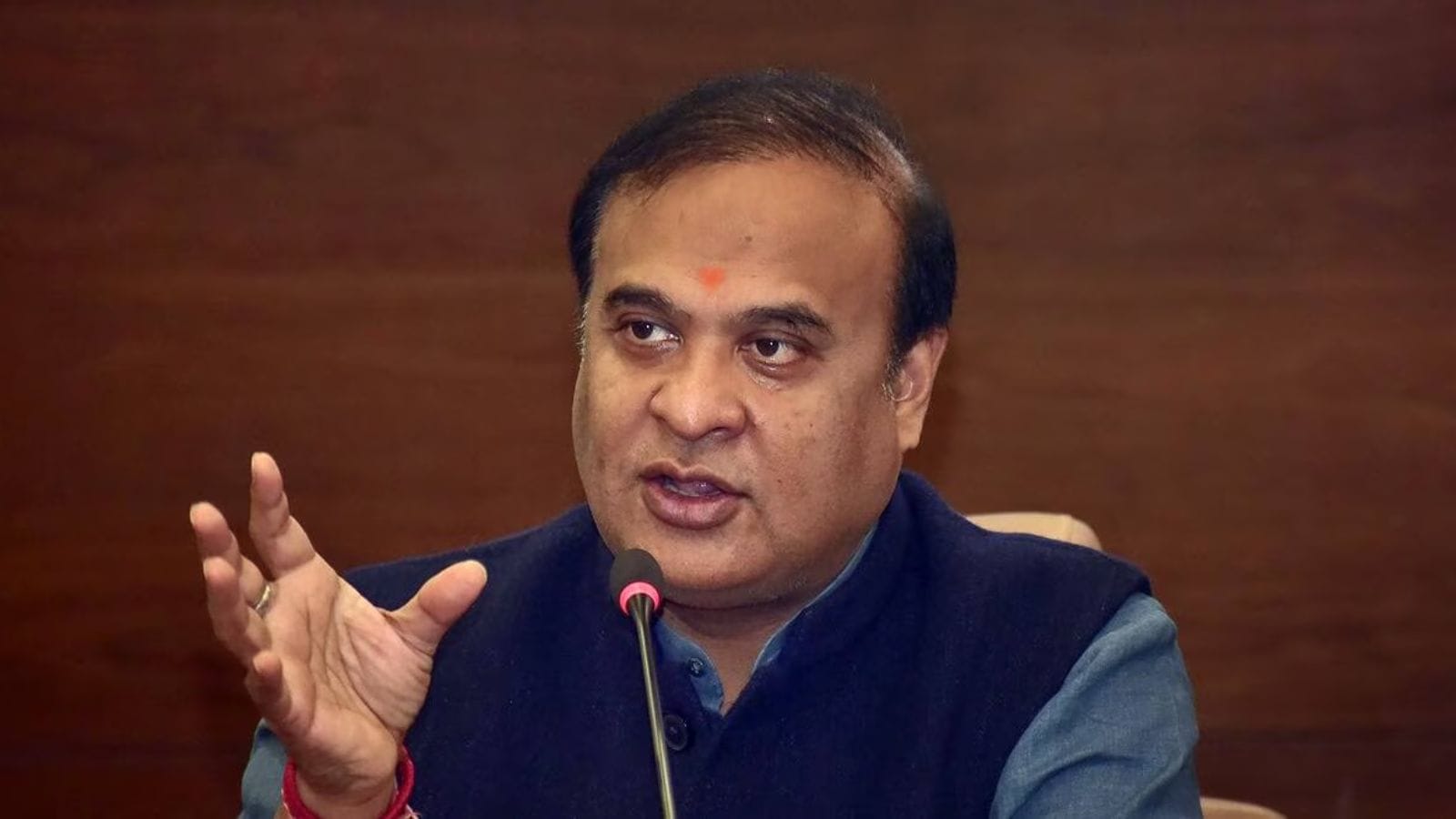
A Group of Ministers, constituted to frame recommendations on the demand by six communities in Assam for Scheduled Tribe status, tabled its report in the state Assembly on Saturday, saying that it finds “full justification” for including these communities in the ST list and recommending the creation of a distinct category of ST (Valley).
Existing Scheduled Tribes in Assam have opposed the demand of the six communities, and on Saturday, protesting students stormed the Bodoland Territorial Council secretariat building.
The report was tabled late Saturday evening, at the tail end of the winter session of the Assembly, amid an outcry by Opposition MLAs demanding a discussion on the report. This demand was turned down by Speaker Biswajit Daimary, and the session was adjourned immediately after the report was tabled.
A couple of hours earlier, hundreds of students in Kokrajhar, the headquarters of the Bodoland Territorial Council (BTC), stormed the BTC secretariat and damaged chairs, desks and other infrastructure. The protesting students demanded that the six communities not be included in the ST list.
The Bodos are a Plain tribe and are Assam’s largest ST community.
The six communities that have long been agitating for the grant of ST status are the Tai Ahoms, tea tribes or Adivasis, Moran, Motok, Chutia and Koch-Rajbongshi. They are currently part of the state’s Other Backward Classes list and comprise around 27% of Assam’s population.
Organisations of all six communities have been holding mass demonstrations in the past two months, building pressure on the government ahead of the upcoming elections in the state. Ahead of the 2019 Lok Sabha election, a Bill proposing to include these communities in Assam’s ST list had been introduced in Rajya Sabha, but was not discussed or passed. Based on Home Ministry directions, the Group of Ministers was constituted that year, and reconstituted twice since, “to determine quantum of reservation for six communities in the State, suggest revised quantum of reservation for OBCs after creation of a new ST category in Assam and measures ensuring full safeguard to protect the interests, rights and privileges of the existing Scheduled Tribes of Assam.”
The report submitted by the Group of Ministers on Saturday will be forwarded to the central government.
Key recommendations
The key recommendation of the report is the creation of a “three-tier classification” of Scheduled Tribes in Assam “to protect the political rights and socio-economic and educational interests of existing ST communities, while accommodating the six communities”.
The ST communities in Assam are currently categorised as ST (Plains) with 10% reservations and ST (Hills) with 5% reservation. The report recommends the creation of a distinct ST (Valley) category for the Ahom, Chutia, tea tribes and Adivasis, and Koch-Rajbongshis (excluding those residing in the undivided Goalpara region). It recommends that the Morans, Motoks and Koch Rajbonghis in the unidivided Goalpara — subject to an NOC from the BTC for parts of undivided Goalpara under the BTC — be included in the ST (Plains) list saying that they possess “clear ethnographic characteristics, identifiable settlement areas and limited overlap with other social groups” and that their inclusion does not face as much opposition from the existing ST (Plains) communities.
The report states that an ST(Valley) category so created will have separate reservation quotas with distinct rosters and vacancy registers for all state government recruitment and educational institutions, and that “existing ST(P) and ST(H) quotas will remain fully protected”.
However, it recommends that in the case of central government reservations, all these communities compete under the common ST pool, as there is a single national ST list.
It recommends that Lok Sabha constituencies that are currently covering Sixth Schedule areas — Kokrajhar and Diphu — be permanently reserved for the existing ST(P) and ST(H) respectively, through a constitutional amendment. It states that additional seats will have to be reserved to the Parliament for ST(V) since the number of reserved seats will increase “in view of the fact that a large number of people will now be recognised as Scheduled Tribes in the state of Assam”.
Interim arrangements
The report also makes a set of recommendations for interim arrangements while the Union government considers its recommendations. This includes sub-categorisation of the existing OBCs in the state within the 27% OBC quota into seven categories — one for each of the six communities in question and one for the other OBCs.
It recommends a comprehensive enumeration and socio-economic survey for this purpose, such that each of these sub-categories be entitled to state government reservation as per their populations “on a pro rata basis”. Among other things, it also recommends that reservation be provided to OBC communities in the local bodies of Assam, including panchayats and ULBs, and that the state government enact a law preventing the transfer of the land of these six communities, as well as the existing STs, to people outside their community.