
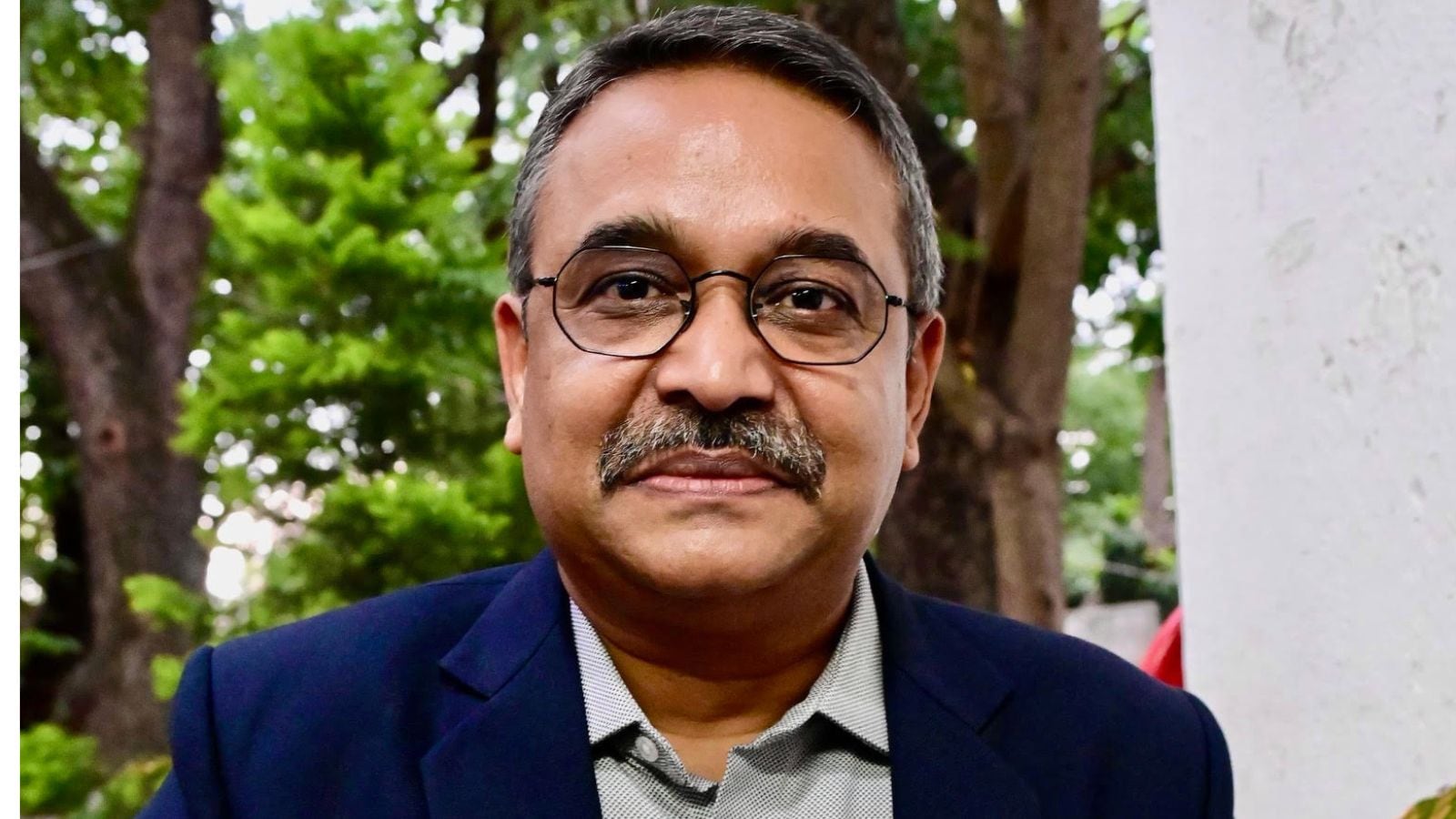
Sugata Srinivasaraju has long been a fixture in Karnataka journalism, but for those less familiar with his reportage, they are more likely to know him from his three most recent books – Furrows in a Field: The Unexplored Life of H D Deve Gowda; Strange Burdens: The Politics and Predicaments of Rahul Gandhi; and his most recent work touching on the Emergency, The Conscience Network: A Chronicle of Resistance to a Dictatorship.
All of these reflect a striking insight into different aspects of India’s recent political history, but these are not his only works. Both Pickles from Home and Keeping Faith with the Mother Tongue afford unique perspectives from Srinavasaraju’s point of view – that of a Kannada speaker in a city that has evolved rapidly in terms of its linguistic landscape.
On how the city of Bengaluru interacts with his work in that sense, Srinivasaraju says, “It is there in every inch, because I am a bilingual writer. If you are a functional bilingual, and not just in a pedestrian way – to be able to write and read and have a scholarly pursuit – it doesn’t easily allow you to settle with one thing. Bangalore’s whole cosmopolitan nature, where you have different languages, cuisines, new people coming in…amidst all of that, Kannada’s linguistic culture trying to keep its influence is very fascinating.”
How his latest book came to be
Srinivasaraju’s most recent work, the Conscience Network, has its roots in research for a column that he was working on in 2020… He recalls, “I was reading the New York Times archives… I stumbled upon a page from March 1976, which had a full-page coverage of a few people in America resisting Indira Gandhi’s emergency… I started looking up archives in India, but that did not help regarding what was happening in the diaspora in Europe and India. My gut feeling as a journalist and writer told me there should be something more.”
While he interviewed some of the people involved in the movement early on, archival material was also of importance. He said, “I started in San Jose, Chicago… Then I realised that this was not just a resistance against Indira Gandhi but a Gandhian resistance. It had resisted left-wing and right-wing takeovers… It had allied with civil rights activists, Quakers, western Gandhian scholars, Nobel laureates, etc. I decided to tell the story through certain protagonists using the thousands of pages of archive material I had gathered across America.”
He went on to look up the papers of J J Singh, who had lobbied the Truman administration to ensure that Indians could obtain naturalised citizenship decades earlier. Another goldmine was the documents in the Nehru Memorial Library belonging to T N Kaul, Indira Gandhi’s ambassador to the USA during the Emergency. “Every speech that he had made was there in transcript form… He was the biggest propagandist of the Emergency and a defender of Indira Gandhi.” Another major character and source of archival material in the narrative was US citizen Paula Braunstein, whose husband Anadi Nayak was arrested during the Emergency, leading her to campaign for his release.
How journalism and writing go hand in hand
On the process of writing itself, Srinivasaraju says, “As a journalist and a writer, you can’t draw a line between the two and create silos. Certainly, the book-writing process requires a certain energy and perspective. Gabriel Garcia Marquez was a journalist and also wrote novels. He spoke about journalistic training, his process of writing a novel or looking at the world. It is similar for a lot of us. We are not as big as a Marquez or a Hemingway, but the way you get trained…” He added that the three decades he spent in journalism helped in terms of the discipline of adhering to a deadline and not giving up on an idea, as well as maintaining a perspective on events that were only a few decades in the past.
Story continues below this ad
As might be expected from a writer with the pace and consistency that Srinivasaraju has displayed with his recent books, he already has the next idea taking shape – dealing with the contemporary history of the early phase of Indian democracy. Tipu Sultan is another topic that he is looking into. As he puts it, “History has already been written about Tipu Sultan. Of course, I will be looking at the French and English papers, etc, but the perspective that I might finally offer could be very different.”