
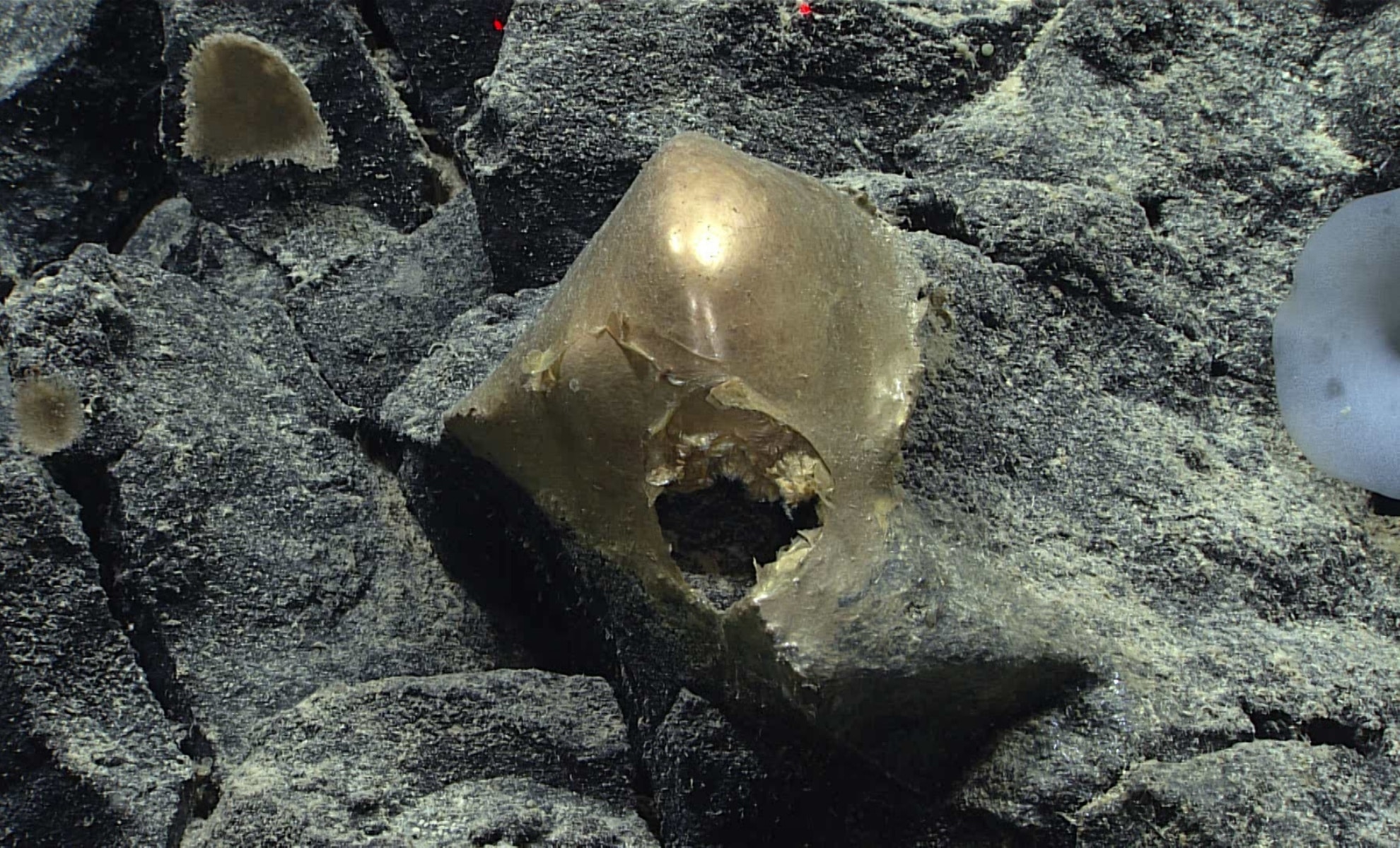
This strange find was made by a remotely operated underwater vehicle deployed by NOAA Ocean Exploration. At this depth, where sunlight never penetrates and conditions are harsh, such discoveries are rare.
The orb, measuring about 10 centimeters across, was found attached to a rock covered in white sponges, and it had a hole in one side. Scientists are still uncertain about what it is, but theories include it being an egg casing, a dead sponge, or a coral. The expedition has since captured widespread attention, given how little we know about the creatures that thrive in the deep ocean.
A Perplexing Golden Mystery
The discovery of the golden orb was part of a 23-day expedition in 2023, aimed at exploring the depths off the coast of Alaska. As the remotely operated vehicle (ROV) hovered above the ocean floor, researchers noticed the orb tightly adhered to a rock, surrounded by sponges. The object’s shiny, golden appearance and peculiar hole sparked immediate curiosity, reports ScienceAlert.
According to NOAA, the orb was soft to the touch, suggesting it could be some form of biological material. While no definitive explanation has been offered, the shape and texture have led to the speculation that it could be an egg casing of an unknown species. However, it remains an enigma.
The object’s unusual characteristics were evident. The hole in the orb’s side raised intriguing possibilities. “It’s definitely got a big old hole in it, so something either tried to get in or tried to get out,” said one of the researchers during a live-streamed dive. This prompted some to wonder if the orb had once held a developing organism, possibly a creature that had now hatched or left the casing behind.
Researchers even joked that they hoped nothing would “decide to come out” as they carefully approached the object. While this remark was in good humor, it highlighted the mysterious and sometimes unsettling nature of deep-sea discoveries.

An ‘Egg’ Unlike Any Other?
The orb’s most intriguing theory is that it could be the egg of a large sea creature, although this hypothesis is far from conclusive. “If it is an egg, the really interesting question is whose egg is it,” said Kerry Howell, a deep-sea ecologist at the University of Plymouth. This is a critical point—egg cases are typically laid in groups, not singularly.
The orb’s solitary nature makes it an outlier compared to the reproductive habits of many ocean species. Researchers have compared the orb to the size of fish eggs, but this one was significantly larger and unlike anything they’ve seen before in their research.
For Howell, the texture of the orb made the egg theory more plausible, but he stressed that it didn’t resemble any egg casing he had ever encountered. This uncertainty reflects the challenges of studying life at such depths.
Even with the orb carefully collected and brought aboard the research vessel, the biological mystery remains unsolved. The orb’s size and texture could indicate it is part of a reproductive process that we have yet to fully understand.

A Window Into the Unknown Deep
The discovery of the golden orb underscores the vast unknowns of the deep ocean. According to NOAA, humans have visually explored only a fraction of the ocean floor, a fact that continues to limit our understanding of deep-sea ecosystems.
The deep ocean, with its crushing pressures and freezing temperatures, is one of the least explored and least understood parts of our planet. As researchers continue to use remotely operated vehicles to explore these depths, new surprises are uncovered. The orb is just one example of the many mysteries that await further investigation.
This golden orb, whatever its true nature may be, exemplifies the ongoing challenges of ocean exploration. As Sam Candio, an exploration coordinator with NOAA, remarked, “Isn’t the deep sea so delightfully strange?”.