
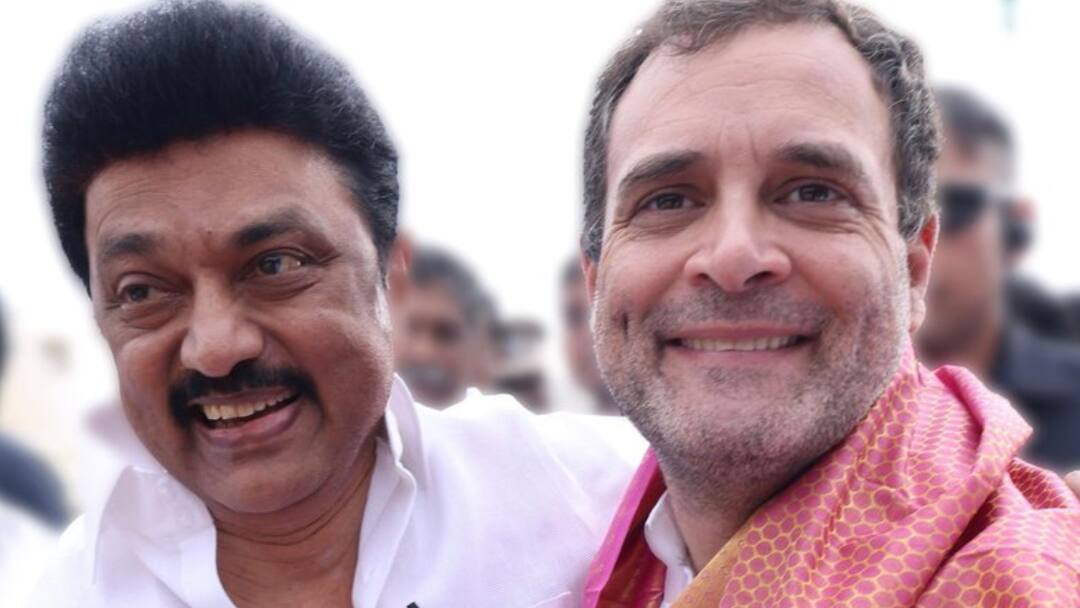
Seeking to draw a line under weeks of political speculation in Tamil Nadu, the Congress has constituted a five-member committee tasked with engaging the Dravida Munnetra Kazhagam (DMK) on finalising alliance terms for the 2026 assembly elections. The decision is viewed as the party’s clearest signal yet that it intends to stay within the ruling coalition and avoid any ambiguity in the run-up to the polls.
The committee will be led by Girish Raya Chodankar, the AICC in-charge for Tamil Nadu and Puducherry, and will feature state unit president K. Selvaperunthagai, Assembly floor leader Rajesh Kumar, and Karnataka leaders Nivedith Alva and Suraj Hegde, as per Deccan Herald. The panel’s formal announcement is expected imminently.
DMK Sought Clarity Amid Political Buzz
According to party insiders, the DMK had reached out to the Congress High Command to address confusion generated by internal chatter within the state Congress about exploring an understanding with actor Vijay’s Tamilaga Vetri Kazhagam (TVK), as per reports. A senior functionary said the noise had become politically disruptive.
It was revealed that a member of the DMK’s first family met AICC president Mallikarjun Kharge and Leader of Opposition Rahul Gandhi earlier in the week, carrying a message from Chief Minister M.K. Stalin urging swift clarity. Congress leaders indicated that a formal communication reaffirming alliance commitment will soon be dispatched to Stalin.
Talks To Cover Seat-Sharing, Coalition Role
Discussions between the two parties will include seat-sharing formulas as well as the Congress’s participation in a future coalition government, TNCC said. Both sides are reportedly optimistic that negotiations will proceed smoothly and conclude without friction.
Longstanding Partnership with Shifting Equations
The Congress-DMK partnership has largely endured since 2004, barring the 2014 Lok Sabha elections. However, the Congress’s bargaining power has diminished over successive assembly elections. The party was allotted 48 seats in 2006, saw a spike to 63 in 2011, but subsequently faced reductions to 41 in 2016 and 25 in 2021 — the lowest allocation to date.
As both parties embark on the next phase of negotiations, the formation of the panel signals the Congress’s intent to stabilise the alliance and present a united front ahead of a crucial electoral year.