
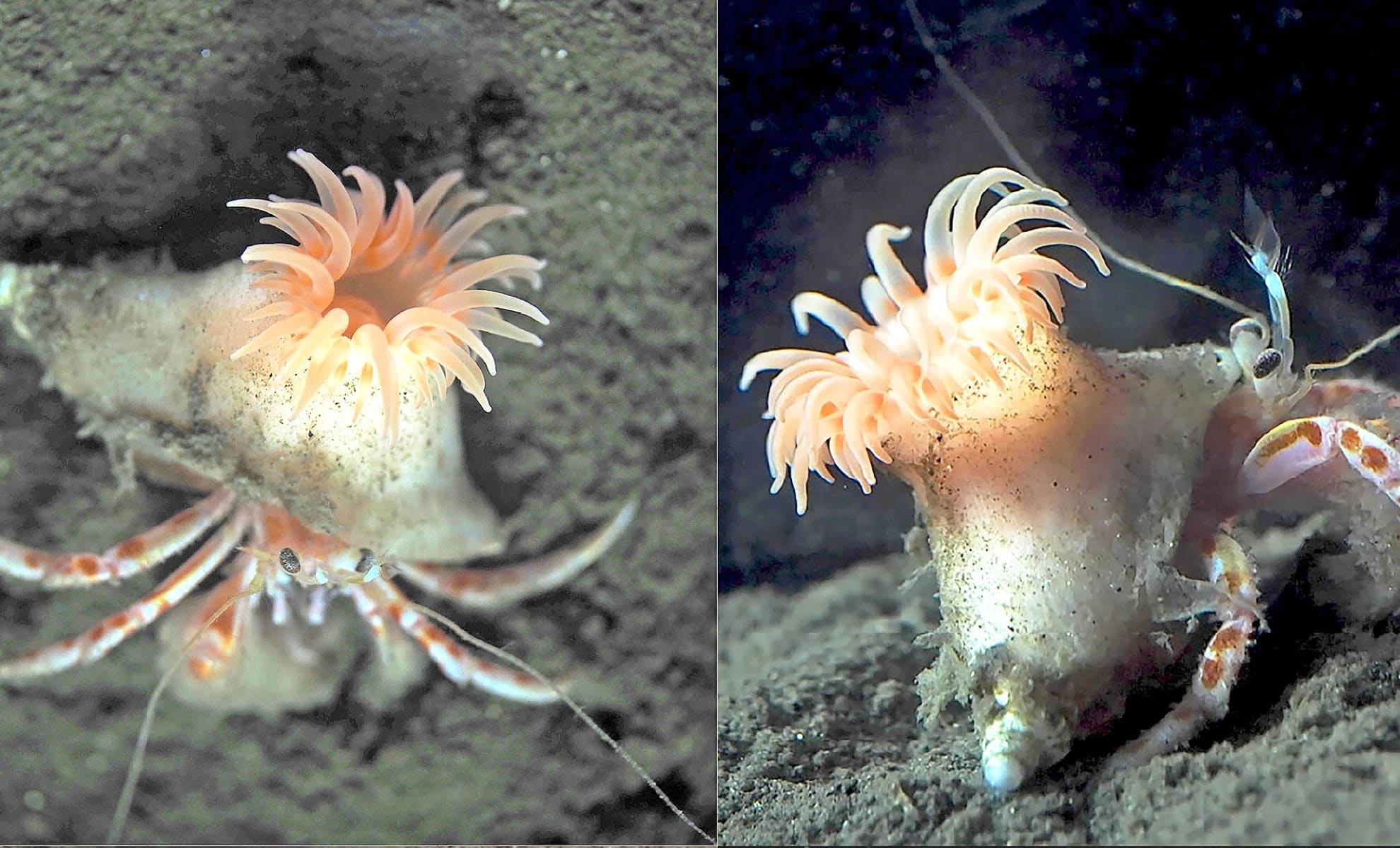
Paracalliactis tsukisome, pale pink and soft-bodied, builds rigid, shell-like structures that hermit crabs use for protection—turning a passive invertebrate into an underwater architect. Uncovered between 190 and 500 meters below the surface, this sea-floor species doesn’t just attach to a crab’s shell; it helps form it. In an environment where light and food are scarce, this arrangement benefits both animals, offering safety, stability, and a rare example of mutual cooperation in the deep sea.
The discovery comes from a research team led by Akihiro Yoshikawa at the Aitsu Marine Station of Kumamoto University. Their work focuses on deep-sea animal relationships, and this finding sheds light on how survival strategies can emerge in places long considered biologically simple. The behavior of P. tsukisome rewrites expectations of what sea anemones are capable of—and how they interact with mobile crustaceans like hermit crabs.

One-Way Growth for Two-Way Protection
Unlike typical sea anemones, which rely on existing surfaces for support, Paracalliactis tsukisome actively secretes a material called a carcinoecium that strengthens and extends the crab’s borrowed shell. This reinforcement grows in a single, forward-facing direction—anchored close to the shell’s entrance, allowing food particles to pass through while offering a snug fit for the crab’s body.
Using micro-CT scanning to image the internal structure of the shell-like layer, the researchers observed a consistent growth pattern across multiple specimens. That directional shell formation—rare in soft-bodied organisms—mirrors the spiral growth of real mollusk shells. It enables the crab to grow larger without constantly seeking new shells, which can be both dangerous and energetically costly on the ocean floor.
According to Earth.com, this design isn’t accidental. The smooth interior, free of sediment or loose particles, suggests the anemone carefully manages how and where material is laid down—an ability not previously documented in species from this group.

Mutualism Built on Food, Structure, and Growth
To better understand whether this partnership was balanced or exploitative, the team conducted stable isotope analysis—tracking nitrogen and carbon levels in both the crab and the anemone. The results pointed to shared resources, not one-sided benefit. The anemone appeared to consume a mix of drifting particles and crab-produced waste, while the crab gained structural support and greater mobility security.
The isotope data matched another surprising observation: crabs paired with P. tsukisome were consistently larger than related species without anemone partners. This size difference likely results from the more durable housing reducing the need for frequent shell changes. Crabs that don’t have to abandon their shells are less exposed to predators and spend less energy hunting for new ones—giving them an edge in growth and survival.
This kind of relationship is rare in deep-sea environments, where most species compete for limited resources. That makes P. tsukisome and its crab partner a valuable model for studying how cooperation can evolve even in high-stress ecosystems.

A Separate Species With a Poetic Name
To confirm that this sea anemone was not a variation of an existing species, the team performed detailed anatomical comparisons and genetic sequencing. They analyzed five gene markers—both mitochondrial and nuclear—and found that Paracalliactis tsukisome formed a clearly distinct group from its nearest relatives.
The name tsukisome comes from the Man’yōshū, Japan’s oldest anthology of poetry. It refers to a pale pink dye, evoking the anemone’s color and the delicacy of its enduring relationship with the crab. This poetic reference also reflects the researchers’ intent to capture the quiet intimacy of this cross-species cooperation.
Only a handful of sea anemone lineages are known to build shell-like structures for hermit crabs, making this a rare find even in the context of deep-sea research. Specimens and data have been placed in public collections to allow future comparisons, helping other scientists verify and build on the work.