
“Star Trek” has produced more television episodes and movies than most franchises you could name. Across nearly 60 years, it’s seen multiple high-profile revivals with several distinct eras of stories, and each generation of “Star Trek” stories has become beloved and iconic in its own way. More than many other franchises, “Star Trek” has also been retrospective, with a fondness for its own past and a deep appreciation for everything that has come before. Thanks to its embrace of sci-fi tropes, too — including some of the best time travel stories in the franchise — this has often led to episodes that directly revisit classic installments from that past.
Over the years, “Star Trek” has gone back in time, sometimes literally, and revisited, retold, or otherwise reconceived old episodes, and one might be surprised at just how often they’ve done it. In fact, some of these revisitations have become iconic and beloved in their own right, a testament to the quality of writing and cleverness of scripts that rewove old tales into new ones. So focus the deflector dish and emit an inverse tachyon pulse, because we’re opening a spatial fissure and setting a course for a look back at 10 times “Star Trek” revisited older episodes, from the original “Star Trek” series to today.
All Good Things…
In May of 1994, “Star Trek: The Next Generation” closed its doors in grand fashion with the finale that blew everyone away, “All Good Things…” But the episode did more than say goodbye; it also served as a perfect bookend to the series, connecting back to the very first episode of the show, “Encounter at Farpoint.” It’s not just a mere flashback, though. The episode sees Captain Picard (Patrick Stewart) quite literally reliving the events of that story — with a strange twist.
“All Good Things…” begins with Picard inexplicably moving back and forth through time: Alternating between the past, present, and future, Picard faces the same problem across three very different periods of time. In the present, a spatial anomaly has appeared in the Neutral Zone, which sends him on a precarious mission to the same region in a future where Klingons and the Federation are no longer allies. But in the past, we revisit the very first mission of the Enterprise-D, seen in “Encounter at Farpoint.”
There, commanding a group of officers who don’t know him, Picard must convince his stalwart crew to go on a daring mission to the Neutral Zone to find out what’s really going on. In addition to revisiting that first episode, “All Good Things…” brought back the cosmic trickster Q (John de Lancie), who once again puts Picard and humanity on trial, with the fate of all mankind hanging in the balance.
Shattered
Unlike “Star Trek: The Next Generation,” the series finale to “Star Trek: Voyager” didn’t revisit its premiere, nor serve as a look back at its impressive run. Instead, it focused on the crew’s final journey back to Earth. But elsewhere in the show’s final season, the episode “Shattered” did take a stroll down memory lane, revisiting not just one, but several episodes from the previous six seasons, beginning with scenes from the pilot episode, “The Caretaker.”
The episode kicks off when a temporal event causes Voyager to become unstuck in time, with different parts of the ship experiencing different moments in time. Thanks to the Doctor (Robert Picardo), Chakotay (Robert Beltran) is given a special serum that will allow him to pass through the different time periods on a mission to correct the fractures in time. Suddenly, he finds himself back in the middle of several old episodes, including the Season 2 cliffhanger “Basics,” which saw the Kazon taking over the ship with the help of Seksa (Martha Hackett). We also get to see Chakotay re-experiencing the events of “Macrocasm,” where a macro-sized alien virus was attacking the crew, and the two-parter “Scorpion” that introduced the Borg drone Seven of Nine (Jeri Ryan).
Amusingly, “Shattered” even pokes fun at the fact that so many “Voyager” episodes follow a similar pattern. In one moment, Chakotay isn’t sure “when” he is, suggesting it’s either the time they were attacked by an alien pitcher plant (“Bliss”) or the time aliens invaded their dreams (“Waking Moments”).
A Quality of Mercy
Revisiting an all-time, beloved classic episode is a risky proposition, but “Star Trek” has done it at least a few times with great success. And in the case of “Star Trek: Strange New Worlds,” the show went the even more dangerous route of essentially remaking the story entirely, which could have ended disastrously. But the episode, which serves as the series’s Season 1 finale, effectively remade the iconic 1966 episode “Balance of Terror,” which introduced the Romulans, and managed to both retell the events of the episode while telling a very different story.
In “A Quality of Mercy,” Captain Pike (Anson Mount) is finally forced to face the dark future he’s been trying to avoid. But when he successfully alters a series of events that would change the course of his life, he’s visited by a future version of himself who says it was a mistake. And to prove it, future Pike sends his past self into the near-future, into the events of “Balance of Terror.” But this time, Pike is captain of the Enterprise instead of Kirk (here played by Paul Wesley). As it turns out, Pike’s decisions in the command chair are very different, and it ultimately sends the Federation into war with the Romulans.
With plenty of sequences that mirror the original episode, “A Quality of Mercy” altered the story significantly, as well as much of the tone. It’s also, of course, filled with modern-day VFX that amp up the excitement. But at its core, it’s a story of one man who must face his fate.
Flashback
In 1996, “Star Trek” was celebrating its 30th anniversary, and with two shows on the air — “Deep Space Nine” and “Voyager” — there needed to be something special to mark the occasion. The result on “Voyager” was the episode “Flashback,” which took the story back in time to the events of “Star Trek VI: The Undiscovered Country.” At the time, the film was just five years old, but it was nonetheless thrilling to revisit because it meant the return of original “Trek” star and pop culture icon George Takei as Captain Sulu — the last time he played the role in live-action.
Eschewing time travel, the story centers on Lieutenant Tuvok (Tim Russ), the long-lived Vulcan, who it’s revealed once served under Captain Sulu aboard the USS Excelsior. A mysterious repressed memory is making Tuvok ill, and the only way to find out more is through a mind-meld with Captain Janeway (Kate Mulgrew). But the mind-meld sends Janeway and Tuvok back into the Vulcan’s memories of his time aboard the Excelsior, when Sulu came to the rescue of Captain Kirk, Leonard McCoy, and Spock at the Khitomer Conference in “Undiscovered Country.”
Remarkably, the episode brought back more than just Takei, with Grace Lee Whitney reprising her role as Janice Rand, and Jeremy Roberts and Boris Krutonog back as Excelsior bridge officers Valtane and Lojur. But the biggest surprise was an appearance by Michael Ansara, who returned as the Klingon captain Kang. He gets to spar with Sulu over the viewscreen in a moment we didn’t get to see in “Star Trek VI.”
Trials and Tribble-ations
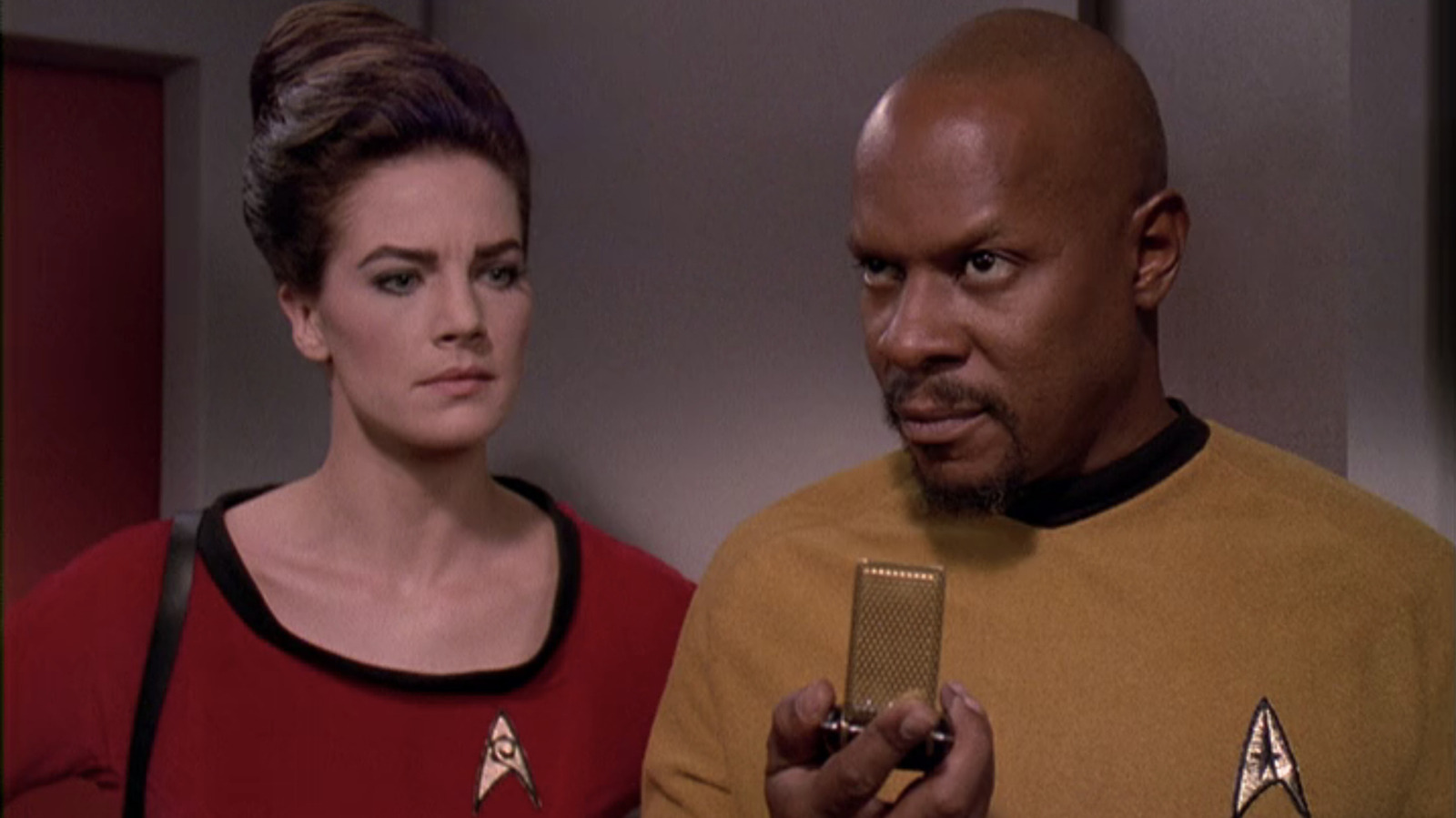
While “Voyager” was celebrating the franchise’s 30th birthday with “Flashback,” “Star Trek: Deep Space Nine” wasn’t to be outdone. Over on that series, writers came up with a story that was an even bigger swing, choosing to revisit the events of one of the most iconic episodes in the history of “Star Trek.” To do it, they utilized cutting-edge visual effects, including some that had recently been used to critical acclaim on a smaller scale in the film “Forrest Gump.” This technology digitally inserted the crew of “Deep Space Nine” into the classic 1967 episode “The Trouble with Tribbles.”
Far from a jaunt just for fun, Captain Sisko (Avery Brooks) is forced to take the USS Defiant back into the past when he discovers a Klingon spy (Charlie Brill) has gone back in time in an attempt to kill Captain Kirk. Back then, that same spy was going by the name Arne Darvin, masquerading as a human merchant aboard station K-7. His older self revisits K-7 and plants an explosive device in the form of a Tribble aboard the station, intent on blowing Kirk out of the stars.
Though it could have been a mere gimmick that showcased some pretty cool digital compositing, the episode is much more than that. “Trials and Tribble-ations” is genuinely one of the best episodes of “Deep Space Nine,” a series full of standout classics.
Projections
While “Star Trek: Voyager” has received plenty of love, there aren’t many episodes in its seven seasons that would be considered all-time classics in the franchise. Despite this, the series has more stories that revisit its own past than you’d expect. This includes the Season 2 mind-bender, “Projections,” which revisited the series premiere, “Caretaker.” It did so without the use of any time travel hijinks.
The story begins with the ship’s holographic Doctor (Robert Picardo) somehow reliving his first mission from the pilot episode. Once again, he finds himself in sickbay amid a disaster, and he’s the only doctor available to treat an incoming stream of wounded patients as the ship is under attack. Certain that something is wrong with his program, the Doctor is confronted by Lieutenant Reginald Barclay (Dwight Schultz), who tells him that he’s not the Doctor at all — he’s Lewis Zimmerman, the engineer who created the Emergency Medical Hologram (EMH), and he’s trapped inside a holodeck simulation of a mission designed to test the EMH. Barclay claims that Zimmerman is suffering from memory loss and psychosis and now believes he’s the holographic doctor. And the only way to end the holodeck program, Barclay says, is to destroy the ship. The first of several appearances from Lieutenant Barclay, “Projections” is a whodunit of sorts, as viewers must untangle what’s really going on.
These are the Voyages…
“Star Trek: The Next Generation” wasn’t the only series finale to revisit its own past, as the 2001 prequel series, “Star Trek: Enterprise,” did the same. This time, the series finale, “These Are the Voyages…,” didn’t go back to an earlier episode, but rather revisited an episode of “Star Trek: The Next Generation”: Season 7’s “The Pegasus,” which was an odd choice of an episode.
It begins aboard the USS Enterprise-D in the 24th century, where amid the events of “The Pegasus,” Commander Riker (Jonathan Frakes) is facing a dilemma: His old captain, Eric Pressman (played in “The Pegasus” by Terry O’Quinn), is demanding Riker hide the nature of a deadly mission, but he’s torn between his loyalty to now-Admiral Pressman and his current Commanding Officer, Captain Picard. To help work through the quandary, Riker and Deanna Troi (Marina Sirtis) use the holodeck to relive the last mission of the NX-01 Enterprise, where Captain Archer (Scott Bakula) is forced to make a similar choice.
With the “Enterprise” ending “Star Trek” on television for the first time in nearly 20 years, “These Are the Voyages…” is a bookend to this era of the franchise, so going back to a “TNG” episode makes some sense. Still, Frakes’ true feelings about it aren’t all positive. However you feel about it, though, it was a delight to see Jonathan Frakes and Marina Sirtis back as Riker and Troi — and to see the Enterprise-D one more time.
Worst Case Scenario
A Season 3 episode of “Star Trek: Voyager,” titled “Worst Case Scenario,” took audiences on a journey back to the show’s beginnings, when the crew of the USS Voyager had just been sent hurtling across the galaxy into the distant Delta Quadrant. It happens in perhaps the most unique way possible, via an errant holodeck program originally designed as a training scenario. The program was developed by Lieutenant Tuvok, who, as chief of security, had very real concerns about the Maquis crew, who were forced to join Voyager at the end of the premiere episode “Caretaker.”
It’s Lieutenant Tom Paris (Robert Duncan McNeill) who stumbles across the program, which sees a Starfleet officer approached by a member of the Maquis concerning a planned mutiny of the ship. At first, he thinks it’s a fun little adventure, but Tuvok admits he designed it as a training program to ensure that the Starfleet crew would be ready if the Maquis ever attempted an armed takeover. He abandoned the program after relations between the two crews eased, but when Paris tries to complete the story, he discovers that former Cardassian agent Seska (Martha Hackett) had embedded a mole in the program that traps Paris and Tuvok inside the simulation and forces them into a life-or-death scenario. Another episode of “Voyager” to return to the events of the series premiere (or at least, their immediate aftermath), “Worst Case Scenario” was essentially a new story, set amid the early days of the series.
Star Trek Into Darkness
In 2009, JJ Abrams rebooted the “Star Trek” franchise, with new actors in the roles of Kirk, Spock, and the rest of the Enterprise crew. The film, set in a newly created parallel universe, introduced younger versions of all the characters. It told the story of how they first met, as well as their first mission aboard the USS Enterprise. Some fans didn’t like the quasi-prequel concept, but the sequel, “Star Trek Into Darkness,” doubled down, essentially serving as a loose remake of “Star Trek II: The Wrath of Khan.”
In this timeline, the crew of the Enterprise has never met Khan (Benedict Cumberbatch), the genetically enhanced super soldier who is revived from a centuries-long stay in stasis by Admiral Marcus (Peter Weller). Given his freedom, Khan is forced to use his enhanced intellect to aid Section 31, a clandestine intelligence organization within Starfleet, which is preparing for a war with the Klingons. But Khan escapes their grasp, and he goes on a mission of revenge against Marcus and Starfleet, who have threatened to kill Khan’s fellow super soldiers who are still in stasis.
To be sure, “Star Trek: Into Darkness” is a very different movie from “The Wrath of Khan,” and it could even be seen as a remake of Khan’s first appearance, the 1967 episode “Space Seed.” But the parallels go further than just the plot, as the former movie borrowed from some of the latter’s most iconic scenes. All told, it might have been one of the most successful “Star Trek” movies at the box office, but it wasn’t the most original.
The Menagerie
It might seem hard to imagine, but even when “Star Trek” was less than a season old, way back in 1966, they were already revisiting old episodes. Because that year, the series aired a two-part story titled “The Menagerie,” a courtroom drama story that puts Spock on trial for stealing the Enterprise. While audiences thought it was a fantastic new episode, what they didn’t realize at the time was that much of it was itself a callback to a previous episode. They didn’t know this because that previous episode hadn’t aired, and wouldn’t air on television for another 20 years.
The episode in question, titled “The Cage,” was Star Trek’s original pilot, which starred Jeffrey Hunter playing Captain Pike instead of William Shatner as Captain Kirk. “The Menagerie” was designed to save some budget by using the unaired episode to fill out an extra-long two-part story. But in doing so, it established that Pike was the captain before Kirk, and there were years of stories before the events of the show’s first season. “The Cage” had long been thought lost to time by the 1980s, but when a print resurfaced, it finally aired on TV and is now part of Paramount’s “Star Trek” streaming library.
The episode was later the inspiration behind the 2022 streaming spin-off, “Star Trek: Strange New Worlds.” There, Anson Mount and Ethan Peck star as Captain Pike and a younger Mr. Spock, on missions set about a decade before Kirk took command.