There’s no one quite like Stephen King. The man is responsible for some of the most iconic horror novels of all time, from “The Shining” and “Carrie” to “Pet Sematary” and “It.” Those four have all been made into excellent films, ones that come up just about any time King’s name does. His Constant Readers are well aware that there are plenty of other adaptations, too, both good and bad. He’s a famously prolific writer, releasing at least one novel a year for most of his career, which means there’s a wealth of material for people to adapt … and boy, have they. For every critically-acclaimed standout like “The Mist,” there’s a deservedly-mocked misfire like “Maximum Overdrive,” which some call King’s worst film ever.
Most King films land somewhere in the middle. Some seem like lesser works only compared to more immediately-famous, similar adaptations. Others flew entirely under the radar when they were released, but deserve wider audiences. Some on this list, you’ve probably (incorrectly!) heard were bad; others, you’ve probably never even heard of.
Still, they’re all worthwhile. After all, again, there’s no one quite like Stephen King. He has a unique ability to entertain even as he makes you think. His stories alternate between horrifying and heartfelt, scary and sweet, frightening and funny. Some of the most underrated King adaptations blend all of the above; even if they’re not “good” by most metrics, they’re singular experiences you wouldn’t get from any other writer.
The Running Man (2025)
2025 brought us a number of well-received Stephen King adaptations, including Osgood Perkins’s deviously-funny mounting of “The Monkey,” Mike Flanagan’s stirring film “The Life of Chuck,” and Francis Lawrence’s brutal “The Long Walk.” The same year brought us Edgar Wright’s new version of “The Running Man,” which was first adapted in 1987. This isn’t a remake of the Arnold Schwarzenegger-starring actioner, though; this is a brand-new telling of King’s story.
“The Running Man” envisions a future shattered by rampant class disparity, where people who live “slum-side” have no choice but to compete on violent, deadly reality television competitions if they hope to escape their circumstances. Enter Ben Richards (Glen Powell), whose daughter is ill. Ben’s angry … very angry. When he’s cast against his will on “The Running Man” – a show where contestants must survive for 30 days, despite being hunted by assassins and the viewing public — he becomes determined to survive out of spite.
Unfortunately, “The Running Man” was a failure at the box office, which is a shame. It’s great! King’s original novel was ahead of its time, cannily predicting the way humanity has turned suffering into entertainment. While it’s blackly funny, this is an angry movie, one that feels unflinching in how it responds to our current political moment. “Stop f***ing filming me!” Richards growls, and by the time the credits roll, “Richards Lives!” feels like a rallying cry for a people waking up to our modern surveillance state.
The Boogeyman (2023)
“Yellowjackets” star Sophie Thatcher wants to be known for more than just her mullet, and if she continues her streak of starring in fun horror films, she’s likely to get her wish. In 2023 — the year before “Heretic” and two years before “Companion” – Thatcher led “The Boogeyman,” a Rob Savage film adapted from the 1973 short story by Stephen King. The story was later included in “Night Shift,” but it’s short, one of those punchy ones that gets in, makes its point, and gets out. In other words, it’s an underrated entry in the King canon.
The short story takes the format of a conversation between a therapist and his client, a man who is convinced that his family was murdered by “the boogeyman.” In the film, that therapist is Will Harper (Chris Messina), and the film centers on his two daughters. Sadie (Thatcher) is the older sister, and she’s afraid for her younger sister Sawyer (Vivien Lyra Blair), who seems to be losing her grip on reality after the death of their mother. Sawyer is convinced that there’s something living in her closet, or under her bed, or lurking in the corner of the room …
Without spoiling anything, “The Boogeyman” takes a wild turn in its third act that should someday cement it as a cult classic. This is a go-for-broke creature feature that mixes suspense with scares, a great example of taking scant source material and honoring it while also deepening it.
In The Tall Grass (2019)
I’m a big Stephen King fan, but I didn’t much enjoy “In The Tall Grass,” a novella he wrote alongside his son Joe Hill. A lot of the book felt like a retread of ideas he’s explored better elsewhere. After all, it’s about people who find themselves lost in a vast field of tall grass, mixing creepy children, rural religiosity, and strange cosmic-horror implications. In other words, it felt like “Children of the Corn” 2.0, only not as interesting.
Enter: Vincenzo Natali, the filmmaker behind weirdo cult hits like “Cube” and “Splice.” He turned out to be the perfect person to adapt the novella for Netflix; after all, most of it takes place in this one location, and “Cube” is perhaps the prime example for how to keep a single set interesting and scary. His “In The Tall Grass” is a strange, ever-shifting film, one that basically covers the entire novella in its first act and then deepens into something far weirder and more interesting.
Thanks in part to some wonderfully-weird shots from concept art designed by manga artist Shintaro Kago, “In The Tall Grass” is a visual treat. Mainly, though, the whole thing is anchored by a bravura performance from Patrick Wilson, whose work here is, for my money, one of the most underrated King villains ever. The star of “The Conjuring” and “Insidious” does supernaturally-infected religious fervor extremely well, and as the film morphs into something grotesque and inexplicable, Wilson becomes genuinely terrifying.
1922 (2017)
“In The Tall Grass” was actually the second farm-based King adaptation to hit Netflix in short order. Back in 2017, the streamer tapped writer/director Zak Hilditch to adapt “1922,” a novella from “Full Dark, No Stars.” While we mostly think of King as a horror writer who conjures up nightmarish dreamscapes to terrify adults, King is also an astute observer of childhood emotion, and “1922” stands alongside films like “Stand By Me” as brilliant depictions of children coming to terms with death.
The film takes place in the titular year. Wilfred (Thomas Jane) is going quickly mad, driven psychotic by the summer heat and the pressures of leading his family in a time of economic uncertainty. His son Henry (Dylan Schmid) looks up to him even as he fears him, so Wilfred is able to rope the boy into an insurance scheme. Namely: if they murder Henry’s mother Arlette (Molly Parker), they can survive on her life insurance money.
Of course, after doing the terrible deed, Henry and Wilfred slip sideways into a nightmare. “1922” is a brutal, melancholic film about grief, guilt, and growing up, a film as interested in recreating what it’s like to fear your dad as it is in scaring the audience with gore. Jane is a powerhouse, a vengeful patriarch of the sort that looms large in many King adaptations. “1922” didn’t make much impact when it hit Netflix, but it’s still there available to stream, waiting for the reputation it deserves.
11.22.63 (2016)
Stephen King isn’t just prolific; many of his books are quite long and complex. In 2011, King dropped “11/22/63,” a sprawling book about an attempt to travel back in time to prevent the assassination of President John F. Kennedy on the titular date. The book is one of his best, full of complex characters, long periods of time, and a yawning chasm of soul-shredding horror that awaits the main character in the climax. In trying to adapt it for the screen, Hulu decided it required a significant runtime.
“11.22.63” was born, an eight-part 2016 miniseries that unfortunately doesn’t get talked about much anymore. James Franco plays Jake Epping, a man who discovers a portal to the past in his local diner. Epping realizes that no matter when you enter the portal, you’re always brought back to the same day in 1958. He realizes that, as long as he can hunker down and remain undetected for five years, he has a chance to safe JFK’s life.
James Franco was embroiled in controversy a few years after “11.22.63,” which may explain its muted reputation. Still — without condoning anything he’s alleged to have done — he’s pretty great in this show. Jake ropes a man named Bill Turcotte into his scheme, and he’s played by George MacKay, who would go on to star in excellent projects like “1917” and “The Beast.” MacKay, too, is great, and their rapport makes “11.22.63” infinitely watchable even during the slower bits.
Storm of the Century (1999)
Stephen King’s stories have lent themselves to so many excellent films and shows that it was only natural that King himself would try his hand at screenwriting. Several of his screenplays were disasters; “Maximum Overdrive,” for example, is a bizarre entry in his output. In 1999, King published a screenplay for “Storm of the Century” before it was adapted as a miniseries, which aired later that year on ABC.
Like many of the best works in the King oeuvre, “Storm of the Century” takes place in coastal New England. It’s full of colorful characters, small-town suspicion, and the kind of “stranger blows in from out of town” story that’s worked well for him many times before. In this case, that stranger is Andre Linoge (Colm Feore), a man who seems to know more than he should about the town’s residents. As they face a brutal blizzard unlike any they’ve seen in their lifetimes, Linoge gives the townspeople a demand: willingly turn over one of their children, or else.
Most people don’t first think of “Storm of the Century” when they think of King’s impact on media. They don’t think of it fifth, or probably even fifteenth. King is very proud of the way the show turned out, and he should be; it’s chilly and shocking, ultra-90s and ultra-Kingian. He even told The New York Times that it was the best King-related television work, gushing, “That is my absolute favorite of all of them.”
Dolores Claiborne (1995)
When you hear the names “Kathy Bates” and “Stephen King,” your mind probably goes right to “Misery.” That’s because Bates won an Oscar for it, because her Annie Wilkes is one of the scariest female horror villains of all time. It’s only natural, then, that “Dolores Claiborne” has been somewhat forgotten in the shadow of that other movie. It’s a shame, though, because “Dolores Claiborne” is excellent, and Bates is phenomenal as always.
In this one — from a screenplay adapted by “Andor” and “Michael Clayton” scribe Tony Gilroy — Bates plays Dolores, a woman ostracized by her town because they think she killed her husband. Almost two decades later, Dolores — accused of another murder — tries to reconnect with her daughter Selena (Jennifer Jason Leigh). This is a story told all out of order, finding resonances and frightening juxtapositions in the way memory slips into flashback colored by emotion, all of which affects the characters’ actions in the present.
“Dolores Claiborne” was adapted from a novel that crosses over with “Gerald’s Game” during a pivotal eclipse scene. Years later, Mike Flanagan would honor the eerie color palette of this film when he adapted its companion novel into one of the best King films ever. We wouldn’t have gotten those transcendent sequences without this movie, so it deserves a much larger reputation in the King canon. Forget whether Dolores can forgive herself, or whether she needs to; can “Dolores Claiborne” forgive us, for letting it down?
Sometimes They Come Back (1991)
“Sometimes They Come Back” is easily the worst adaptation on this list. It’s a made-for-CBS movie, and we’re not claiming that this is some undiscovered gem that should’ve been in theaters. What it is, however, is a campy good time, a creepy-crawly chiller about greaser ghosts who haunt a teacher who’s been haunted by his past. When he was younger, he watched a friend die at the hands of some James Dean-wannabe bullies. Now, he’s horrified to find that his students are being replaced by gleefully-grotesque apparitions who look a whole lot like the rebels who terrified him as a kid.
“Sometimes They Come Back” is effective not in spite of its messiness, but because of it; this feels like a half-realized idea, and that’s precisely what gives it its power. It operates on a kind of nightmare logic, scenes bleeding into one another in a way that doesn’t quite make sense. It’s clear that the filmmakers feel they’ve tapped into a truly-frightening well — something primal and unsettling about youth versus adulthood, or maybe the America of the ’50s versus the America of the ’90s. They don’t pull it off, but that helps; it makes it feel all the more urgent, like someone trying and failing to tell you about an off-kilter nightmare knowing they’ll soon fall asleep forever. Plus, it gave us two all-time-great (read: awful) sequel titles: “Sometimes They Come Back … Again!” and “Sometimes They Come Back … For More!”
The Running Man (1987)
The original adaptation of “The Running Man” also deserves a spot on this list. It’s underrated as both a Stephen King movie and an Arnold Schwarzenegger movie, not the first thing anyone would pull for either of those iconic figures in pop culture. Still, it’s worth a watch as a deliciously-batty slice of eighties cheese. It’s trading on Schwarzenegger’s star persona so hard, in fact, that it lifts one of Schwarzenegger’s most famous movie one-liners. Just before being dropped into the reality show that’ll ruin his life, Schwarzenegger’s Ben Richards snarls what else but, “I’ll be back.”
This version of the King novella isn’t nearly as angry as the Edgar Wright adaptation that would follow in 2025. Instead, this one’s just plain fun, playing around with the idea of a reality competition show-centric dystopia rather than taking its implications seriously. In 1987, that was still the stuff of science fiction; as a result, the movie is full of all the practical sets, goofy costumes, and clunky technology you could possibly want.
It’s no surprise that this version of “The Running Man” failed to set audiences on fire. It came out the same year as the superficially-similar (and much better) “RoboCop,” which was also the year Schwarzenegger starred in “Predator.” A goofy movie like this said strange things about what kind of a star Schwarzenegger was trying to be; it’s not so much post-“The Terminator” as it is pre-“Kindergarten Cop.” And that’s exactly why it’s a blast.
Christine (1983)
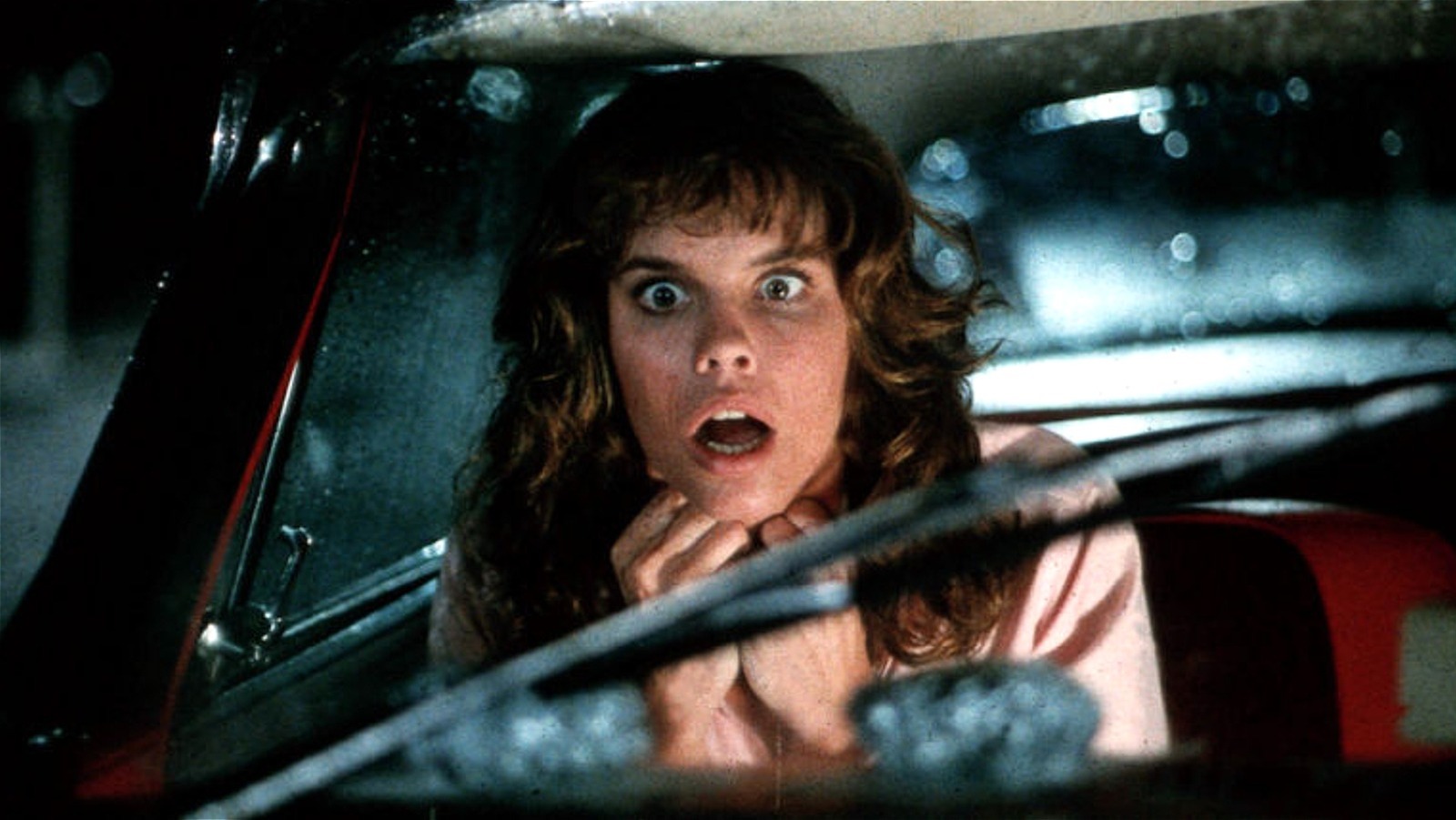
When you’ve made audiences afraid of telekinetic (and pyrokinetic) youth, evil clowns, harrowing hotels, rabid St. Bernards, vampires, and the family cat crawling out of its grave, it’s kind of hard to get people to fear a car. That’s exactly what King did with “Christine,” and when John Carpenter adapted the novel for the big screen in 1983, he successfully made the classic car as creepy as it should’ve been.
This is the story of a boy named Arnie (Keith Gordon). He’s a lonely guy, bullied at school and afraid to talk to girls. Then he acquires a car that makes him feel like a bada**, and everything changes. Suddenly, women throw themselves at him, and he’s got a cool confidence he never would’ve tapped into without his ride, which he names Christine. He’s especially grateful for his car when she begins the gruesome work of tracking down his bullies and making them pay.
No one really thinks of “Christine” as a major work in Carpenter’s filmography — Carpenter made “Halloween” and “They Live” and “Assault on Precinct 13” and more! — but many people who have seen “Christine” agree that “Christine” is very good. There’s no beating the sublime, strange shot of the car on fire, speeding down the highway to one of Carpenter’s trademark electronic scores. Every King adaptation — especially ones that adapt those cocaine-fueled early books — should have a score this good.