If there’s one thing Star Wars fans love, it’s arguing about Star Wars. Most of the time, that comes in the form of movie rankings, who shot first, and whether or not the prequels are any good. But in a franchise so massive and sprawling, why limit yourself? You can find controversy in any corner of the galaxy far, far away, including the very garments the characters wear on screen.
Yes, today we’re talking about Star Wars costumes — specifically the ones that drew ire, split audiences, or, in some cases, were just straight-up bad ideas from the start. While you might not think of costuming first when naming the most memorable things about the franchise, it should be right up there in the discussion alongside lightsaber battles, the Force, and John Williams’ iconic score.
From Darth Vader’s costume to Stormtrooper masks, Jedi robes, Princess Leia’s famous “A New Hope” outfit, the many exceptional outfits of Padmé Amidala in the prequel trilogy and Mon Mothma in “Andor,” and everything in between, this is a series with countless recognizable fits. With that vast number comes the inevitability of polarizing choices. Let’s take a look at 10 Star Wars costumes that divided audiences from day one.
Ahsoka Tano’s teenage tube top
Today, Ahsoka Tano is one of the most popular Star Wars characters not featured in any of the numbered films. But it wasn’t always like that. It took years for many Star Wars fans to warm up to the character. Some protested Anakin Skywalker having a padawan at all, which they saw as a retcon of “Revenge of the Sith” and other previous stories. Others just felt like her teenage snarkiness was annoying — a trait that was intentional in the early seasons of “The Clone Wars,” and which Ahsoka eventually grew out of.
But there was one other early controversy: The short skirt and tube top combo she wore for the first couple of seasons of “The Clone Wars.” We could talk all day about the implications of dressing a fictional teenage girl in what some would consider revealing clothes, and many viewers did. But even absent all that, there’s a simple practicality issue. As Ahsoka’s own voice actor, Ashley Eckstein, said at Fan Expo Philadelphia 2024, “Who fights a war in a tank top?”
As with many of the most curious Star Wars decisions, this one apparently came from Lucas himself, according to a 2018 StarWars.com article about the origins of the character. In more recent years, though, Lucasfilm has shied away from the look, even going so far as to softly retcon it in the live-action “Ahsoka” series, where a flashback sequence set in “The Clone Wars” Season 1 shows a young Ahsoka wearing a much more practical outfit.
The First Order’s Stormtrooper armor
Most fans agree that Stormtroopers look cool. It’s the reason so many build their own helmets and armor, showing out en masse to conventions and other events like a platoon of the Empire’s own aim-challenged soldiers. At least, you’d hope it’s the aesthetics and not the historical inspirations behind the design.
The armor is iconic, and while the sequel trilogy brought back the core design for its First Order stormtroopers, there are also a lot of differences. The helmets are sleeker and less bulbous. The blasters are smaller — more silver-age sci-fi than modified ’70s Hollywood gun props — and there’s a sort of polished action figure sheen to the First Order. While many fans liked the design just fine, others were critical from the moment “The Force Awakens” came out, decrying it as far inferior to both the original Stormtrooper look and the various phases of Clone trooper armor from the prequels.
The polarizing nature of the First Order Stormtroopers is emblematic of the sequel trilogy writ large. Yes, fans loved the nostalgia and the return to the old designs, but was that emphasis on similarity a good thing in the end? Or a trap that stopped the films from growing beyond their predecessors? To this day, it’s an active debate.
Kit Fisto’s altered anatomy
This is less of a costuming controversy and more of a costuming goof, but it’s become such a meme in the Star Wars fan community that it merits mention. Everybody loves Kit Fisto. How could you not? He’s mean, he’s green, he’s doing Force pushes and backflips all around the scene. He’s also extremely shredded and has a pretty dedicated following in that particular department, but that’s not the topic at hand here.
Kit Fisto doesn’t get much material in the prequel trilogy, with most of his actual character development coming in “The Clone Wars” and various books and comics. But he does appear prominently in “Attack of the Clones,” where he carves up droids in the Geonosis arena, and in “Revenge of the Sith,” where he gets quickly overwhelmed by Darth Sidious. The issue that fans noticed, though, is that the Jedi Master looks wildly different in the two films, which take place just three years apart.
In “Episode II,” Kit has a much wider skull, with a broad forehead and smaller, rounder eyes. His Nautolan tendrils look different than in “Revenge of the Sith,” where he also has larger eyes and a smaller head, giving him a bugged-out look that some fans jokingly attributed to the toll of the war. The animated version of Kit is somewhere between the two live-action costumes in look. We’ll leave it up to you to pick which look is better.
Boba Fett’s Mod gang
Ah, the Mods. Of all the controversial things about “The Book of Boba Fett,” few have drawn as much ire as the Tatooine street gang conscripted by Boba to serve as street muscle for his criminal empire. When the show first came out, many fans immediately piled on the delinquent cyborgs of Mos Espa, both because their 60s-inspired cyberpunk aesthetic felt out of place on the desert planet, and because their bright Vespa-esque speeder bikes didn’t exactly ooze cool.
In reality, the Mods were an homage to the mid-20th-century British subculture of the same name, and to the world of hot rods that George Lucas chronicled in “American Graffiti.” Whether or not those references fit well into the post-Imperial world of twin suns and sand in “The Book of Boba Fett” remains up for debate.
In defense of the Mods, they at least brought something new to the motley aesthetics of Star Wars. Tatooine might have been a jarring venue for them, but there’s value in attempting to ground the planet as a place people actually live. Deleted scenes from the original “Star Wars” detailed Luke Skywalker’s own aimless teenage life on the “rock,” as he calls it, and the Mods followed up on that legacy. It’s not their fault that their colorful, cyberpunk costumes just happened to appear in a Disney+ series widely viewed as lackluster.
Ahsoka’s flashback armor
Episode 5 of “Ahsoka” Season 1, “Shadow Warrior,” is one of those moments from the Disney Star Wars era that most fans can actually agree to love. Yes, it’s extremely indulgent on the fan service, to the point that Dave Filoni, who both wrote and directed the episode, may as well have placed a camera inside an old toy box full of LEGO Star Wars playsets from 2010. But they got Hayden Christensen back as Anakin Skywalker. It’s Hayden! How can you not be excited about that?
So where’s the controversy in an episode that people generally enjoyed? Well, there was a lot of discussion about the show’s attempt at translating the animated “Clone Wars” armor to live action, both for the clones themselves and for their Jedi counterparts. See, all of that Clone trooper armor in the prequel trilogy? It’s entirely CGI. Until the Disney+ era, there weren’t practical versions of the costumes seen in the films and “The Clone Wars.”
Inevitably, changes have to be made when you’re building something people have to actually wear, and some Star Wars fans who adore the Clone troopers quickly got into hyper-granular detail exploring all of the differences in the Ahsoka flashbacks, from shoulder pads and viewfinders to the art on Captain Rex’s helmet. Anakin’s “Clone Wars” armor is also a good deal different in live-action, with a leather look that’s more practical for his Jedi robes than the hard metallic look of his animated counterpart.
The Acolyte’s Jedi robes
“Star Wars: The Acolyte” is a show of high highs and low lows. It has arguably the best lightsaber battle since “Revenge of the Sith,” a handful of fantastic characters, interesting themes, expansions of Star Wars lore, and endless shipping potential. Unfortunately, it also suffers from uneven pacing in the front half, some lackluster writing, and, most relevant for our purposes here, some questionable choices in the costuming department.
Specifically, the Jedi robes are a far cry from what we see in the prequels. Part of the difference is intentional, as “The Acolyte” is set in the High Republic era. The various novels and comics set back then had already established a different look for the Jedi, with brighter white and yellow-gold robes instead of the more muted browns and beiges of the prequel trilogy.
Unfortunately, this more saturated look, all sharp contrasts and uniformity, drew some criticism, with some fans arguing the Jedi all looked the same. Others claimed that the robes looked more like cosplay than Hollywood-caliber costumes. This clearly wasn’t a top-down issue from the costume department, as other looks on the show, like the Stranger’s dark side outfit and Osha’s meknek uniform, look great. Instead, this is an example where loyalty to the source material — in this case, the art of the High Republic books — may have held back the overall look.
Deepfake Luke Skywalker’s Return of the Jedi hand-me-downs
Many viewers felt Disney continued to mess up Luke Skywalker with its uncannily digitized “deepfake” version. It was cool the first time, when he showed up like Goku to carve up a platoon of Dark Troopers at the end of “The Mandalorian” Season 2. It was less cool when he took his hood off, but hey, a fair trade, or so many people thought. The nostalgia was strong, the green lightsaber was slicing and dicing, and fans had a good time. But then he came back in “The Book of Boba Fett,” with actual dialogue scenes, and it was… not great.
Half a decade passes between “Return of the Jedi” and “The Mandalorian,” and somehow, Luke never finds time in those years to go shopping for a new spring fit. Yes, there are technically differences between his Disney+ costume and the one Mark Hamill wore in “Jedi,” but you’re not supposed to notice. You’re supposed to point at the screen like the Leonardo DiCaprio meme and say, “Hey! He’s wearing the thing!”
Let’s ignore that this is essentially the Glup Shitto version of shirts. On a narrative level, a lot of fans felt that it just didn’t make sense. Luke’s black robes were intentional in “Return of the Jedi” because they reflected the turmoil inside him, the razor’s edge he was walking between the dark and the light. Five years later, building a Jedi temple in the wilderness, the look didn’t land the same.
Princess Leia’s slave outfit
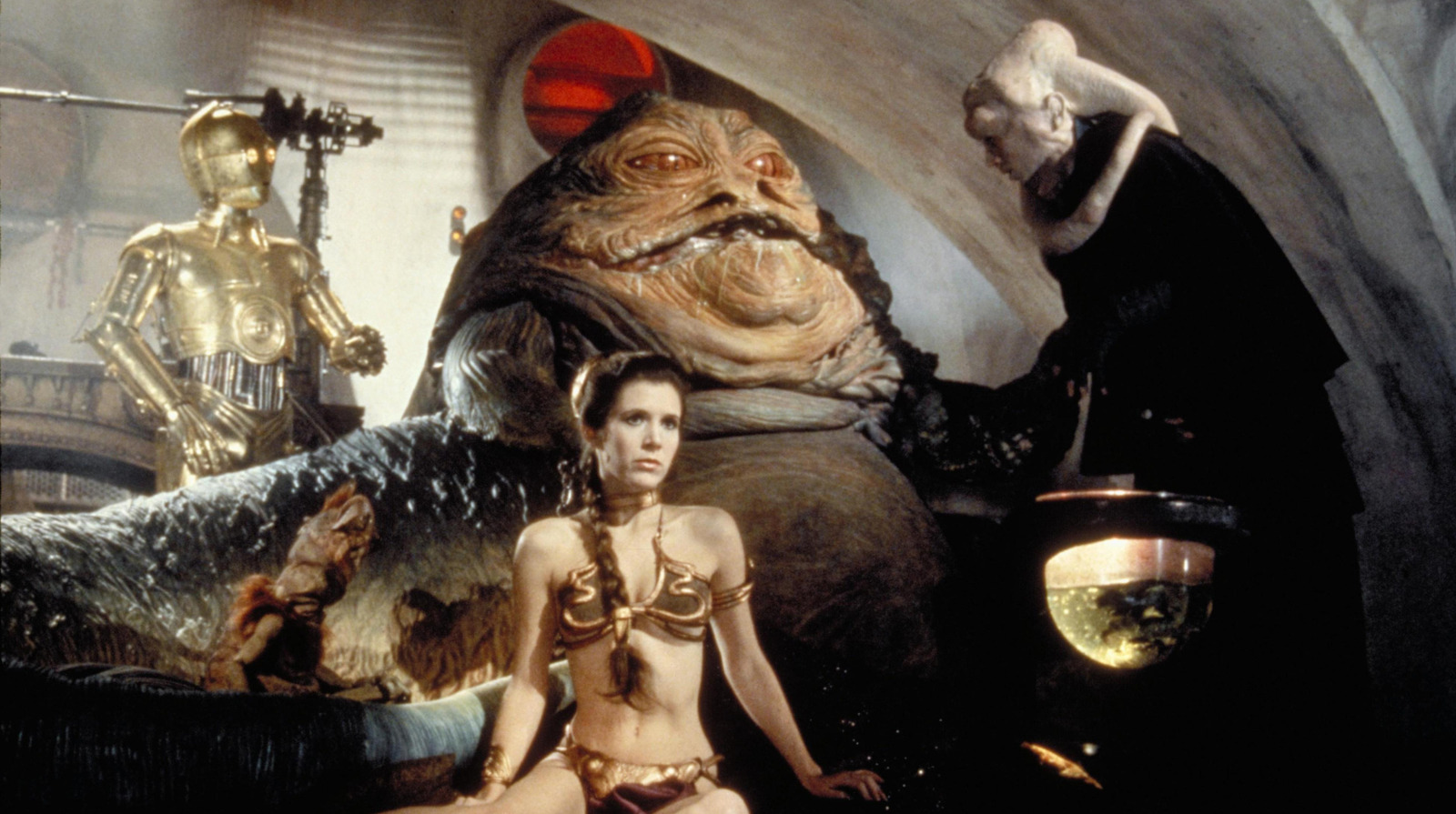
All right, let’s do the big one. Where its two predecessors were universal Hollywood hits, praised by critics and viewers alike, 1983’s “Return of the Jedi” was the first Star Wars movie that divided the fandom. While many loved it at the time, and still do, it received criticism from other segments of the audience for the odd pacing, the prevalence of the seemingly made-to-sell-toys Ewoks, and of course, that metal bikini Carrie Fisher had to wear while chained to a massive slug.
The “Slave Leia” outfit is a cultural institution all its own, the subject of thinkpieces, feminist critiques, unending cosplay, and a downright obsession in certain segments of “nerd culture.” As for Carrie Fisher herself, she shared in interviews that the costume wasn’t her choice and was physically uncomfortable to wear. There is perhaps no single look for a female character of Leia’s magnitude that carries the same currency in our shared cultural consciousness; it is now widely seen as a symbol of powerlessness and objectification.
The criticism is understandable. At the same time, due to the costume’s ubiquity, some have made arguments attempting to defend it, or at the very least, to add a bit of nuance to the discussion. In a 2016 NPR interview, Fisher pointed out the later scene of Leia strangling Jabba the Hutt to death with the very chain that binds her to him, saying: “I really relished that because I hated wearing that outfit and sitting there rigid straight, and I couldn’t wait to kill him.”
Padmé’s battle crop top from Attack of the Clones
Like mother, like daughter. Some Star Wars fans argue that Natalie Portman suffered more sexist material in the prequels than Carrie Fisher did in the original trilogy, even accounting for the slave bikini. At the very least, Leia always gets to be at the front of the action, blaster in hand, telling most of the men in her life to get lost when they’re out of line. Padmé gets a fair amount of active material in her first two films, but the infamous romance arc of “Attack of the Clones” typically overshadows her action scenes, and “Revenge of the Sith” is often criticized for relegating her to the stereotype of a pregnant woman who doesn’t know what to do.
At least Padmé gets a whole slew of fabulous outfits over the course of the trilogy, from her queenly regalia in “The Phantom Menace” to the infamous black fireside corset gown. When she journeys to Geonosis with Anakin in “Attack of the Clones,” she wears a skin-tight, white bodysuit, which is fairly unassuming until a conspicuous slash by the Nexu in the Geonosis arena turns it into a… sexy, bloody crop top? After all, how would audiences have gotten through the end of the movie with her midriff still covered up? While this outfit is less revealing and far less infamous than the Slave Leia costume, it’s still garnered its fair share of critiques.
Obi-Wan Kenobi’s cheap costumes
“Obi-Wan Kenobi” should have been a home run. Instead, it’s often seen as the biggest disappointment of the Disney+ Star Wars era, with uneven pacing, a meandering story, too many narrative conveniences, and an overall bad look.
Literally, the show looks bad, according to many fans. Viewers found it cheap-looking, and that’s likely as much because of the limitations of the Volume soundstage and the erratic camera work as it is any single element of production design. But it’s also true that the costumes in “Obi-Wan Kenobi” look rough across the board. From Ewan McGregor’s many dubious disguises to the space pirates who kidnap young Princess Leia (Vivien Lyra Blair), there’s just a lot of costume-y costumes, and not in the fun way. (Don’t even get started on the Inquisitors, we’d be here all day.)
Of course, with the way the show is lit, you can barely see how rough the costumes look half the time. Perhaps that’s a small intentional mercy, but given how the rest of the show is, it’s more likely just another instance of “Obi-Wan” falling flat.